2018-02-19

Astronomy picture of the day - 2018 February 19 - Galaxy Formation in a Magnetic Universe

Galaxy Formation in a Magnetic Universe 
Video Credit: IllustrisTNG ProjectVisualization: Mark Vogelsberger (MIT) et al.
Music: Gymnopedie 3 (Composer: Erik Satie, Musician: Wahneta Meixsell)
Explanation: How did we get here? We know that we live on a planet orbiting a star orbiting a galaxy, but how did all of this form? To understand details better, astrophysicists upgraded the famous Illustris Simulation into IllustrisTNG-- now the most sophisticated computer model of how galaxies evolved in our universe. Specifically, this featured video tracks magnetic fields from the early universe (redshift 5) until today (redshift 0). Here blue represents relatively weak magnetic fields, while white depicts strong. These B fields are closely matched with galaxies and galaxy clusters. As the simulation begins, a virtual camera circles the virtual IllustrisTNG universe showing a young region -- 30-million light years across -- to be quite filamentary. Gravity causes galaxies to form and merge as the universe expands and evolves. At the end, the simulated IllustrisTNG universe is a good statistical match to our present real universe, although some interesting differences arise -- for example a discrepancy involving the power in radio waves emitted by rapidly moving charged particles.

2018-02-18

Astronomy picture of the day - 2018 February 18 - LL Ori and the Orion Nebula

See Explanation.  Clicking on the picture will download
 the highest resolution version available.
LL Ori and the Orion Nebula 
Image Credit: NASAESA, and The Hubble Heritage Team
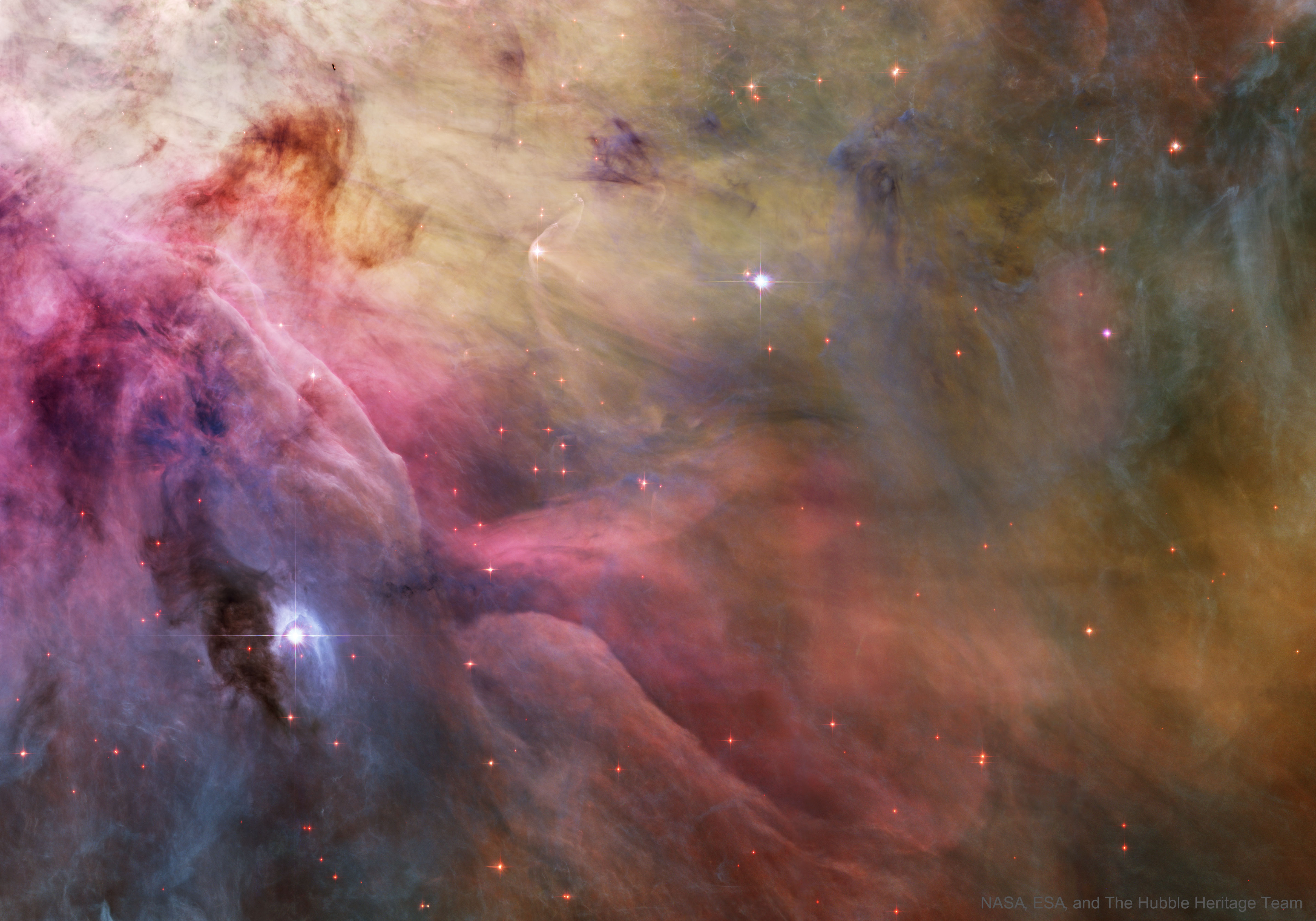
Explanation: Stars can make waves in the Orion Nebula's sea of gas and dust. This esthetic close-up of cosmic clouds and stellar winds features LL Orionis, interacting with the Orion Nebula flow. Adrift in Orion's stellar nursery and still in its formative years, variable star LL Orionis produces a wind more energetic than the wind from our own middle-aged Sun. As the fast stellar wind runs into slow moving gas a shock front is formed, analogous to the bow wave of a boat moving through water or a plane traveling at supersonic speed. The small, arcing, graceful structure just above and left of center is LL Ori's cosmic bow shock, measuring about half a light-year across. The slower gas is flowing away from the Orion Nebula's hot central star cluster, the Trapezium, located off the upper left corner of the picture. In three dimensions, LL Ori's wrap-around shock front is shaped like a bowl that appears brightest when viewed along the "bottom" edge. This beautiful painting-like photograph is part of a large mosaic view of the complex stellar nursery in Orion, filled with a myriad of fluid shapes associated with star formation.

Alita Pinheiro - "Valsa" - Pintura contemporânea


Foto de Alita Pinheiro.

"Valsa"

Fevereiro de 2017
Alita Pinheiro

Mery Paulino - "Anjo da guarda" - Arte-bordados


Anjo da guarda para berço de bebé ; renda e fita de cetim ou seda, argola forrada e medalhão de metal prateado representando um anjinho. Diâmetro 17 centímetros.


Mery Paulino é portuguesa originaria da Madeira e vive na Venezuela. Apaixonada de bordado, enviou-nos este seu magnifico trabalho.

2018-02-17

Steve Hanks - "Feiticeirinha" - Aguarela

Steve Hanks, aquarelas
Feiticeirinha

Bairros de Lisboa - Alfama (2) - Imagens

Lisboa bairro a bairro Alfama Como ir
Alfama tem um dos mais lindos mirantes de Lisboa e abriga o célebre Castelo de São Jorge. O bairro escapou ileso do terremoto de 1755 que devastou parte da cidade. Ao contrário do Chiado ou Bairro Alto, aqui a vida segue em ritmo mais lento sob o cheiro de sardinhas e castanhas portuguesas assadas.

Astronomy picture of the day - 2018 February 17 - Manhattan Skylines

See Explanation.  Clicking on the picture will download
 the highest resolution version available.
Manhattan Skylines 
Image Credit & CopyrightStan Honda
Explanation: City lights shine along the upper east side of Manahattan in this dramatic urban night skyscape from February 13. Composed from a series of digital exposures, the monochrome image is reminiscent of the time when sensitive black and white film was a popular choice for dimly lit night and astro-photography. Spanning 2 minutes and 40 seconds, the combined 22 frames look across the reservoir in New York City's Central Park. Stars trail in the time-lapse view while drifting clouds make patterns in the sky. Traced from top to bottom, the dashed line in the surreal scene is the International Space Station still in sunlight and heading for the southeast horizon. The short time intervals between the exposures leave gaps in the space station's bright trail.

2018-02-16

Bairros de Lisboa - Alfama - Imagens

A capital portuguesa possui bairros emblemáticos e com características próprias. Alfama é o mais tradicional deles e, também, o mais antigo da cidade. A região está cheia de escadinhas e ruelas pitorescas, onde portinhas singelas podem esconder as melhores casas de fado do país.

Astronomy picture of the day - 2018 February 16 - 2018 February 16

See Explanation.  Clicking on the picture will download
 the highest resolution version available.
Comet PanSTARRS is near the Edge 
Image Credit & CopyrightJoAnn McDonald
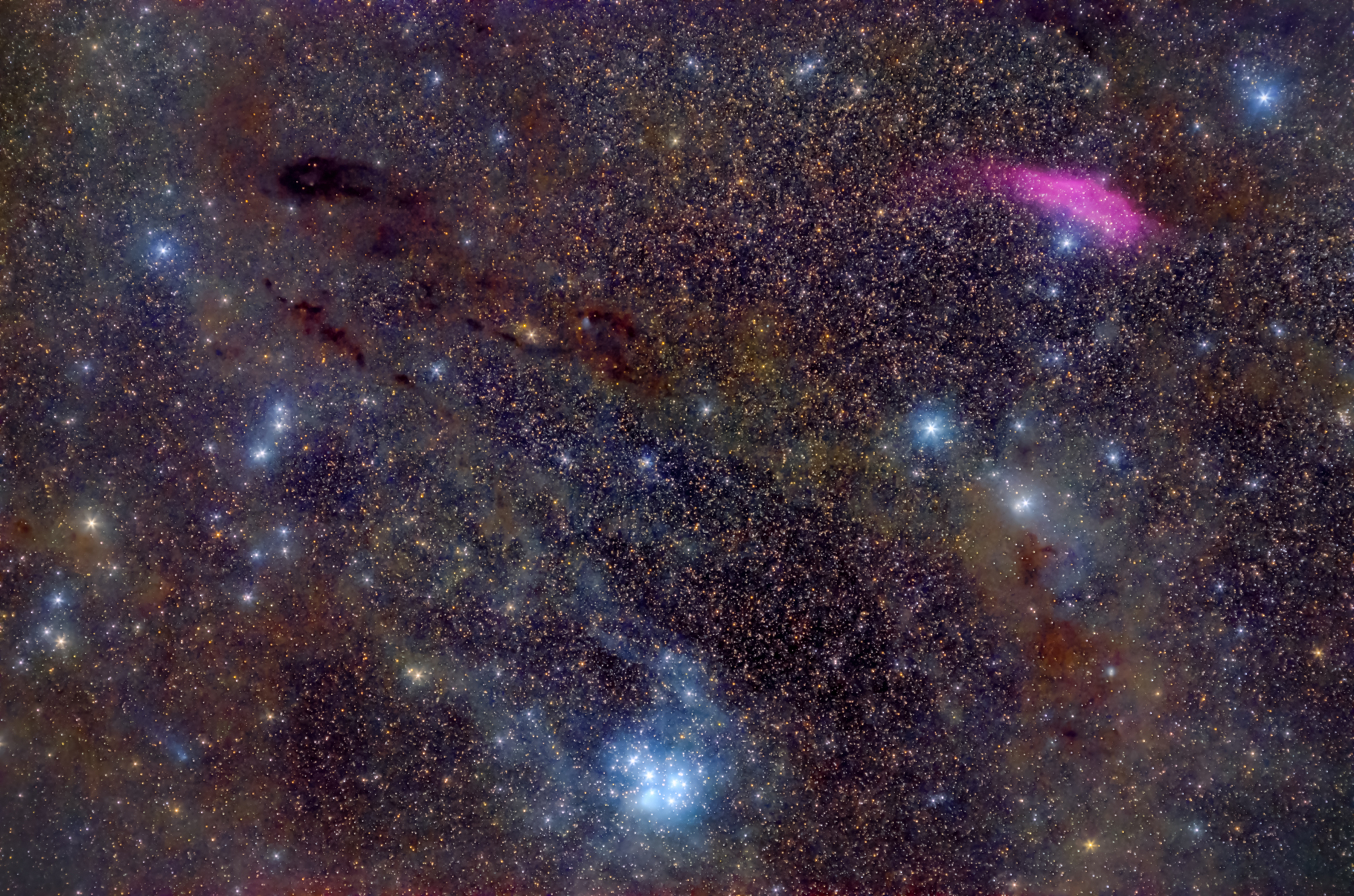
Explanation: The comet PanSTARRS, also known as the blue comet (C/2016 R2), really is near the lower left edge of this stunning, wide field view recorded on January 13. Spanning nearly 20 degrees on the sky, the cosmic landscape is explored by well-exposed and processed frames from a sensitive digital camera. It consists of colorful clouds and dusty dark nebulae otherwise too faint for your eye to see, though. At top right, the California Nebula (aka NGC 1499) does have a familiar shape. Its coastline is over 60 light-years long and lies some 1,500 light-years away. The nebula's pronounced reddish glow is from hydrogen atoms ionized by luminous blue star Xi Persei just below it. Near bottom center, the famous Pleiades star cluster is some 400 light-years distant and around 15 light-years across. Its spectacular blue color is due to the reflection of starlight by interstellar dust. In between are hot stars of the Perseus OB2 association and dusty, dark nebulae along the edge of the nearby, massive Taurus and Perseus molecular clouds. Emission from unusually abundant ionized carbon monoxide (CO+) molecules fluorescing in sunlight is largely responsible for the telltale blue tint of the remarkable comet's tail. The comet was about 17 light minutes from Earth.

2018-02-15

Astronomy picture of the day - 2018 February 15 - Enceladus in Silhouette

See Explanation.  Clicking on the picture will download
 the highest resolution version available.
Enceladus in Silhouette 
Image Credit: Cassini Imaging TeamSSIJPLESANASA
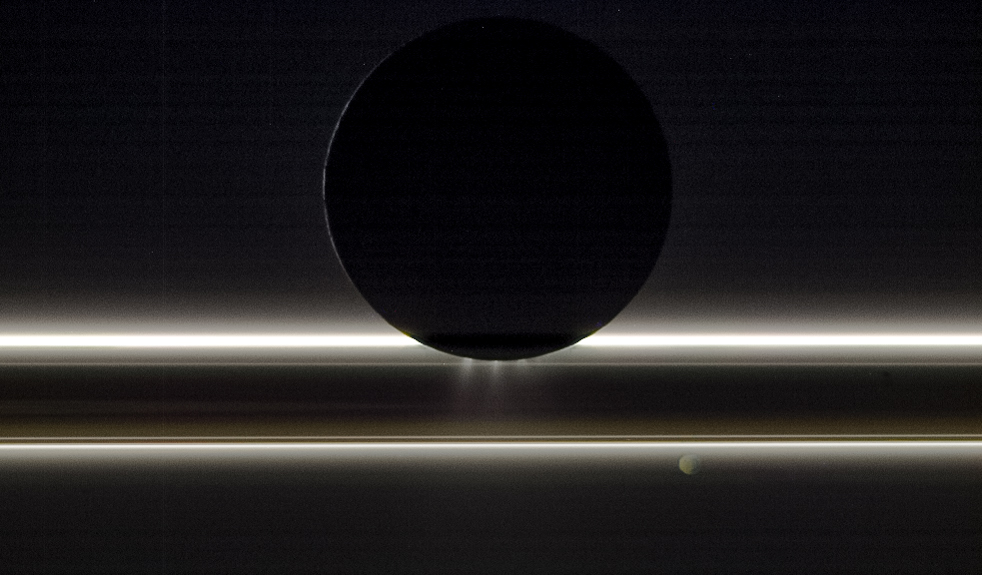
Explanation: One of our Solar System's most tantalizing worlds, Enceladus is backlit by the Sun in this Cassini spacecraft image from November 1, 2009. The dramatic illumination reveals the plumes that continuously spew into space from the south pole of Saturn's 500 kilometer diameter moon. Discovered by Cassini in 2005, the icy plumes are likely connected to an ocean beneath the ice shell of Enceladus. They supply material directly to Saturn's outer, tenuous E ring and make the surface of Enceladus as reflective as snow. Across the scene, Saturn's icy rings scatter sunlight toward Cassini's cameras. Beyond the rings, the night side of 80 kilometer diameter moon Pandora is faintly lit bySaturnlight.