"Halleluija"
2018-03-24

Astronomy picture of the day - 2018 March 24 - NGC 602 and Beyond
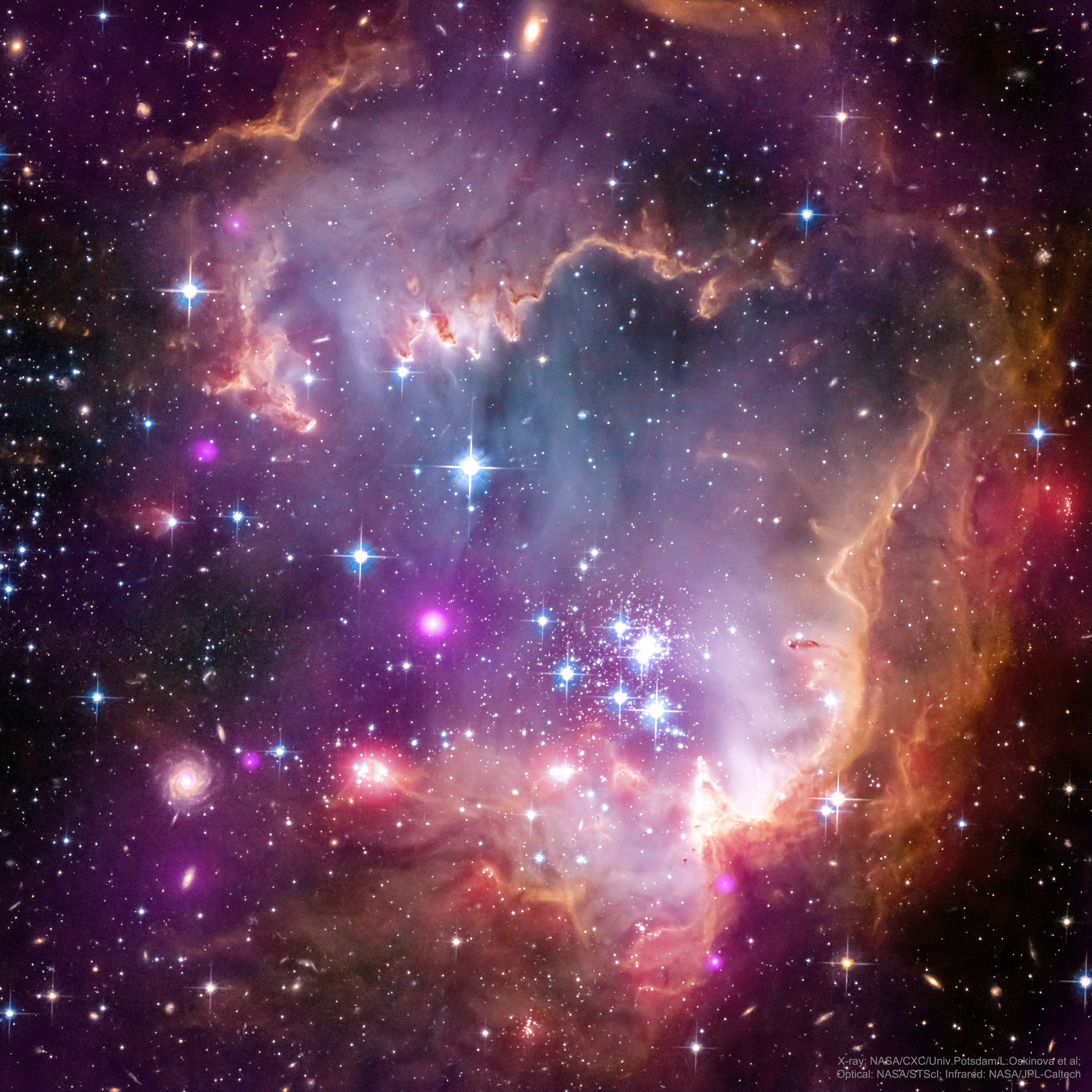
NGC 602 and Beyond
Image Credit: X-ray: Chandra: NASA/CXC/Univ.Potsdam/L.Oskinova et al;
Optical: Hubble: NASA/STScI; Infrared: Spitzer: NASA/JPL-Caltech
Explanation: Near the outskirts of the Small Magellanic Cloud, a satellite galaxy some 200 thousand light-years distant, lies 5 million year young star cluster NGC 602. Surrounded by natal gas and dust, NGC 602 is featured in thisstunning Hubble image of the region, augmented by images in the X-ray by Chandra, and in the infrared by Spitzer. Fantastic ridges and swept back shapes strongly suggest that energetic radiation and shock waves from NGC 602's massive young stars have eroded the dusty material and triggered a progression of star formation moving away from the cluster's center. At the estimated distance of the Small Magellanic Cloud, the Picture spans about 200 light-years, but a tantalizing assortment of background galaxies are also visible in this sharp multi-colored view. The background galaxies are hundreds of millions of light-years or more beyond NGC 602.
2018-03-23
Robert Doisneau - Crianças de Paris - Fotografia

Robert Doisneau (14 de abril de 1912 – 1 de abril de 1994) foi um famoso fotógrafo nascido na cidade de Gentilly, Val-de-Marne, na França. Era um apaixonado por fotografia de rua e registrou a vida social das pessoas que viviam em Paris e seus arredores.
Astronomy picture of the day - 2018 March 23 - Rotating Moon from LRO
Rotating Moon from LRO
Explanation: No one, presently, sees the Moon rotate like this. That's because the Earth's moon is tidally locked to the Earth, showing us only one side. Given modern digital technology, however, combined with many detailed images returned by the Lunar Reconnaissance Orbiter (LRO), a high resolution virtual Moon rotation movie has been composed. The above time-lapse video starts with the standard Earth view of the Moon. Quickly, though, Mare Orientale, a large crater with a dark center that is difficult to see from the Earth, rotates into view just below the equator. From an entire lunar month condensed into 24 seconds, the video clearly shows that the Earth side of the Moon contains an abundance of dark lunar maria, while the lunar far side is dominated by bright lunar highlands. Currently, over 20 new missions to the Moon are under active development from four different countries, most of which have expected launch dates either this year or next.
2018-03-22
Astronomy picture of the day - 2018 March 22 - NGC 253: Dusty Island Universe
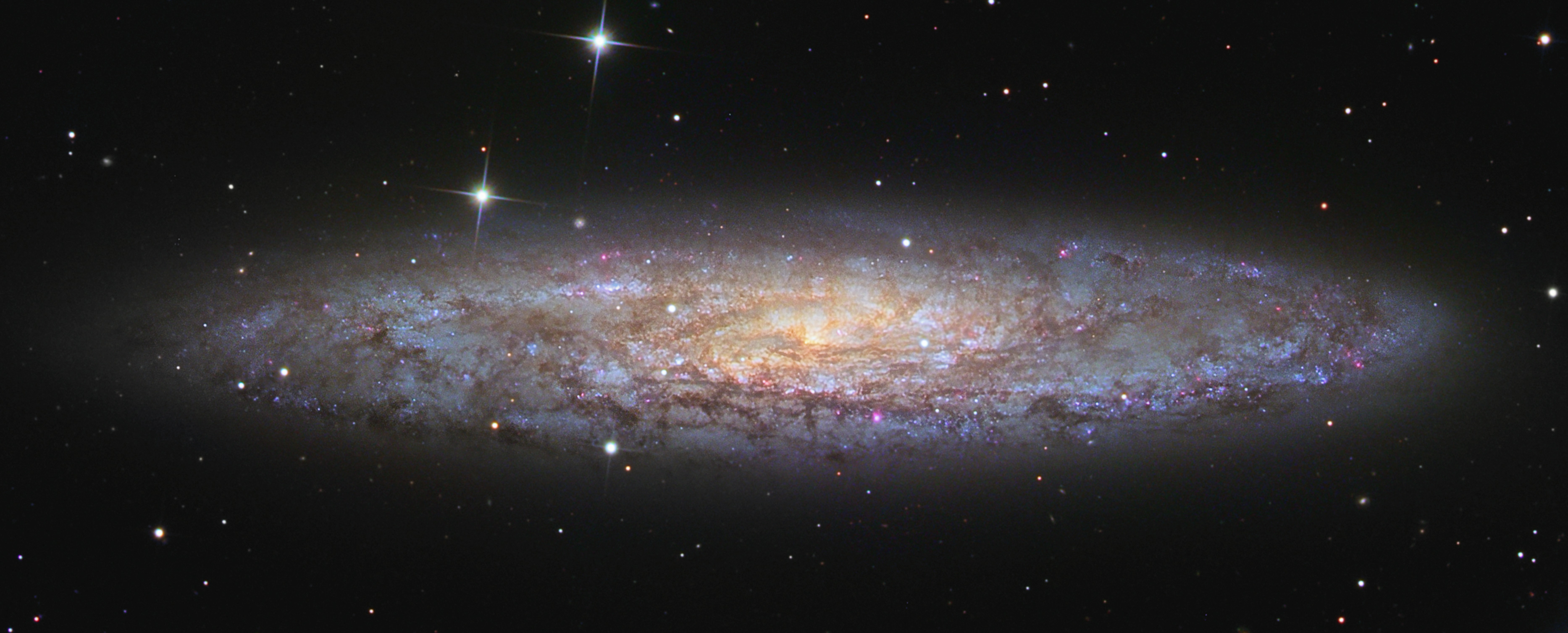
Image Credit & Copyright: Stefano Cancelli, Paul Mortfield
Explanation: Shiny NGC 253 is one of the brightest spiral galaxies visible, and also one of the dustiest. Some call it the Silver Dollar Galaxy for its appearance in small telescopes, or just the Sculptor Galaxy for its location within the boundaries of the southern constellation Sculptor. Discovered in 1783 by mathematician and astronomer Caroline Herschel, the dusty island universe lies a mere 10 million light-years away. About 70 thousand light-years across, NGC 253 is the largest member of the Sculptor Group of Galaxies, the nearest to our own Local Group of Galaxies. In addition to its spiral dust lanes, tendrils of dust seem to be rising from a galactic disk laced with young star clusters and star forming regions in this sharp color image. The high dust content accompanies frantic star formation, earning NGC 253 the designation of a starburst galaxy. NGC 253 is also known to be a strong source of high-energy x-rays and gamma rays, likely due to massive black holes near the galaxy's center. Take a trip through extragalactic space in this short video flyby of NGC 253.
2018-03-21
Henri Cartier-Bresson - O pai do fotojornalismo - Fotografia

Henri Cartier-Bresson (Chanteloup-en-Brie, 22 de agosto de 1908 — Montjustin, 2 de agosto de 2004) foi umfotógrafo do século XX, considerado por muitos o pai do fotojornalismo.
2018-03-20

Astronomy picture of the day - 2018 March 20 - Chicagohenge: Equinox in an Aligned City
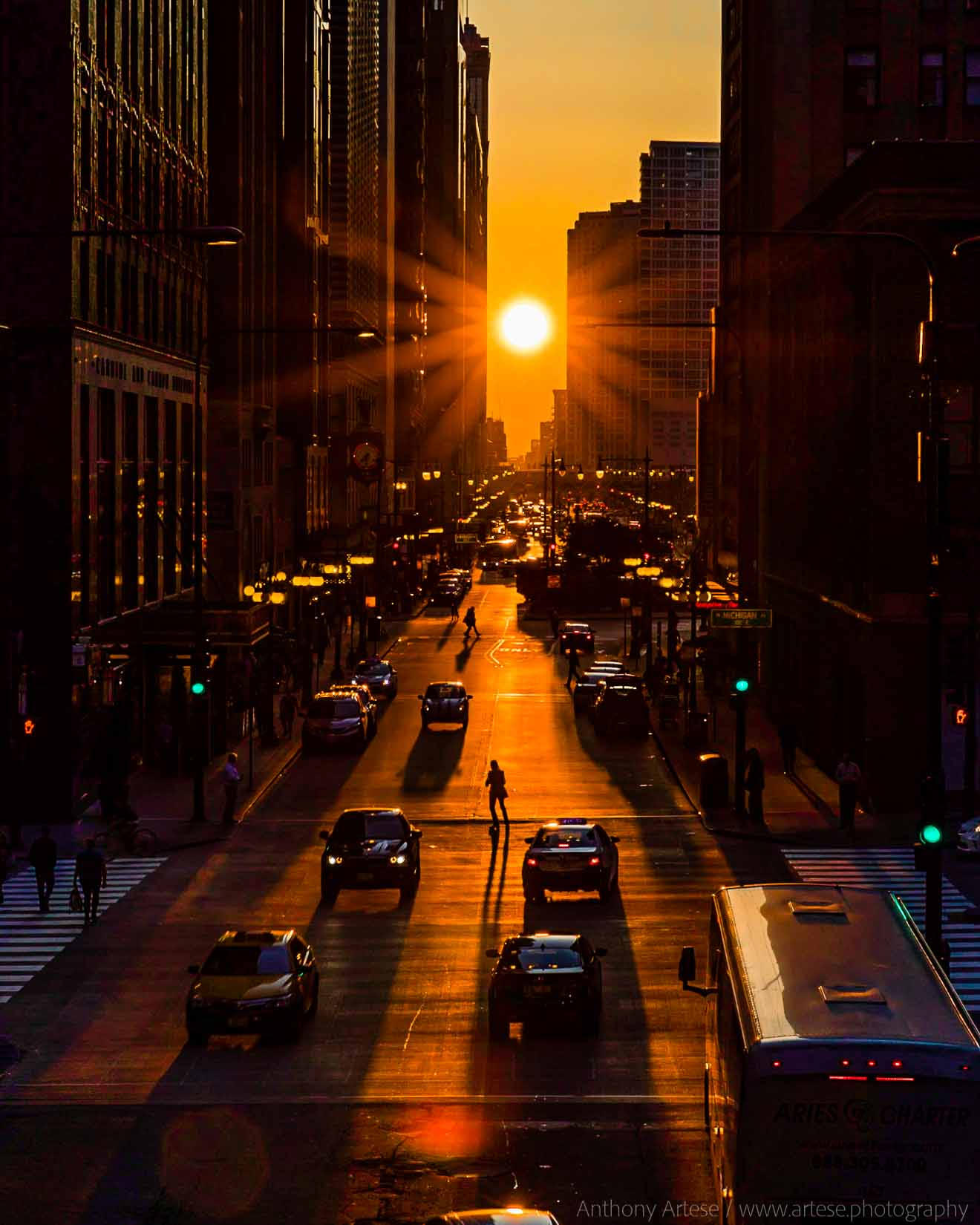
Image Credit & Copyright: Anthony Artese
Explanation: Sometimes, in a way, Chicago is like a modern Stonehenge. The way is east to west, and the time is today. Today, and every equinox, the Sun will set exactly to the west, everywhere on Earth. Therefore, today inChicago, the Sun will set directly down the long equatorially-aligned grid of streets and buildings, an event dubbed #chicagohenge. Featured here is a Chicago Henge picture taken during the last equinox in mid-September of 2017 looking along part of Upper Wacker Drive. Many cities, though, have streets or other features that are well-aligned to Earth's spin axis. Therefore, quite possibly, your favorite street may also run east - west. Tonight at sunset, with a quick glance, you can actually find out.



Inscription à :
Articles (Atom)