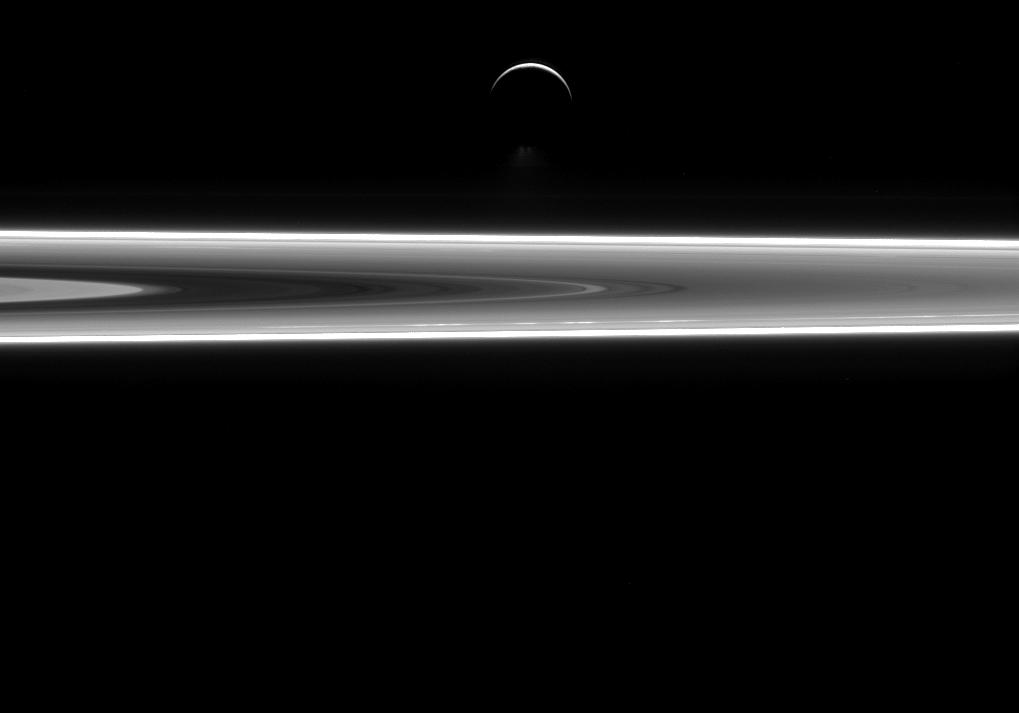
Explanation: Saturn's icy moon Enceladus poses above the gas giant's icy rings in this Cassini spacecraft image. The dramatic scene was captured on July 29, while Cassini cruised just below the ring plane, its cameras looking back in a nearly sunward direction about 1 million kilometers from the moon's bright crescent. At 500 kilometers in diameter, Enceladus is a surprisingly active moon though, its remarkable south polar geysers are visible venting beyond a dark southern limb. In fact, data collected during Cassini's flybys and years of images have recently revealed the presence of a global ocean of liquid water beneath this moon's icy crust. Demonstrating the tantalizing liquid layer's global extent, the careful analysis indicates surface and core are not rigidly connected, with Enceladus rocking slightly back and forth in its orbit.
Explanation: The setting is San Francisco Bay, the time is sunset, and the bridge is the Golden Gate. What you are about to see is an unexpected double sunset ending with a rare green flash. Watch closely -- in the recorded time-lapse sequence, unusually warm air created by bridge traffic refracts sunlight toward the Earth, causing a superior image of the top of the Sun to form. This image will disappear -- marking the first "sunset" -- only after the main image has dipped below the deck. All the while, boats pass in the foreground, cars pass over the bridge, and clouds reflecting sunlight drift by in the distance. The scene ends with Earth's turbulent atmosphere itself creating a path that onlyhigher-energy visible sunlight can traverse, making the last glimpse of our home star appear to flash green.
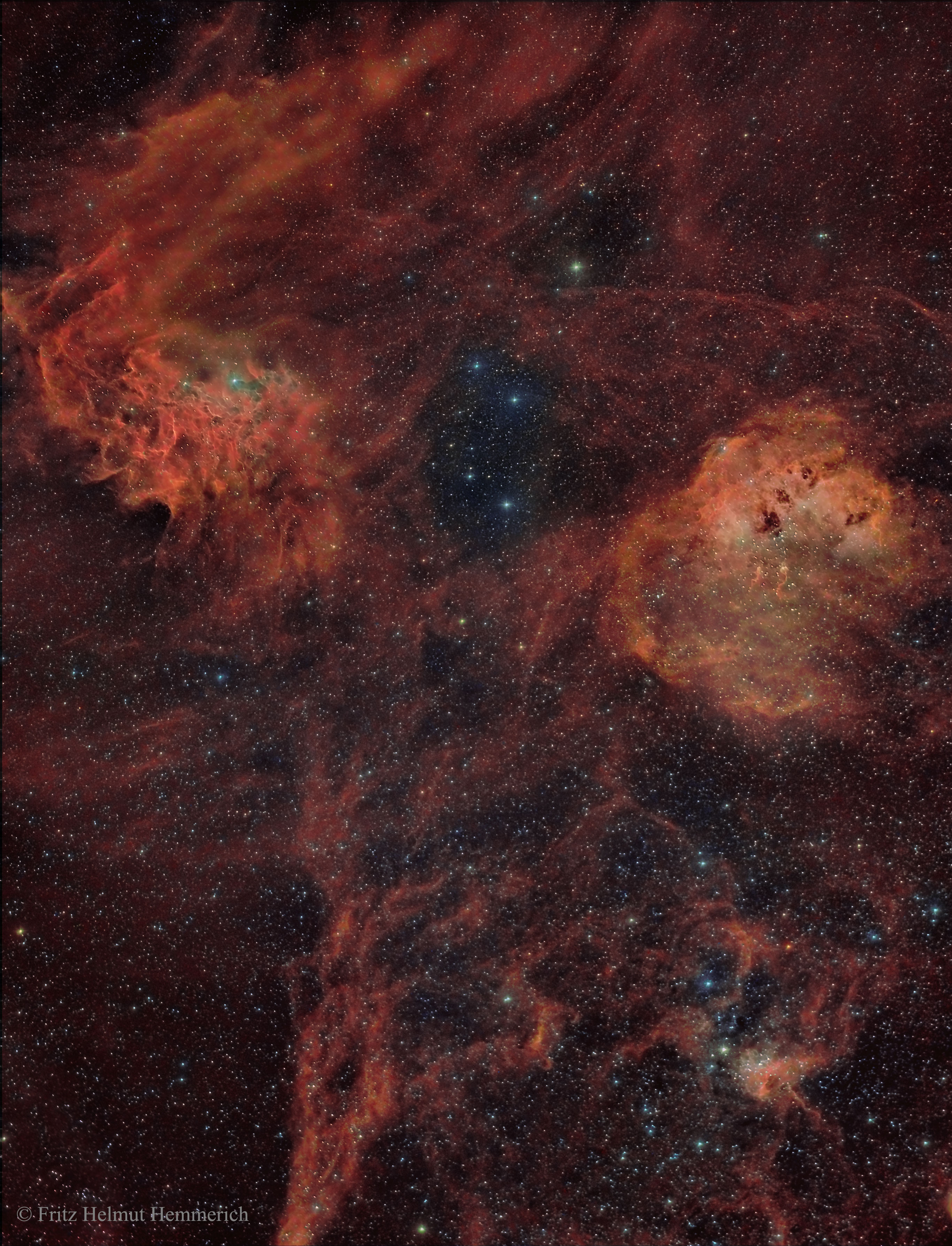
Explanation: Rich in star clusters and nebulae, the ancient constellation of the Charioteer (Auriga) rides high in northern winter night skies. Composed from narrow and broadband filter data and spanning nearly 8 Full Moons (4 degrees) on the sky, this deep telescopic view shows off some of Auriga's celestial bounty. The field includes emission region IC 405 (top left) about 1,500 light-years distant. Also known as the Flaming Star Nebula, its red, convoluted clouds of glowing hydrogen gas are energized by hot O-type star AE Aurigae. IC 410 (top right) is significantly more distant, some 12,000 light-years away. The star forming region is famous for its embedded young star cluster, NGC 1893, and tadpole-shaped clouds of dust and gas. IC 417 and NGC 1931 at the lower right, the Spider and the Fly, are also young star clusters embedded in natal clouds that lie far beyond IC 405. Star cluster NGC 1907 is near the bottom edge of the frame, just right of center. The crowded field of view looks along the plane of our Milky Way galaxy, near the direction of the galactic anticenter.