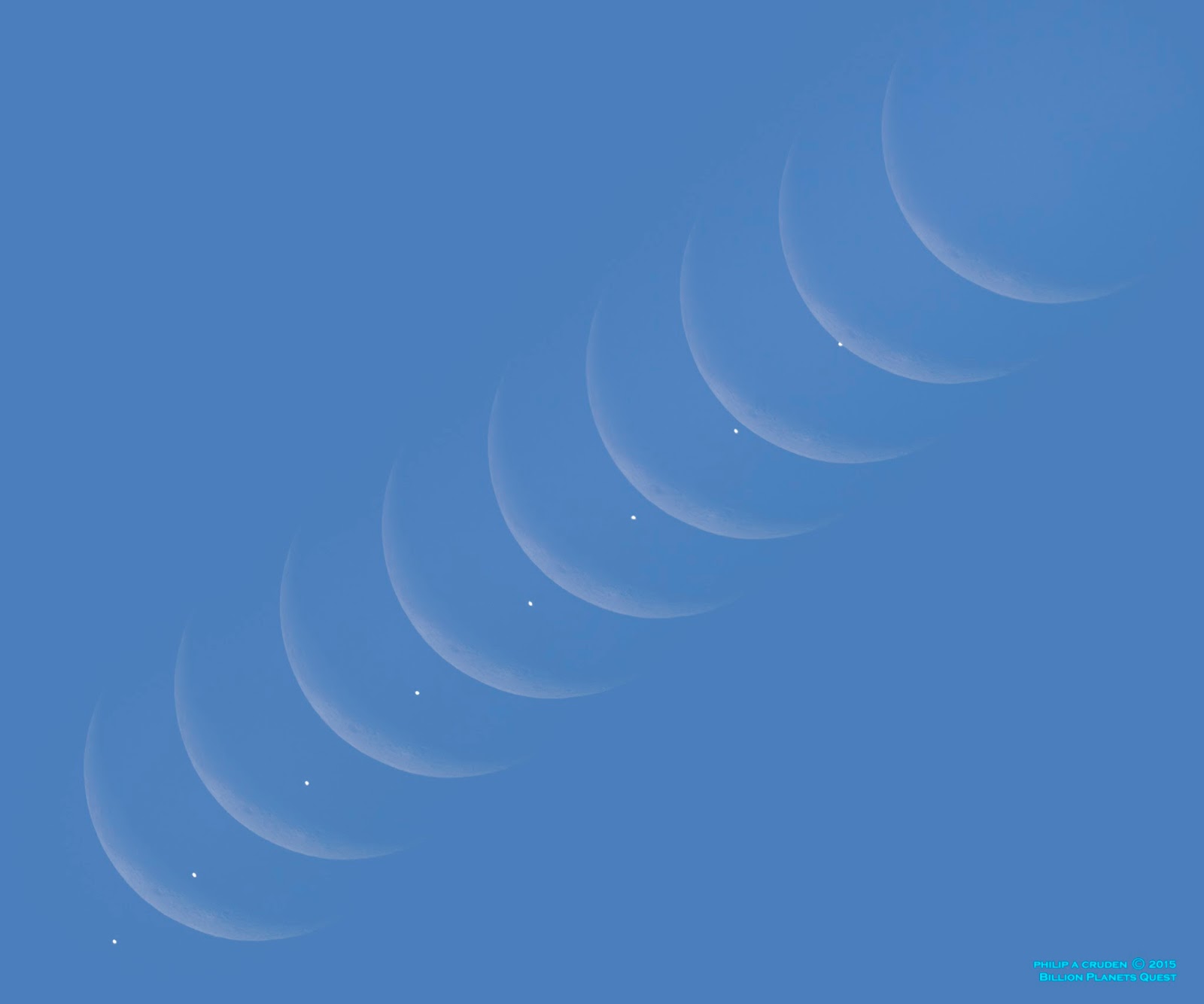
Explanation: Venus now appears as Earth's brilliant morning star, standing in a line-up of planets above the southeastern horizon before dawn. For most, the silvery celestial beacon rose predawn in a close pairing with an old crescent Moon on Monday, December 7. But also widely seen from locations in North and Central America, the lunar crescent actually occulted or passed in front of Venus during Monday's daylight hours. This time series follows the daytime approach of Moon and morning star in clear blue skies from Phoenix, Arizona. The progression of nine sharp telescopic snapshots, made between 9:30am and 9:35am local time, runs from lower left to upper right, when Venus winked out behind the bright lunar limb.
Son excelentes cazadores, capaces de trepar a los árboles para atrapar a sus presas. Su nombre proviene de la parroquia Catahoula de Louisiana, de donde se habría originado esta raza.
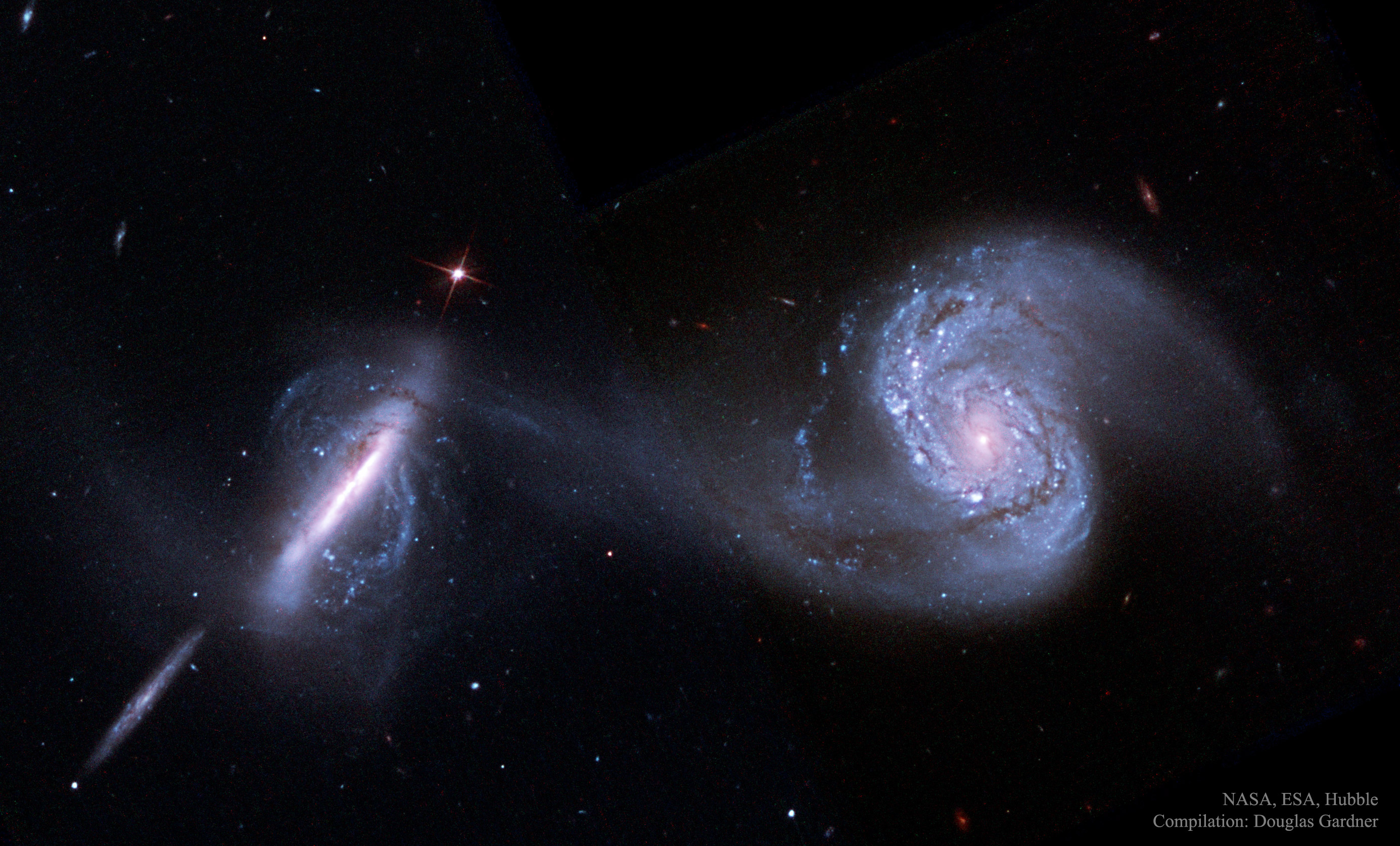
Explanation: This dance is to the death. Along the way, as these two large galaxies duel, a cosmic bridge of stars, gas, and dust currently stretches over 75,000 light-years and joins them. The bridge itself is strong evidence that these two immense star systems have passed close to each other and experienced violent tides induced by mutual gravity. As further evidence, the face-on spiral galaxy on the right, also known as NGC 3808A, exhibits many young blue star clusters produced in a burst of star formation. The twisted edge-on spiral on the left (NGC 3808B) seems to be wrapped in the material bridging the galaxies and surrounded by a curious polar ring. Together, the system is known asArp 87 and morphologically classified, technically, as peculiar. While such interactions are drawn out over billions of years, repeated close passages should ultimately result in the death of one galaxy in the sense that only one galaxy will eventually result. Although this scenario does look peculiar, galactic mergers are thought to be common, with Arp 87 representing a stage in this inevitable process. The Arp 87 pair are about 300 million light-years distant toward the constellation Leo. The prominent edge-on spiral at the far left appears to be a more distant background galaxy and not involved in the on-going merger.
Explanation: Comet Catalina is ready for its close-up. The giant snowball from the outer Solar System, known formally as C/2013 US10 (Catalina), rounded the Sun last month and is now headed for its closest approach to Earth in January. With the glow of the Moon now also out of the way, morning observers in Earth's northern hemisphere are getting their best ever view of the new comet. And Comet Catalina is not disappointing. Although not as bright as early predictions, the comet is sporting both dust (lower left) and ion (upper right) tails, making it an impressive object for binoculars and long-exposure cameras. The featured image was taken last week from the Canary Islands, off the northwest coast of Africa. Sky enthusiasts around the world will surely be tracking the comet over the next few months to see how it evolves.