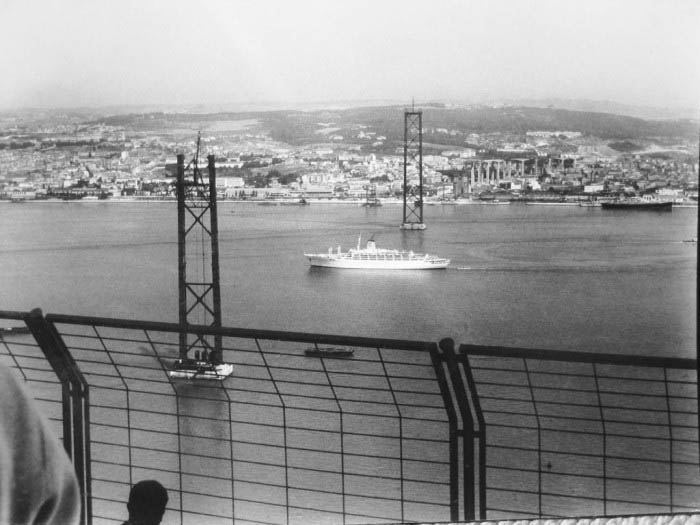
O forte de Copacabana. Nesta praia havera a prova de maratona aquatica
2016-08-02
Astronomy picture of the day - 2016 August 2 - A Rocket Booster Falls Back to Earth
Video Credit & Copyright: Matthew Holt
Explanation: What's that crossing the sky? Although it looked a bit like a large meteor, it was actually the booster of a Chinese rocket returning to Earth after its launch two days earlier. On the night of July 27, the rocket component heated up and broke up into glowing pieces as it re-entered Earth's atmosphere. The path of the falling booster took it over several US states, moving west to east, from California to Utah. Space debris can usually be distinguished from meteors by its slow speed and expansive break up. The featured video was taken in front of the Provo City Library in Utah, which was coincidently occupied by over 100 people -- many with smartphones already out of their pockets playing Pokémon GO.
2016-08-01
Imagenes del Mundo - Tigres de Bengala en Sumatra, Indonesia
Dos pequeñas crías de tigre de Bengala, con apenas un mes de vida, juegan dentro de una jaula en un zoo de Medan, en la región de Sumatra del Norte (Indonesia).
DEDI SINUHAJI EFE
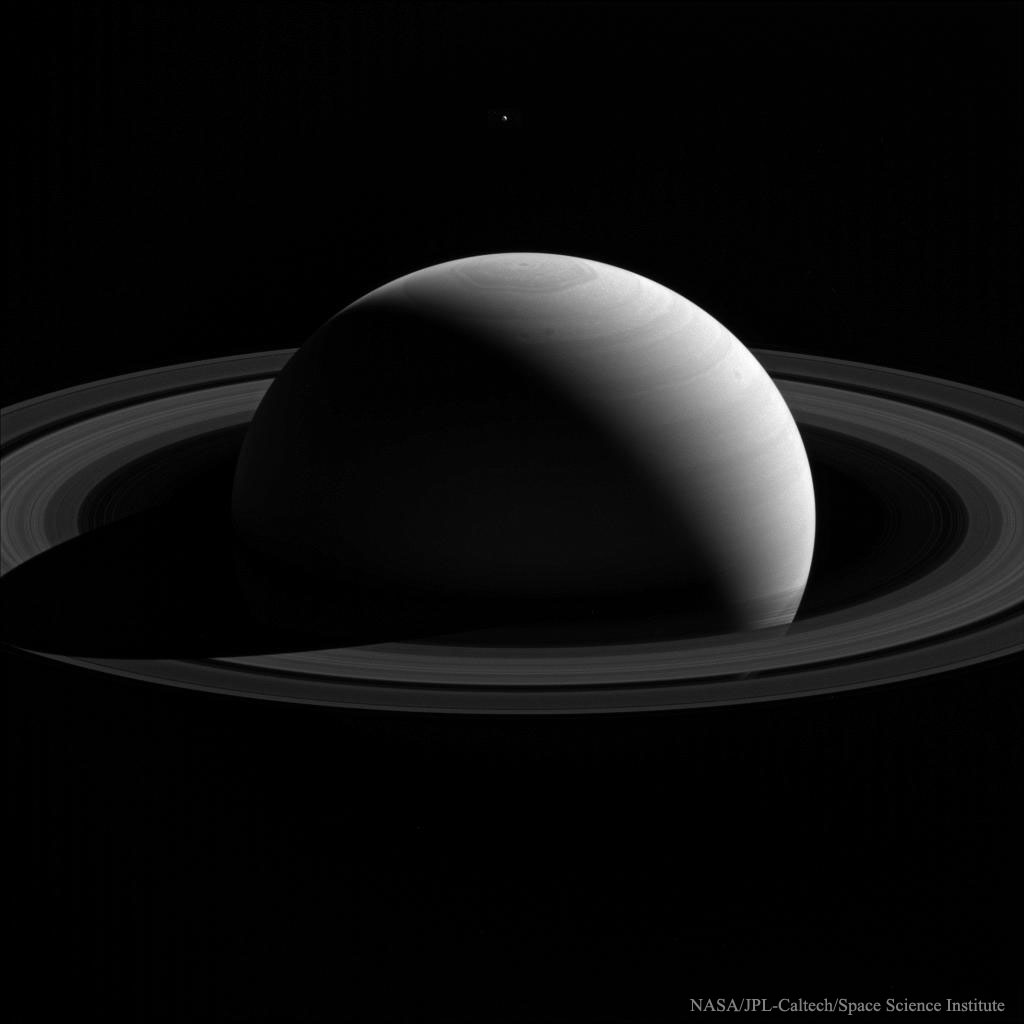
Astronomy pictures of the day - 2016 August 1 - Behind Saturn
Image Credit: NASA/JPL-Caltech/Space Science Institute
Explanation: What's behind Saturn? The first answer is the camera itself, perched on the Cassini spacecraft currently orbiting behind the planet with the most grand ring system in our Solar System. The unusual perspective places Cassini on the far side of Saturn from the Sun so that more than half of Saturn appears dark -- a perspective that no Earth-based observer could achieve. Behind Saturn, in the context of the featured infrared image, is Saturn's moon Tethys, visible as the small speck above the unusual hexagonal cloud pattern that encompasses Saturn's North Pole. Tethys actually orbits Saturn right in the ring plane, which places the 1000-km moon much farther from Cassini than the planet itself. Cassini has been studying Saturn and its moons for 12 years, but, unfortunately, its amazing mission will soon come to an end. In order to protect life that may exist on or inside Saturn's moons, the robotic spacecraft will be directed to crash into Saturn's thick atmosphere next September.
2016-07-31
Luke Aikins, o primeiro a saltar a mais de 7 km de altitude sem paraquedas (Video)
O norte-americano Luke Aikins tornou-se a primeira pessoa do mundo a saltar 25 mil pés (7620 metros) sem paraquedas, depois de se lançar de um helicóptero.
Segundo a imprensa, citada pela agência EFE, o homem de 42 anos alcançou uma velocidade de 193 quilómetros por hora no salto de durou dois minutos e caiu numa enorme rede de segurança instalada por vários metros no solo em Simi Valley, onde o esperava a sua família.
No local da "aterragem" tinham sido realizados testes com manequins de 90 quilos, que decorreram com normalidade, embora um deles não tivesse acertado no alvo. Esperava-se que tal não acontecesse ao paraquedista, mas para prevenir qualquer incidente a Fox emitiu o salto com um ligeiro atraso, de forma a poder parar a emissão em caso de tragédia.
Diario de Noticias - Portugal
Astronomy picture of the day - 2016 July 31 - A Huge Solar Filament Erupts
Video Credit: NASA's GSFC, SDO AIA Team
Explanation: Filaments sometimes explode off the Sun. Featured, a huge filament had been seen hovering over the Sun's surface for over a week before it erupted late in 2010. The image sequence was taken by the Earth-orbitingSolar Dynamics Observatory (SDO) in one color of ultraviolet light. The explosion created a Coronal Mass Ejection that dispersed high energy plasma into the Solar System. This plasma cloud, though, missed the Earth and so did not cause auroras. The featured eruption depicted how widely separated areas of the Sun can sometimes act in unison. Explosions like this will likely become less common over the next few years as our Sun goes through a Solar Minimumin its surface magnetic activity.
2016-07-30
Anedota "alantjana" do dia - 30-07-2016
Um alentejano entrou na sala de espera de um consultório médico. Ao aproximar-se da mesa da recepção, a recepcionista dirige-lhe a palavra:
- Bom dia senhor, qual o seu problema?
Diz o alentejano:
- O mê problema é no pénis.
A recepcionista, ao ouvir o alentejano, irritou-se e pregou-lhe uma descompostura:
- O senhor não devia dizer uma coisa dessas numa sala de espera tão cheia! Está a causar embaraço aos outros presentes! São pessoas de fino porte, educadas… O senhor devia ter dito, por exemplo, que estava com um problema na orelha e depois, já dentro do consultório, contava os detalhes ao doutor.
O alentejano, sentindo-se humilhado, retirou-se da sala, voltou à rua, recompos-se e regressou à sala de espera predisposto a corrigir a má impressão causada de que, aliás, estava francamente arrependido.
A recepcionista ao vê-lo de regresso sorriu e, colaborante, perguntou:
- Muito bom dia senhor, qual o seu problema?
Diz o alentejano:
- Estou com um problema na orelha!
A recepcionista rejubilou num indisfarçável aceno de aprovação e, sorrindo triunfante, prosseguiu:
- E diga-me, qual é o problema da sua orelha?
E responde o alentejano:
- Arde muito, quando mijo.
Inscription à :
Commentaires (Atom)