"Serpas de Guadalupe"
2016-10-12
Imagenes del Mundo - Un ciervo en el parque Richmond en Londres
Un ciervo durante la época de celo en el parque Richmond en Londres (Reino Unido).
TOBY MELVILLE REUTERS
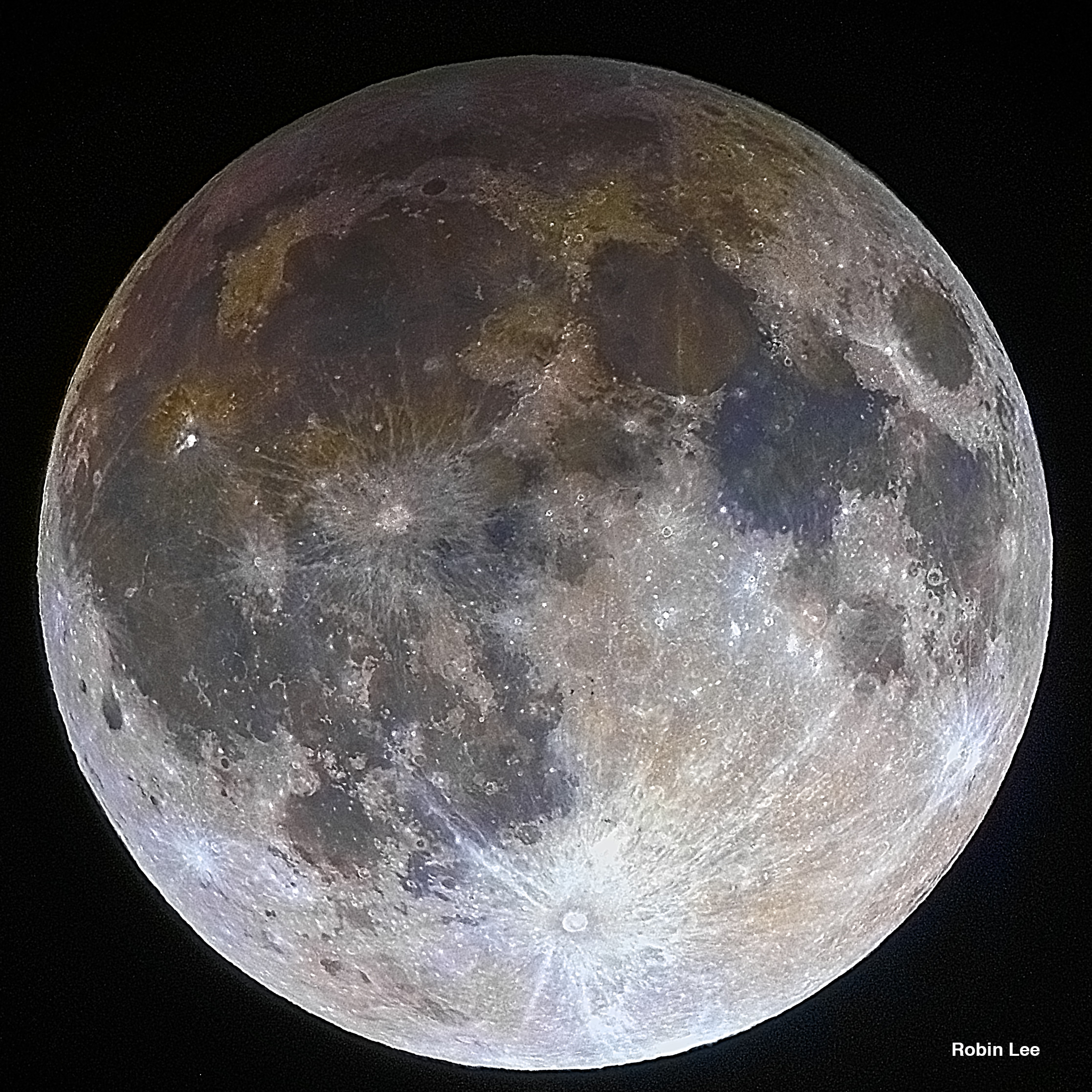
Astronomy picture of the day - 2016 October 12 - Penumbral Lunar Eclipse
Image Credit & Copyright: Robin Lee
Explanation: Does this Moon look a little different to you? Although shown in spectacular detail, the full face of Earth's most familiar satellite appears slightly darker than usual, in particular on the upper left, because it is undergoing apenumbral lunar eclipse. The image was captured in Hong Kong, China, on September 16 when the Moon crossed through part of Earth's shadow -- but not the darkest where the Earth shades the entire Sun. A lunar eclipse can only occur during a full moon, and many know this particular full moon as the Harvest moon for its proximity to northern harvests. The next full moon will occur this coming Sunday. Some cultures refer to it as a Leaf Falling Moon, named for its proximity to northern autumn. The second full moon of the same month ("moonth") is sometimes called a Blue moon; meanwhile, this month features a rare second new moon, an event known to some as a Black moon.
2016-10-11
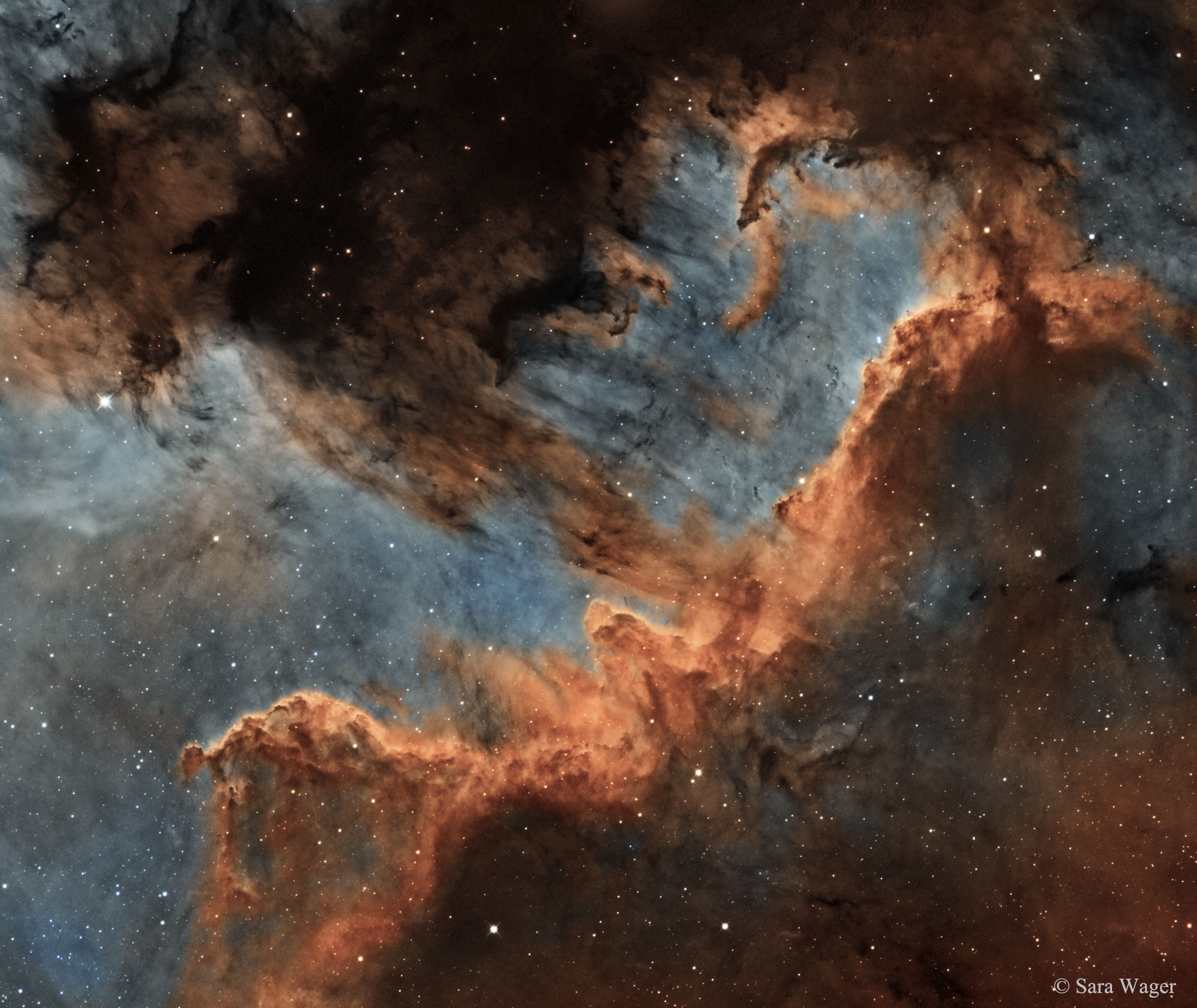
Astronomy picture of the day - 2016 October 11 - The Cygnus Wall of Star Formation
Image Credit & Copyright: Sara Wager
Explanation: Sometimes, stars form in walls -- bright walls of interstellar gas. In this vivid skyscape, stars are forming in the W-shaped ridge of emission known as the Cygnus Wall. Part of a larger emission nebula with a distinctive outline popularly called The North America Nebula, the cosmic ridge spans about 20 light-years. Constructed using narrowband data to highlight the telltale reddish glow from ionized hydrogen atoms recombining with electrons, the image mosaic follows an ionization front with fine details of dark, dusty forms in silhouette. Sculpted by energetic radiation from the region's young, hot, massive stars, the dark shapes inhabiting the view are clouds of cool gas and dust with stars likely forming within. The North America Nebula itself, NGC 7000, is about 1,500 light-years away.
2016-10-10
Astronomy picture of the day - 2016 October 10 - The Winds of Earth
Image Credit & Copyright: Cameron Beccario, earth.nullschool.net;
Data & Processing (abridged): GFS & US National Weather Service (NOAA); GEOS-5 & Goddard Space Flight Center (NASA)
Explanation: Which way is the wind blowing? The featured map can tell you this and much more, no matter your location on planet Earth. The dynamic map displays supercomputer forecasts drawn from multiple sources of globalsatellite data updated every three hours. Bright swirls usually indicate low pressure systems with high wind speeds, including dramatic cyclones, hurricanes and typhoons. Although the globe can be rotated interactively here, to obtain full interactivity -- including the ability to zoom -- you should click the word "earth" on the lower left or send your browser directly to https://earth.nullschool.net. The "earth" control panel there further allows you to overlay temperature, humidity, pressure, precipitation, and carbon dioxide maps, or even switch to displaying higher altitude wind speeds or ocean currents. In particular during times of rapid change, the displayed maps may be outdated or inaccurate.
2016-10-09
Astronomy picture of the day - 2016 October 9 - Hurricane Ivan from the Space Station
Image Credit: Expedition 9 Crew, International Space Station, NASA
Explanation: Ninety percent of the houses on Grenada were damaged by the destructive force of Hurricane Ivan. At its peak in 2004, Ivan was a Category 5 hurricane, the highest power category on the Saffir-Simpson Scale, and created sustained winds in excess of 200 kilometers per hour. Ivan was the largest hurricane to strike the US in 2004, and one of the more powerful in recorded history. As it swirled in the Atlantic Ocean, the tremendous eye of Hurricane Ivan was photographed from above by the orbiting International Space Station. The name Ivan has now been retired from Atlantic Ocean use by the World Meteorological Organization. This month, Hurricane Matthewdevastated part of Haiti and is currently swirling just off the east coast of the USA.
Texto - Belos tempos, velhos dias!
Sei que sou um tanto exagerado no ódio ou na paixão, mas
tento, quanto possivel ser objectivo e justo.
Raramente acerto: seja no pensamento demonstrado, seja no
facto de o não poder correctamente transmitir. Raramente tenho certezas, mas que será saudade
repetida em todos os dias?
Tento disfarçar mas não consigo; alguém esta sempre no meu
pensamento; tardes bem passadas, velhos tempos, belos dias!
Minha memoria esta feita de belas recordações; lindos dias
feitos de emoções. Sorrisos no meio de conversas sem fim…
Belos tempos, velhos dias…
Hoje a vida é feita dessas recordações que ajudam a apagar
emoções para ter sempre presente o que era lindo. Velhos tempos, belos dias.
Bordeaux, 09-10-2016
JoanMira
2016-10-08
Roberto Carlos - "Agora" - Slides - Musica
(dedico esta musica a Amiga Ge no seu aniversario)
"Agora"
Artigo - Cuba - Huracán Matthew avanza en Estados Unidos (Video)
Washington, 8 oct (EFEUSA).- El huracán Matthew, ya de categoría 2, sigue su camino avanzando hacia la costa de Carolina del Sur después de causar inundaciones, cortes de luz y fuertes vientes a su paso por Georgia.
El ciclón se desplaza a una velocidad de 19km por hora con vientos máximos sostenidos de hasta 165km por hora. El Centro Nacional de Huracanes ha informado de que Matthew seguirá su camino hacia el norte durante la mañana de hoy mientas que se espera esta tarde, previsiblemente, girará hacia el nornoroeste y más tarde hacia el noreste.
Según la misma fuente, la localidad de Savannah, entre Georgia y Carolina del Sur podría ser la localidad más afectada. Hasta este momento más de 1.100.000 casas del estado de la Florida permanecen sin electricidad y la ciudad de Charleston sufre inundaciones.
(De notar que la "Cuba de miseria, o pobre Cuba" no hay tenido pierdas humanas!)
Ciber - Cuba
Inscription à :
Commentaires (Atom)