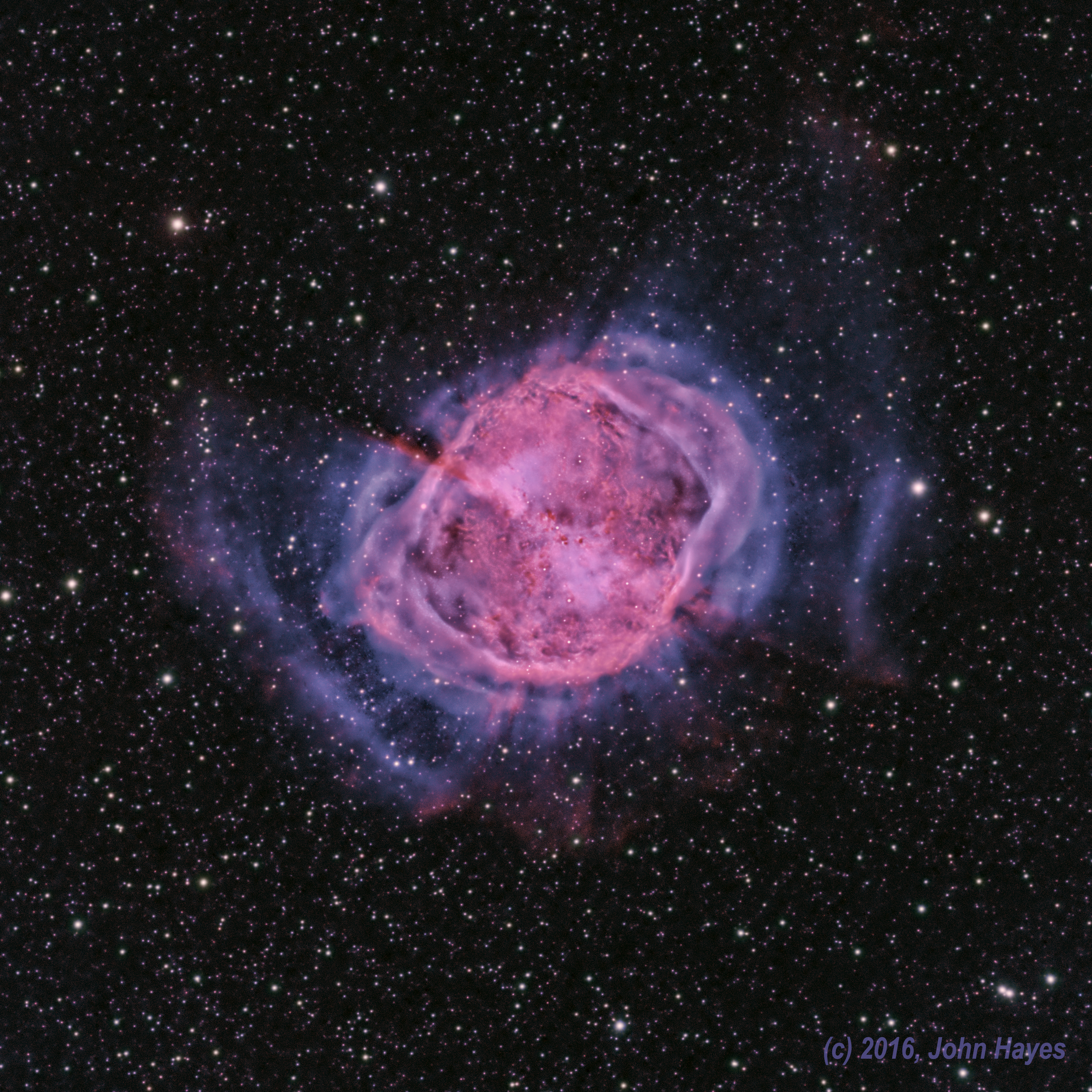
M27: The Dumbbell Nebula Image Credit & Copyright: John Hayes
Explanation: The first hint of what will become of our Sun was discovered inadvertently in 1764. At that time, Charles Messier was compiling a list of diffuse objects not to be confused with comets. The 27th object on Messier's list, now known as M27 or the Dumbbell Nebula, is a planetary nebula, the type of nebula our Sun will produce when nuclear fusion stops in its core. M27 is one of the brightest planetary nebulae on the sky, and can be seen toward theconstellation of the Fox (Vulpecula) with binoculars. It takes light about 1000 years to reach us from M27, shown above in colors emitted by hydrogen and oxygen. Understanding the physics and significance of M27 was well beyond 18th century science. Even today, many things remain mysterious about bipolar planetary nebula like M27, including the physical mechanism that expels a low-mass star's gaseous outer-envelope, leaving an X-ray hot white dwarf.
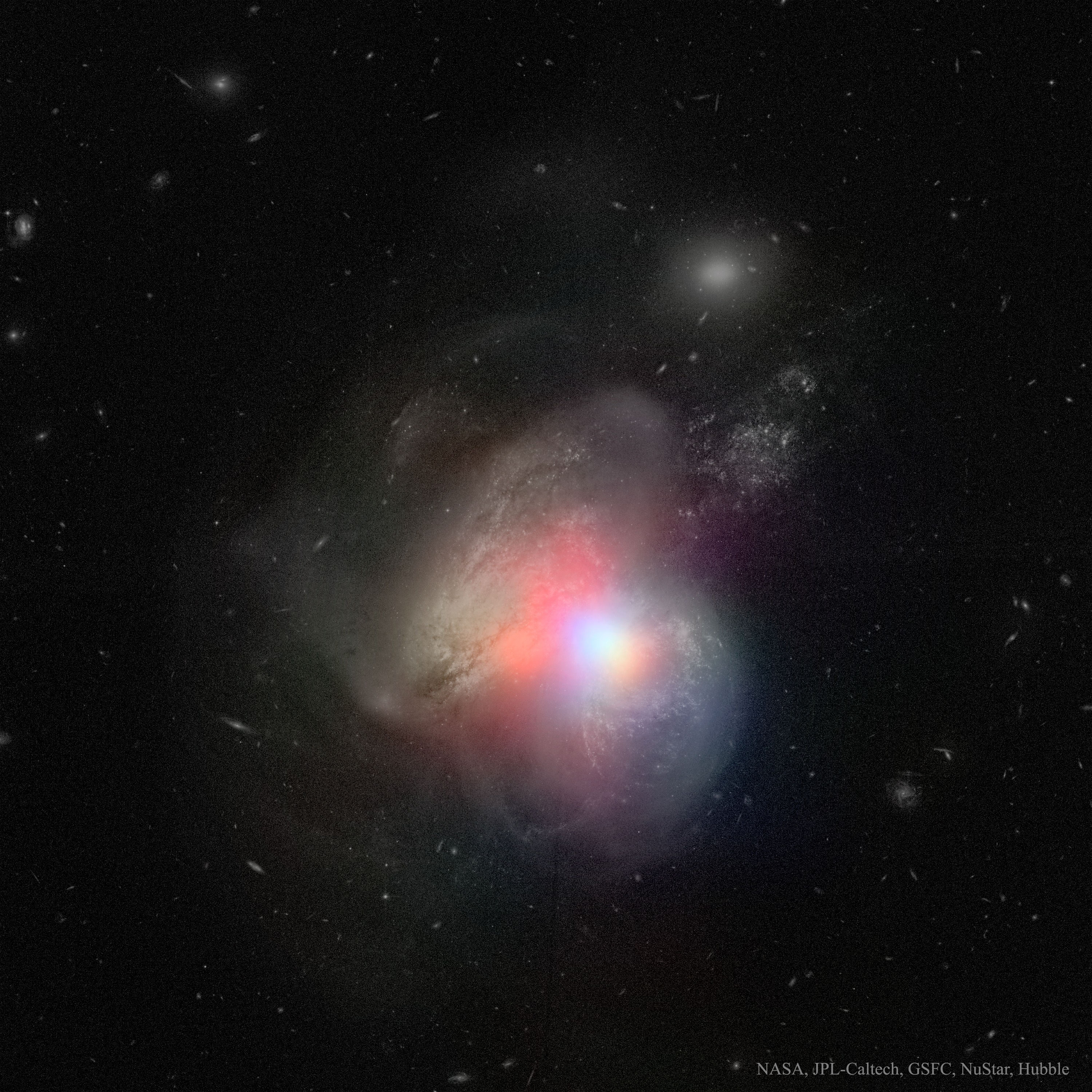
Explanation: Is only one black hole spewing high energy radiation -- or two? To help find out, astronomers trained NASA's Earth-orbiting NuSTAR and Chandra telescopes on Arp 299, the enigmatic colliding galaxies expelling the radiation. The two galaxies of Arp 299 have been locked in a gravitational combat for millions of years, while their central black holes will soon do battle themselves. Featured, the high-resolution visible-light image was taken byHubble, while the superposed diffuse glow of X-ray light was imaged by NuSTAR and shown in false-color red, green, and blue. NuSTAR observations show that only one of the central black holes is seen fighting its way through a region of gas and dust -- and so absorbing matter and emitting X-rays. The energetic radiation, coming only from the galaxy center on the right, is surely created nearby -- but outside -- the central black hole's event horizon. In a billion years or so, only one composite galaxy will remain, and only one central supermassive black hole. Soon thereafter, though, another galaxy may enter the fray.
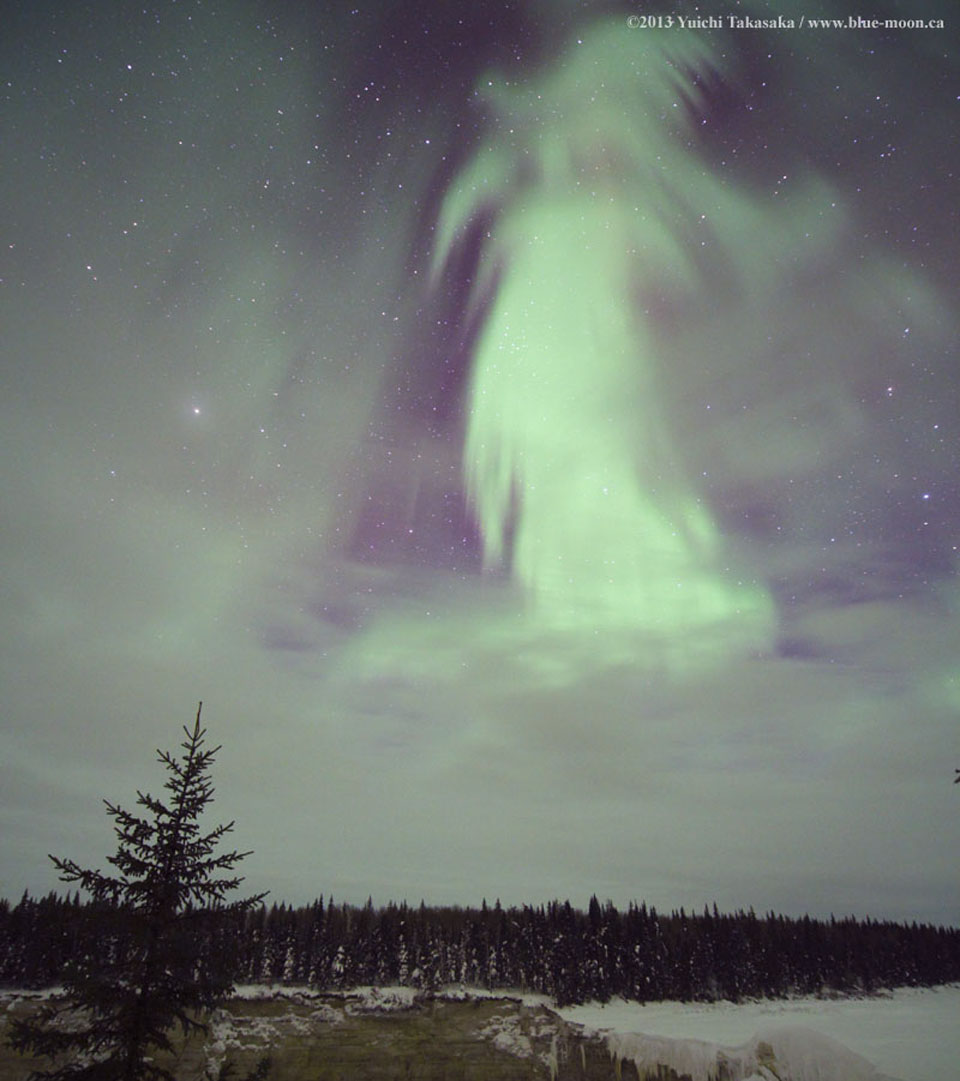
Ghost Aurora over Canada Image Credit & Copyright: Yuichi Takasaka
Explanation: What does this aurora look like to you? While braving the cold to watch the skies above northern Canada early one morning in 2013, a most unusual aurora appeared. The aurora definitely appeared to be shaped likesomething , but what? Two ghostly possibilities recorded by the astrophotographer were "witch" and "goddess of dawn", but please feel free to suggest your own Halloween-enhanced impressions. Regardless of fantastical pareidolicinterpretations, the pictured aurora had a typical green color and was surely caused by the scientifically commonplace action of high energy particles from space interacting with oxygen in Earth's upper atmosphere. In the image foreground, at the bottom, is a frozen Alexandra Falls, while evergreen trees cross the middle.