"Do fundo da alma"
2017-01-19

Astronomy picture of the day - 2017 January 19 - The Elephant's Trunk Nebula in Cepheus
GB-finalLeshin2048.jpg)
Image Credit & Copyright: Stephen Leshin
Explanation: Like an illustration in a galactic Just So Story, the Elephant's Trunk Nebula winds through the emission nebula and young star cluster complex IC 1396, in the high and far off constellation of Cepheus. Also known as vdB 142, the cosmic elephant's trunk is over 20 light-years long. This colorful close-up view includes image data from a narrow band filter that transmits the light from ionized hydrogen atoms in the region. The resulting composite highlights the bright swept-back ridges that outline pockets of cool interstellar dust and gas. Such embedded, dark, tendril-shaped clouds contain the raw material for star formation and hide protostars within. Nearly 3,000 light-years distant, the relatively faint IC 1396 complex covers a large region on the sky, spanning over 5 degrees. This dramatic scene spans a 1 degree wide field, about the size of 2 Full Moons.
2017-01-18
Expressões populares portuguesas - Fila Indiana
 Significado:
Enfiada de pessoas ou coisas dispostas uma após outra.
Origem:
Forma de caminhar dos índios da América que, deste modo, tapavam as pegadas dos que iam na frente.
Astronomy picture of the day - 2017 January 18 - Space Station Vista: Planet and Galaxy
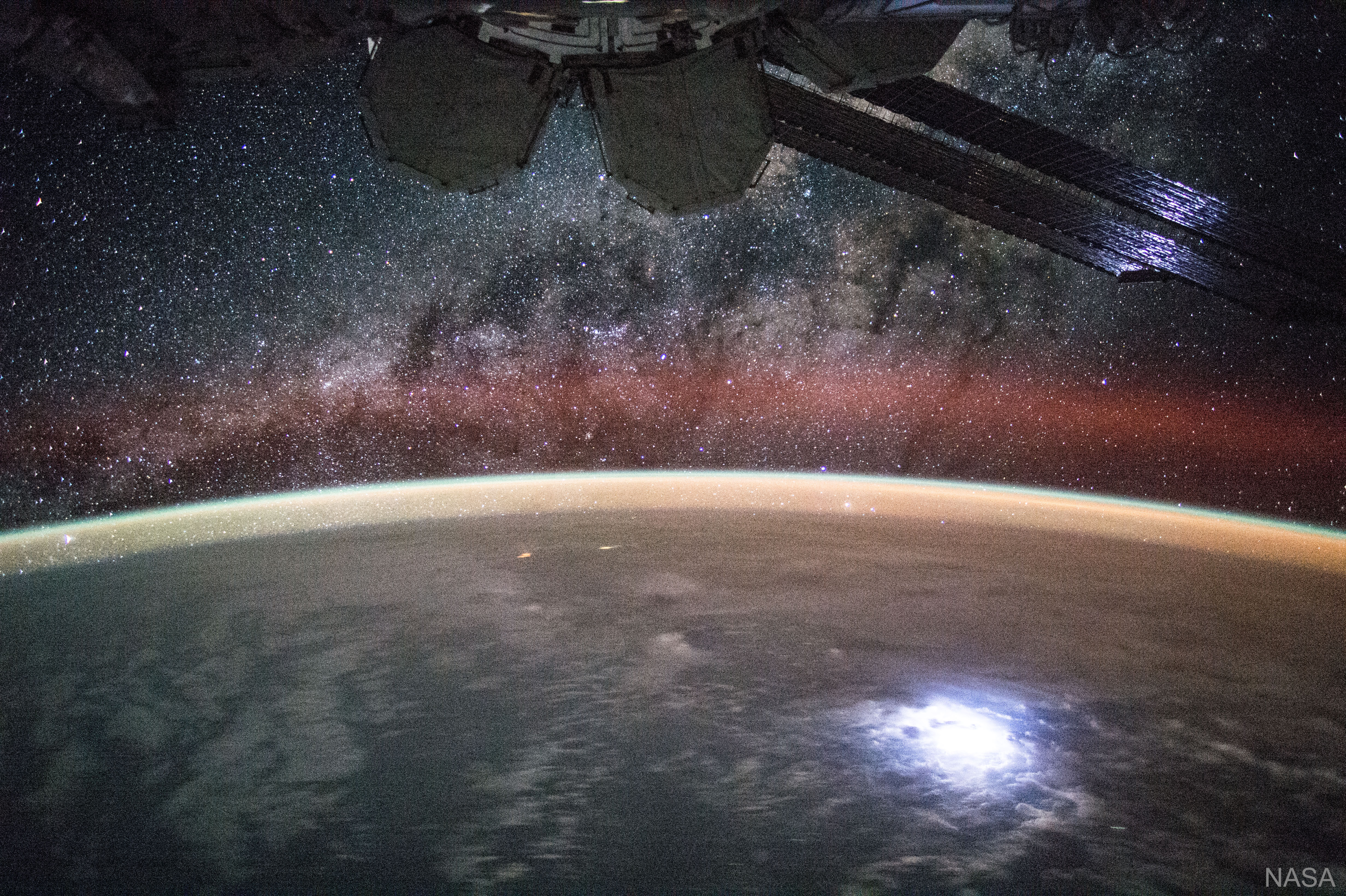
Image Credit: NASA, JSC, ESRS
Explanation: If you could circle the Earth aboard the International Space Station, what might you see? Some amazing vistas, one of which was captured in this breathtaking picture in mid-2015. First, visible at the top, are parts of thespace station itself including solar panels. Just below the station is the band of our Milky Way Galaxy, glowing with the combined light of billions of stars, but dimmed in patches by filaments of dark dust. The band of red light just below the Milky Way is airglow -- Earth's atmosphere excited by the Sun and glowing in specific colors of light. Green airglow is visible below the red. Of course that's our Earth below its air, with the terminator between day and night visible near the horizon. As clouds speckle the planet, illumination from a bright lightning bolt is seen toward the lower right. Between work assignments, astronauts from all over the Earth have been enjoying vistas like this from the space station since the year 2000.
2017-01-17
Astronomy picture of the day - 2017 January 17 - Fly Me to the Moon
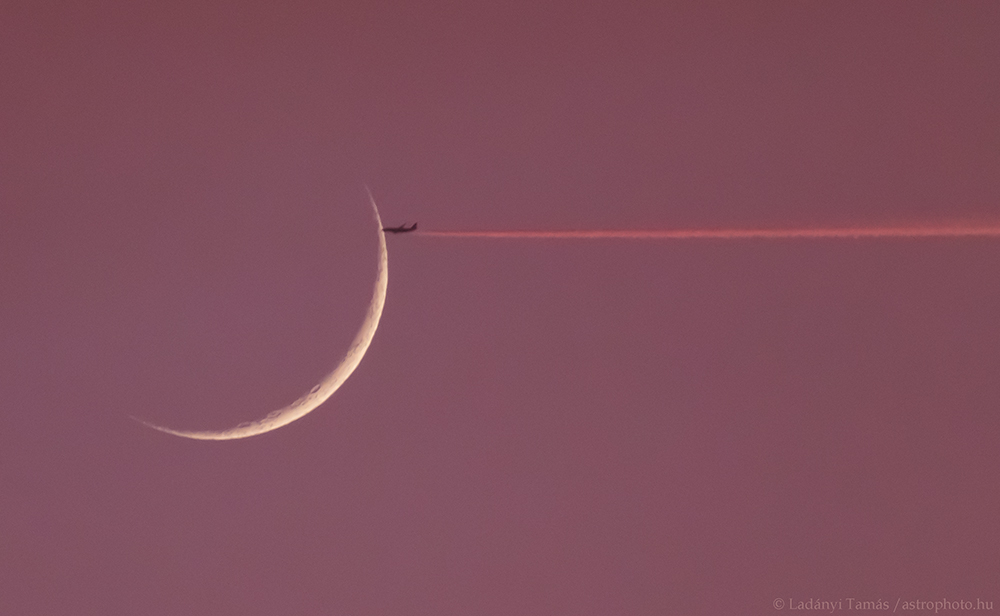
Image Credit & Copyright: Tamas Ladanyi (TWAN)
Explanation: No, this is not a good way to get to the Moon. What is pictured is a chance superposition of an airplane and the Moon. The contrail would normally appear white, but the large volume of air toward the setting Sun preferentially knocks away blue light, giving the reflected trail a bright red hue. Far in the distance, to the right of the plane, is the young Moon. This vast world shows only a sliver of itself because the Sun is nearly lined up behind it. Captured two weeks ago, the featured image was framed by an eerie maroon sky, too far from day to be blue, too far from night to be black. Within minutes the impromptu sky show ended. The plane crossed the Moon. The contrail dispersed. The Sun set. The Moon set. The sky faded to black, only to reveal thousands of stars that had been too faint to see through the rustic red din.
2017-01-16
Expressões populares portuguesas - Andar à toa

Significado:
Andar sem destino, despreocupado, passando o tempo.
Origem:
Toa é a corda com que uma embarcação reboca a outra. Um navio que está "à toa" é o que não tem
leme nem rumo, indo para onde o navio que o reboca determinar.


Astronomy picture of the day - 2017 January 16 - Geostationary Highway through Orion
Image Credit & Copyright: James A. DeYoung
Explanation: Put a satellite in a circular orbit about 42,000 kilometers from the center of the Earth and it will orbit once in 24 hours. Because that matches Earth's rotation period, it is known as a geosynchronous orbit. If that orbit is also in the plane of the equator, the satellite will hang in the sky over a fixed location in a geostationary orbit. As predicted in the 1940s by futurist Arthur C. Clarke, geostationary orbits are in common use for communication and weather satellites, a scenario now well-known to astroimagers. Deep images of the night sky made with telescopes that follow the stars can also pick up geostationary satellites glinting in sunlight still shining far above the Earth's surface. Because they all move with the Earth's rotation against the background of stars, the satellites leave trails that seem to follow a highway across the celestial landscape. The phenomenon was captured last month in this video showingseveral satellites in geostationary orbit crossing the famous Orion Nebula.
2017-01-15
Expressões populares portuguesas - Embandeirar em arco
Significado: Manifestação efusiva de alegria.

Origem: Na Marinha, em dias de gala ou simplesmente festivos, os navios embandeiram em arco, isto é, içam pelas adriças ou cabos (vergueiros) de embandeiramento galhardetes, bandeiras e cometas quase até ao topo dos mastros, indo um dos seus extremos para a proa e outro para a popa. Assim são assinalados esses dias de regozijo ou se saúdam outros barcos que se manifestam da mesma forma.
Inscription à :
Articles (Atom)