2017-03-26

Texto - Carta aberta ao Senhor Provedor da RTPI:

Senhor Provedor da PTPT (Pobre Televisão Para Tugas),

Dirijo esta mensagem a V. Exa. na minha qualidade de Português no Estrangeiro e, também como Vice-Cônsul de Portugal.

Já há muito venho denunciando certo reclame difundido pelo canal RTPI…

Sem qualquer resultado posto que aquele canal televisivo insiste em difundir uma publicidade tão caricata que se torna motivo de chacota de indígenas franceses relativamente aos “tugas” emigrados…

Bem sabemos que a comunicação social depende, também, dos anúncios para sobreviver; mas franca e foneticamente “Lé Zal dû Portougal” é, como dizem os nossos irmãos “brazucas”, “djimaisss”!

…Sendo que em francês correcto (e foneticamente também) deve pronunciar-se “Lé alle du Portugal”!

Bem sabemos que a lusa televisão precisa do “carcanhol” dos anunciantes; mas por favor ponha ordem nessa gente e, sobretudo, a bem falar na língua do Pais onde vivem ...

Também poderia referir, Senhor Provedor, a “Agência funerária Dias”; outro "monumento" da lingua tuga emigrada...mas fica para outra ocasião, pois que neste momento nem sequer jeito tenho para gracejolas...

Entretanto peço-lhe não aceite mais esse tipo de publicidade que seria, porventura, cómica se não ofendesse os Portugueses residentes fora de Portugal. Agradeço.

Amigo “Cara do Corcovado”, diz-lhes tudo isto ; eles a mim não me ouvem…

Bordeaux, 26 de março de 2016

JoanMira

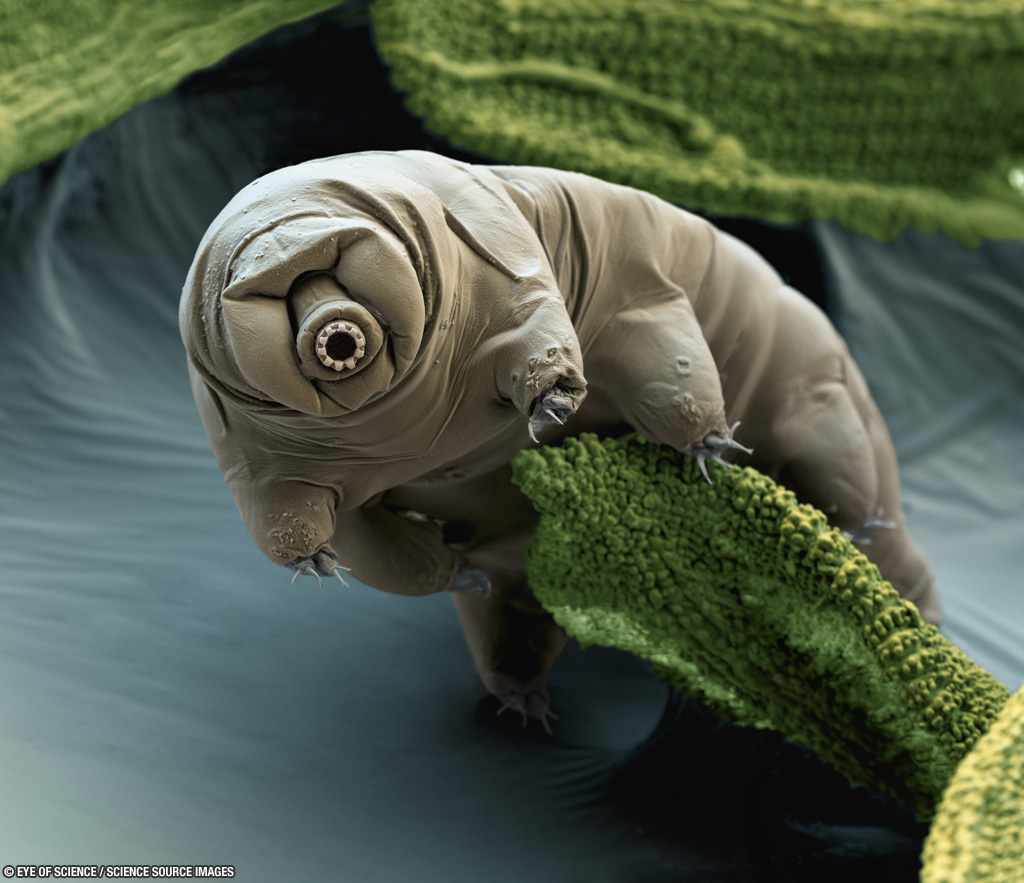
Astronomy picture of the day - 2017 March 26 - Tardigrade in Moss

See Explanation.  Clicking on the picture will download
 the highest resolution version available.
Tardigrade in Moss 
Image Credit & Copyright: Nicole Ottawa & Oliver Meckes / Eye of Science / Science Source Images
Explanation: Is this an alien? Probably not, but of all the animals on Earth, the tardigrade might be the best candidate. That's because tardigrades are known to be able to go for decades without food or water, to survive temperatures from near absolute zero to well above the boiling point of water, to survive pressures from near zero to well above that on ocean floors, and to survive direct exposure to dangerous radiations. The far-ranging survivability of theseextremophiles was tested in 2011 outside an orbiting space shuttle. Tardigrades are so durable partly because they can repair their own DNA and reduce their body water content to a few percent. Some of these miniature water-bearsalmost became extraterrestrials recently when they were launched toward to the Martian moon Phobos on board the Russian mission Fobos-Grunt, but stayed terrestrial when a rocket failed and the capsule remained in Earth orbit.Tardigrades are more common than humans across most of the Earth. Pictured here in a color-enhanced electron micrograph, a millimeter-long tardigrade crawls on moss.

2017-03-25

Expressões populares portuguesas - "Sangria desatada"


Significado: 

Diz-se de qualquer coisa que requer uma solução ou realização imediata.

Origem:

Esta expressão, julga-se, teve origem nas guerras, onde se verificava a necessidade de cautelas acrescidas a ter com os soldados sangrados. É que, se por qualquer motivo, se desprendesse a atadura posta sobre as feridas, a morte sobreviria inevitavelmente se não lhe acudissem a tempo, visto dar-se uma perda de sangue fatal.

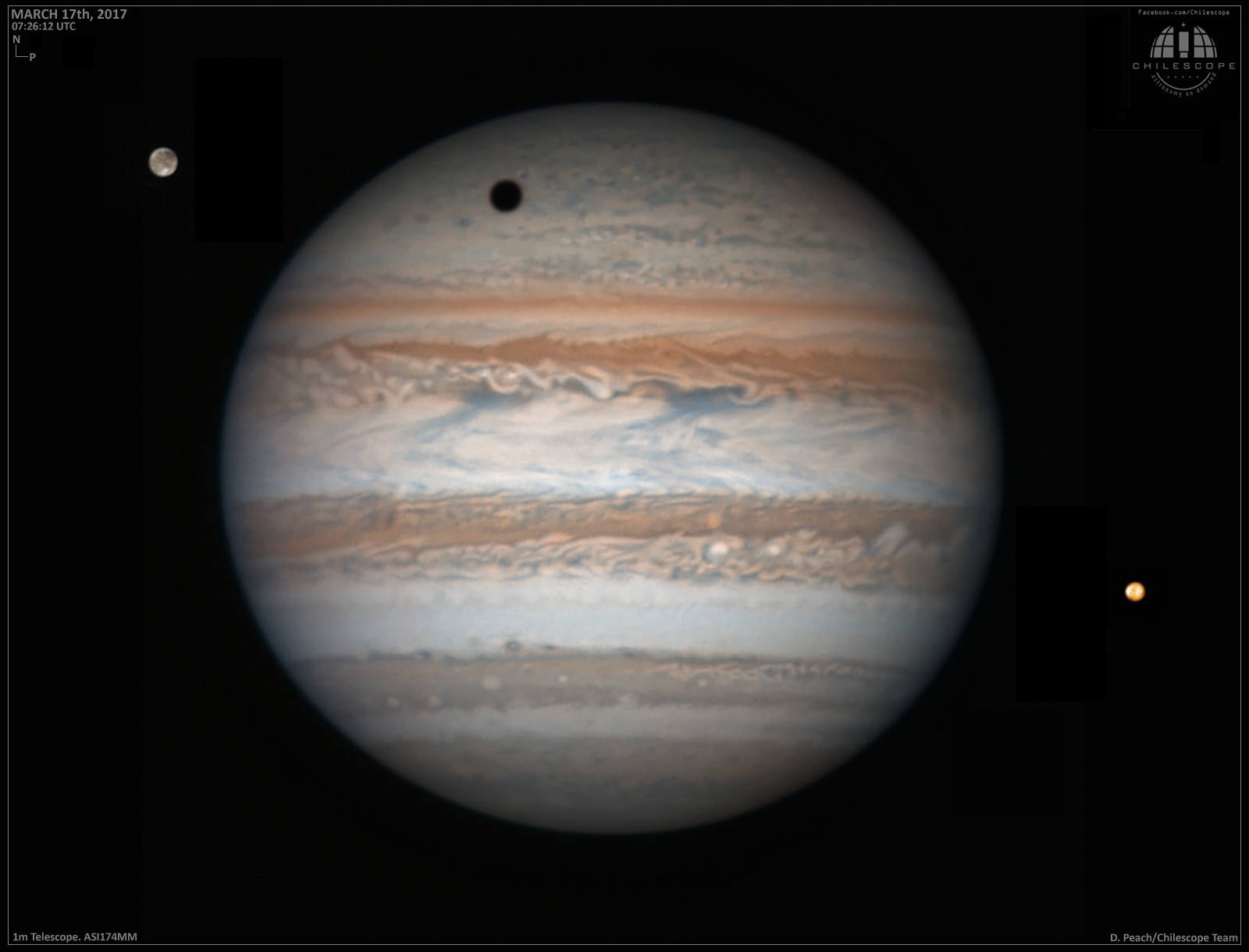
Astronomy picture of the day - 2017 March 25 - Ganymede's Shadow

See Explanation.  Clicking on the picture will download
 the highest resolution version available.
Ganymede's Shadow 
Image Credit & CopyrightDamian PeachChilescope


Explanation: Approaching opposition early next month, Jupiter is offering some of its best telescopic views from planet Earth. On March 17, this impressively sharp image of the solar system's ruling gas giant was taken from a remote observatory in Chile. Bounded by planet girdling winds, familiar dark belts and light zones span the giant planet spotted with rotating oval storms. The solar system's largest moon Ganymede is above and left in the frame, its shadow seen in transit across the northern Jovian cloud tops. Ganymede itself is seen in remarkable detail along with bright surface features on fellow Galilean moon Io, right of Jupiter's looming disk.

2017-03-24

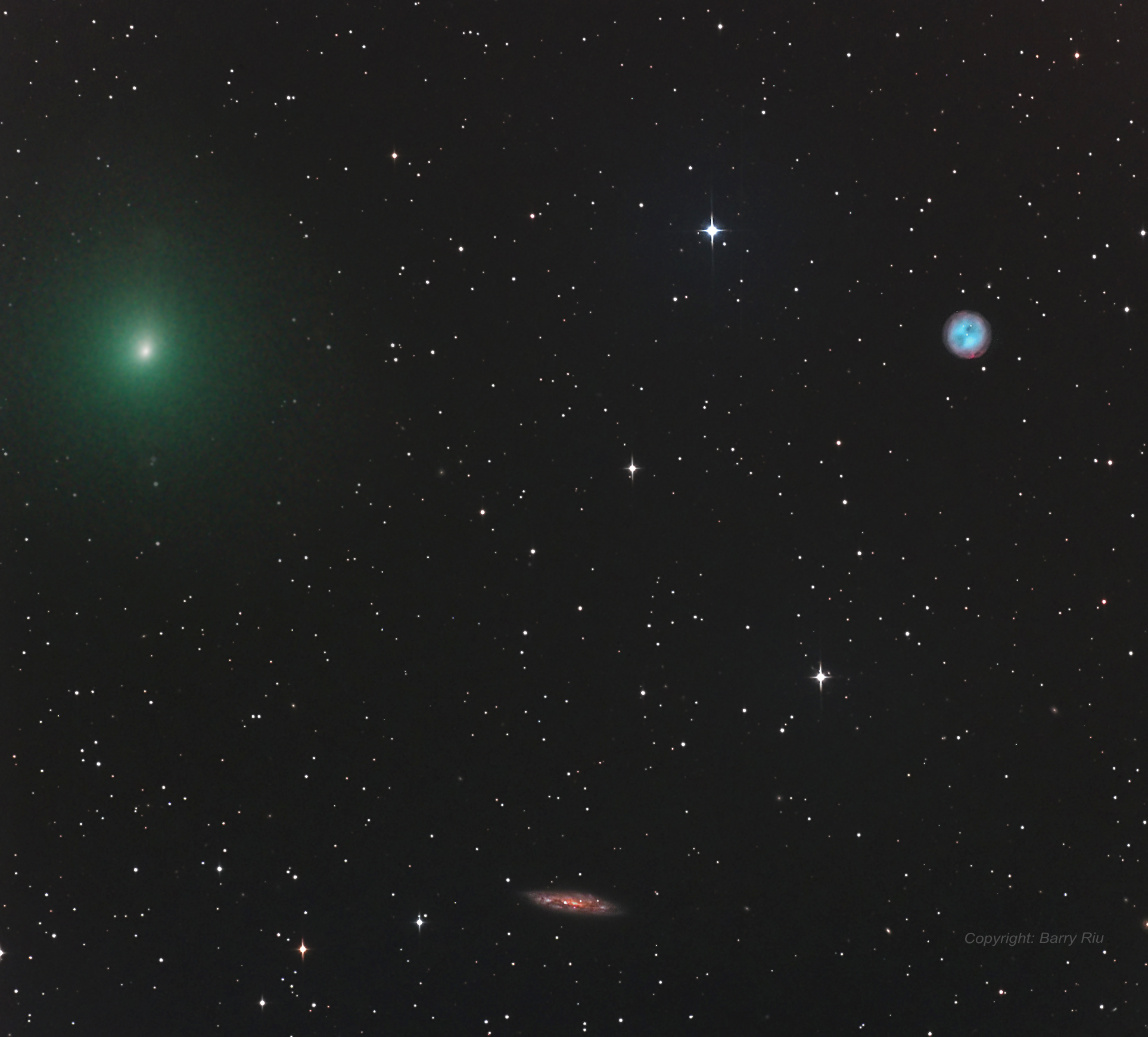
Astronomy picture of the day - 2017 March 24 - The Comet, the Owl, and the Galaxy

See Explanation.  Clicking on the picture will download
 the highest resolution version available.
The Comet, the Owl, and the Galaxy 
Image Credit & CopyrightBarry Riu


Explanation: Comet 41P/Tuttle-Giacobini-Kresak poses for a Messier moment in this telescopic snapshot from March 21. In fact it shares the 1 degree wide field-of-view with two well-known entries in the 18th century comet-hunting astronomer's famous catalog. Sweeping through northern springtime skies just below the Big Dipper, the faint greenish comet was about 75 light-seconds from our fair planet. Dusty, edge-on spiral galaxy Messier 108 (bottom center) is more like 45 million light-years away. At upper right, the planetary nebula with an aging but intensely hot central star, the owlish Messier 97 is only about 12 thousand light-years distant though, still well within our own Milky Way galaxy. Named for its discoverer and re-discoverers, this faint periodic comet was first sighted in 1858 and not again until 1907 and 1951. Matching orbit calculations indicated that the same comet had been observed at widely separated times. Nearing its best apparition and closest approach to Earth in over 100 years on April 1, comet 41P orbits the Sun with a period of about 5.4 years.

2017-03-23

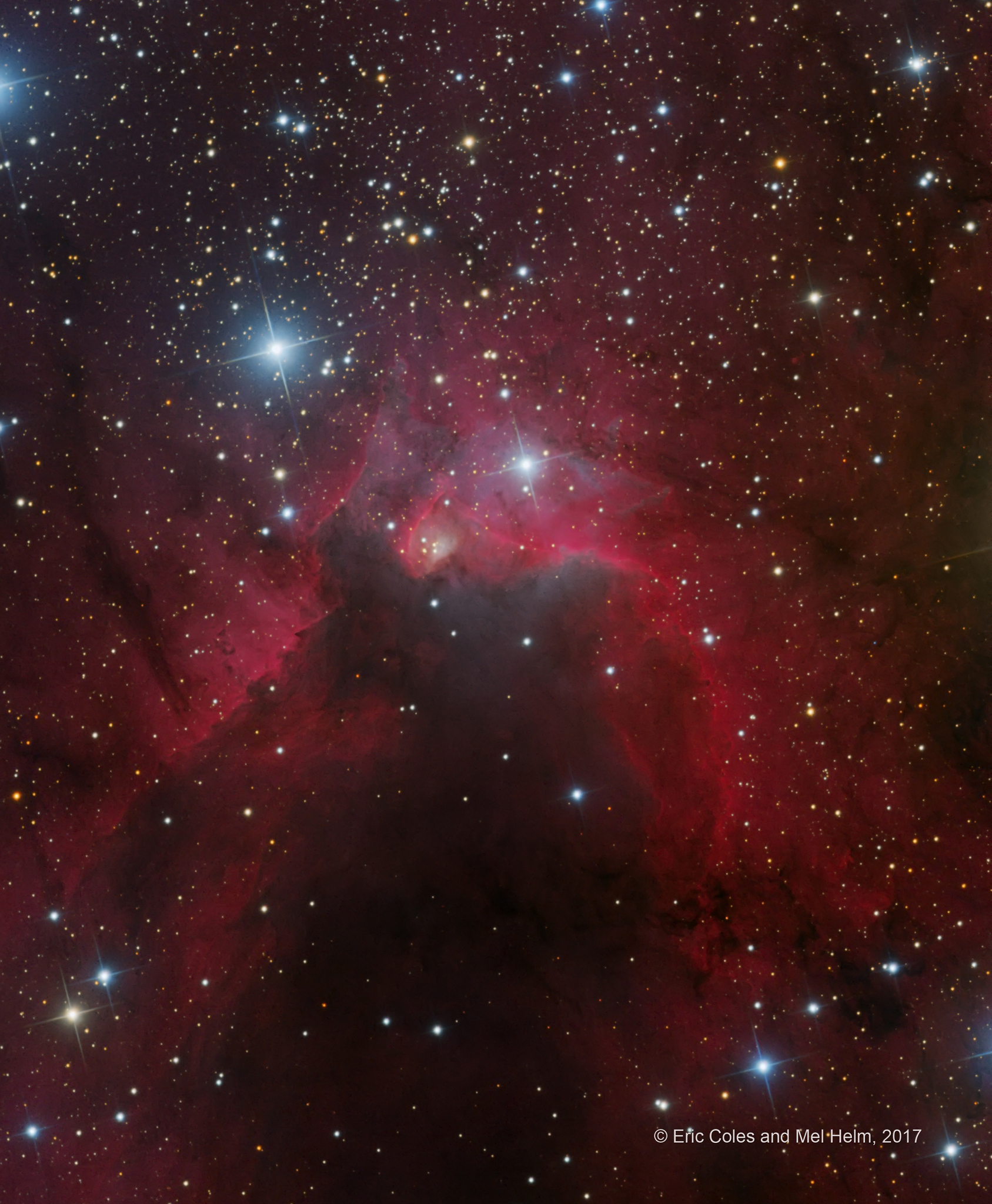
Astronomy picture of the day - 2017 March 23 - SH2-155: The Cave Nebula

See Explanation.  Clicking on the picture will download
 the highest resolution version available.
SH2-155: The Cave Nebula 
Image Credit & CopyrightEric Coles and Mel Helm
Explanation: This skyscape features dusty Sharpless catalog emission region Sh2-155, the Cave Nebula. In the telescopic image, data taken through a narrowband filter tracks the reddish glow of ionized hydrogen atoms. About 2,400 light-years away, the scene lies along the plane of our Milky Way Galaxy toward the royal northern constellation of Cepheus. Astronomical explorations of the region reveal that it has formed at the boundary of the massive Cepheus B molecular cloud and the hot, young stars of the Cepheus OB 3 association. The bright rim of ionized hydrogen gas is energized by radiation from the hot stars, dominated by the brightest star above and left of picture center. Radiation driven ionization fronts are likely triggering collapsing cores and new star formation within. Appropriately sized for a stellar nursery, the cosmic cave is over 10 light-years across.

Fotografia - Lisboa nocturna Praça dos Restauradores

01_Estudio_Horacio_Novais_Praca_dos_Restauradores_Lisboa_sem_data_01.jpg
Estúdio Horácio Novais, Praça dos Restauradores, Lisboa, sem data Colecções da Fundação Calouste Gulbenkian, Lisboa, Portugal (Flickr Commons)

2017-03-22

Teresa Salgueiro - "Você e eu" - Video - Musica

Résultat de recherche d'images pour "imagens de Teresa Salgueiro"
"Você e eu"

Astronomy picture of the day - 2017 March 22 - Central Cygnus Skyscape

See Explanation.  Clicking on the picture will download
 the highest resolution version available.
Central Cygnus Skyscape 
Image Credit & CopyrightRobert GendlerDSSBYU
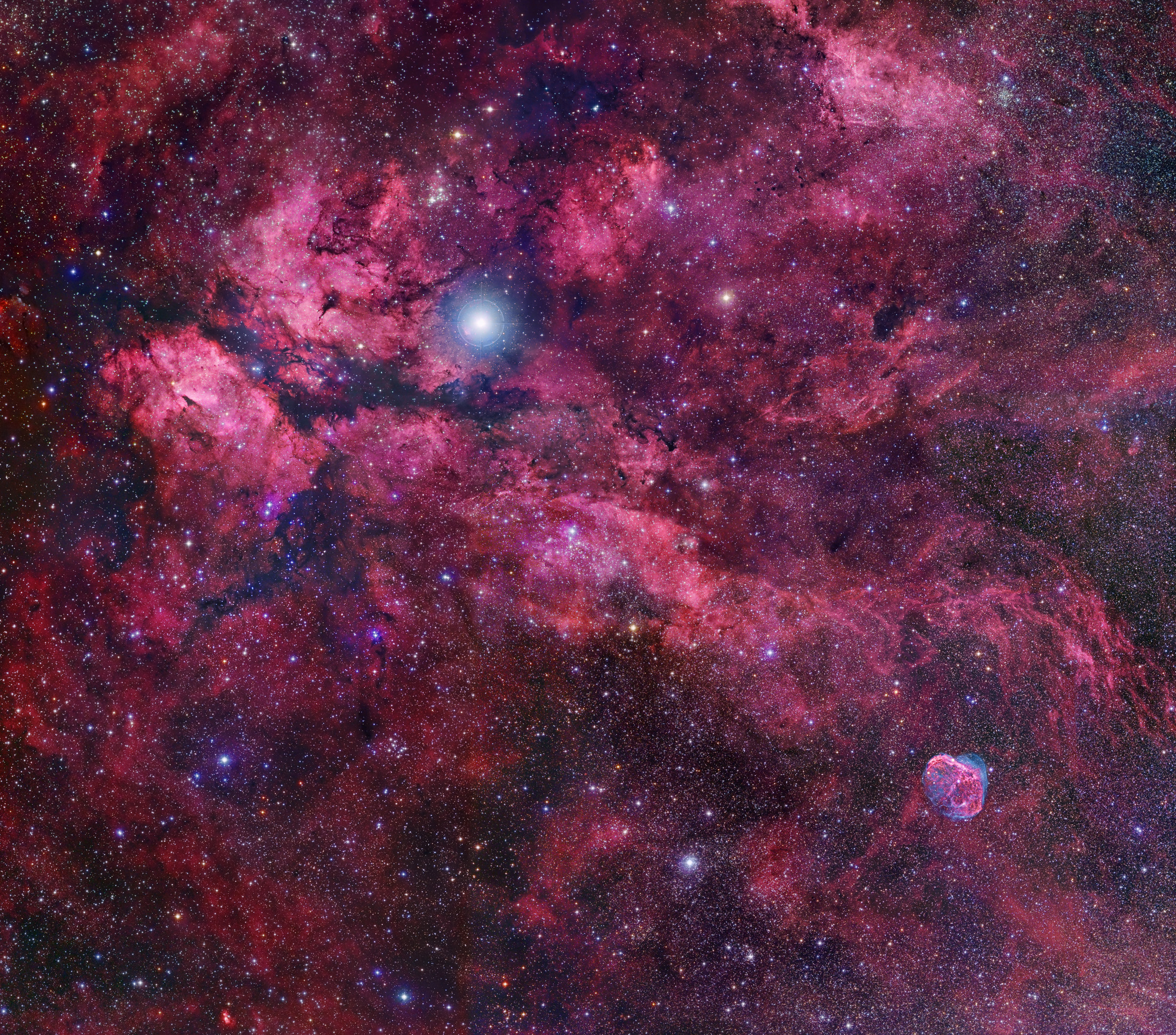
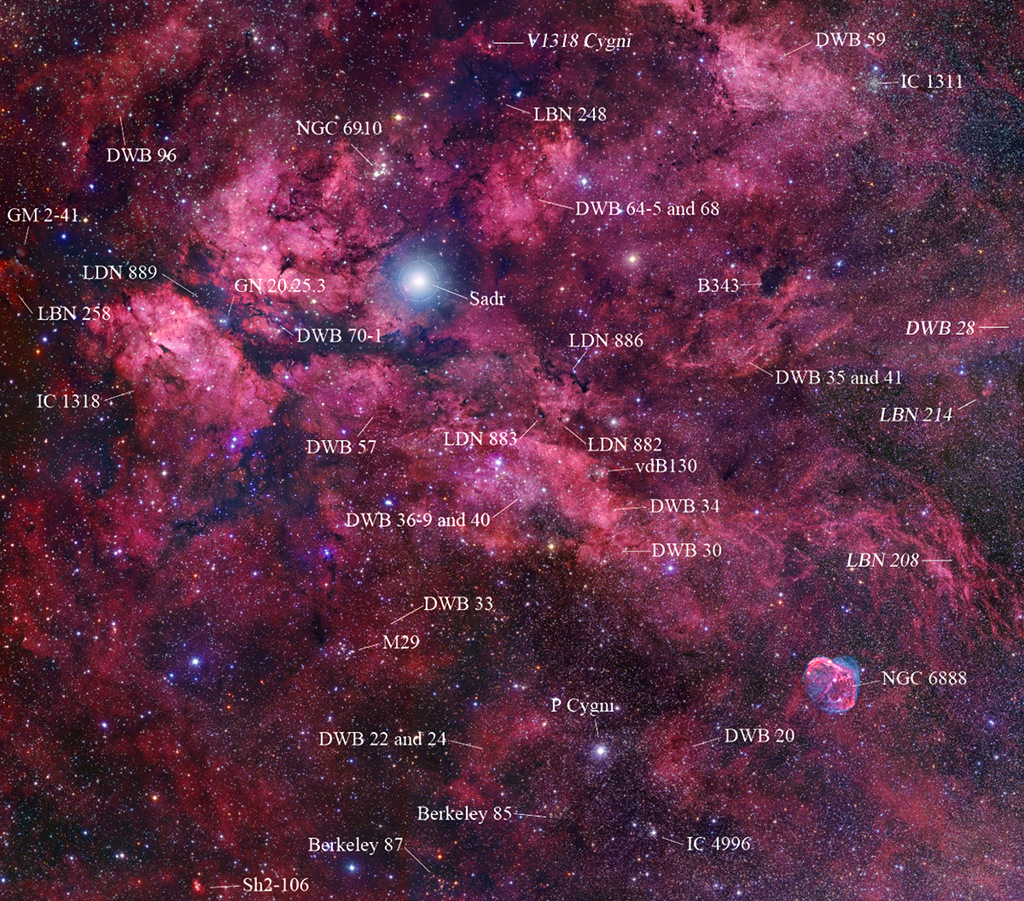
Explanation: In cosmic brush strokes of glowing hydrogen gas, this beautiful skyscape unfolds across the plane of our Milky Way Galaxy near the northern end of the Great Rift and the center of the constellation Cygnus the SwanA 36 panel mosaic of telescopic image data, the scene spans about six degrees. Bright supergiant star Gamma Cygni (Sadr) to the upper left of the image center lies in the foreground of the complex gas and dust clouds and crowded star fields. Left of Gamma Cygni, shaped like two luminous wings divided by a long dark dust lane is IC 1318 whose popular name is understandably the Butterfly Nebula. The more compact, bright nebula at the lower right is NGC 6888, the Crescent Nebula. Some distance estimates for Gamma Cygni place it at around 1,800 light-years while estimates for IC 1318 and NGC 6888 range from 2,000 to 5,000 light-years.

2017-03-21

Astronomy picture of the day - 2017 March 21 - Fast Stars and Rogue Planets in the Orion Nebula

See Explanation.  Clicking on the picture will download
 the highest resolution version available.
Fast Stars and Rogue Planets in the Orion Nebula 
Image Credit: NASAESAHubble
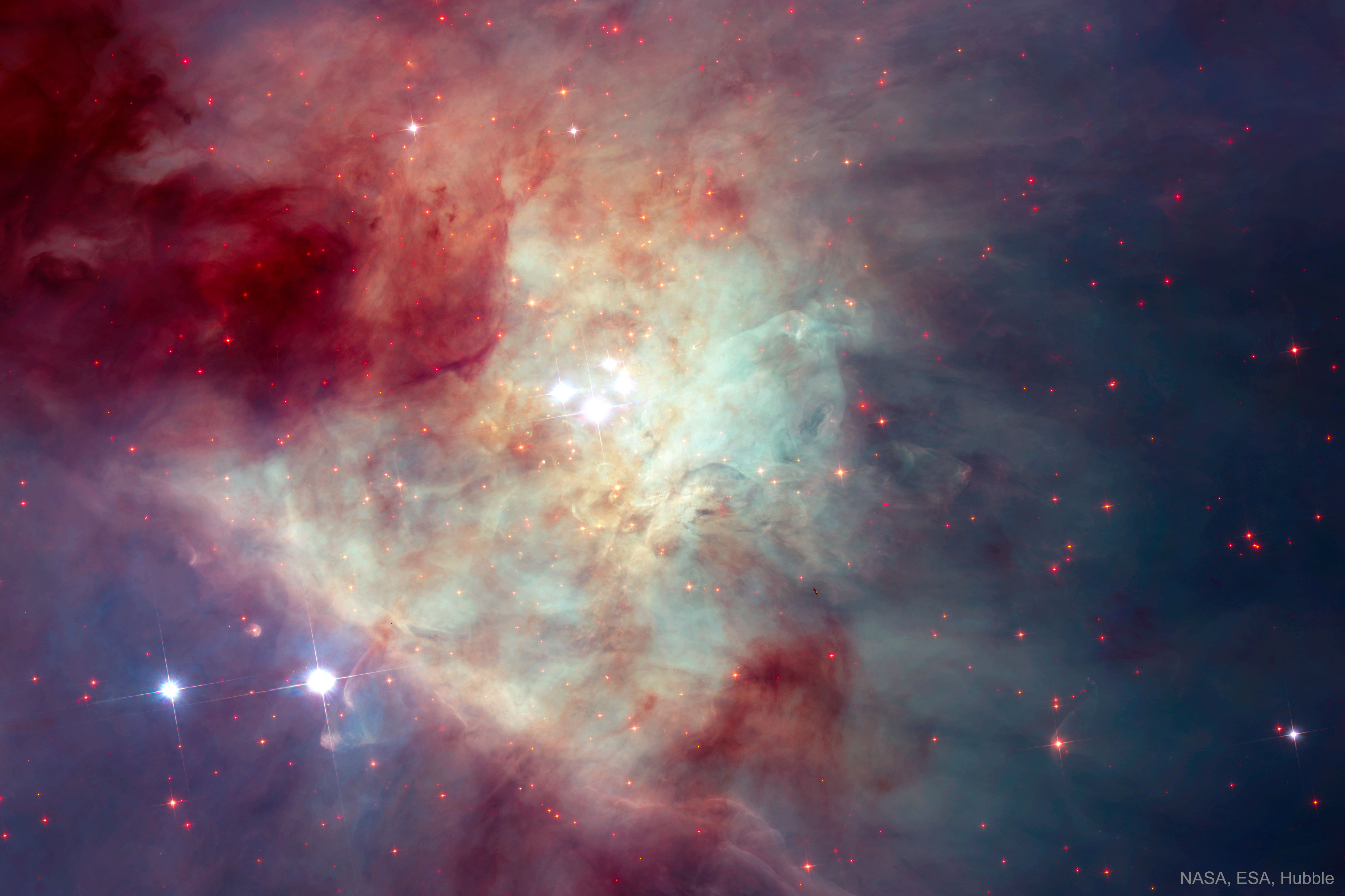
Explanation: Start with the constellation of Orion. Below Orion's belt is a fuzzy area known as the Great Nebula of Orion. In this nebula is a bright star cluster known as the Trapezium, marked by four bright stars near the image center. The newly born stars in the Trapezium and surrounding regions show the Orion Nebula to be one of the most active areas of star formation to be found in our area of the GalaxyIn Orion, supernova explosions and close interactions between stars have created rogue planets and stars that rapidly move through space. Some of these fast stars have been found by comparing different images of this region taken by the Hubble Space Telescope many years apart. Many of the stars in the featured image, taken in visible and near-infrared light, appear unusually red because they are seen through dust that scatters away much of their blue light.