2017-05-08

Astronomy picture of the day - 2017 May 8 - Ancient Ogunquit Beach on Mars

See Explanation. Clicking on the picture will download
 the highest resolution version available.
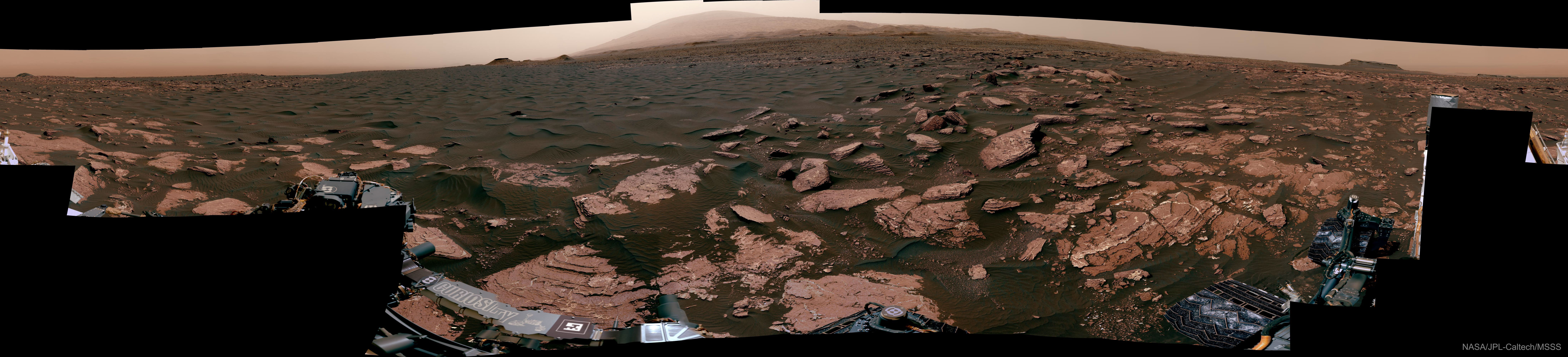
Ancient Ogunquit Beach on Mars 
Image Credit: NASAJPL-CaltechMSSS;
Explanation: This was once a beach -- on ancient Mars. The featured 360-degree panoramahorizontally compressed, was taken by the robotic Curiosity rover currently exploring the red planet. Named Ogunquit Beach after itsterrestrial counterpart, evidence shows that at times long ago the area was underwater, while at other times it was at the edge of an ancient lake. The light peak in the central background is the top of Mount Sharp, the central feature inGale Crater where Curiosity has been deployed. Curiosity is slowly ascending Mount Sharp. Portions of the dark sands in the foreground have been scooped up for analysis. The light colored bedrock is composed of sediment that likely settled at the bottom of the now-dried lakebed. The featured panorama (interactive version here) was created from over 100 images acquired in late March and seemingly signed by the rover on the lower left. Currently, Curiosity is carefully crossing deep megaripples of dark sands on its way to explore Vera Rubin Ridge.

Astronomy picture of the day - 2017 May 7 - Star Formation in the Tadpole Nebula

See Explanation. Clicking on the picture will download
 the highest resolution version available.
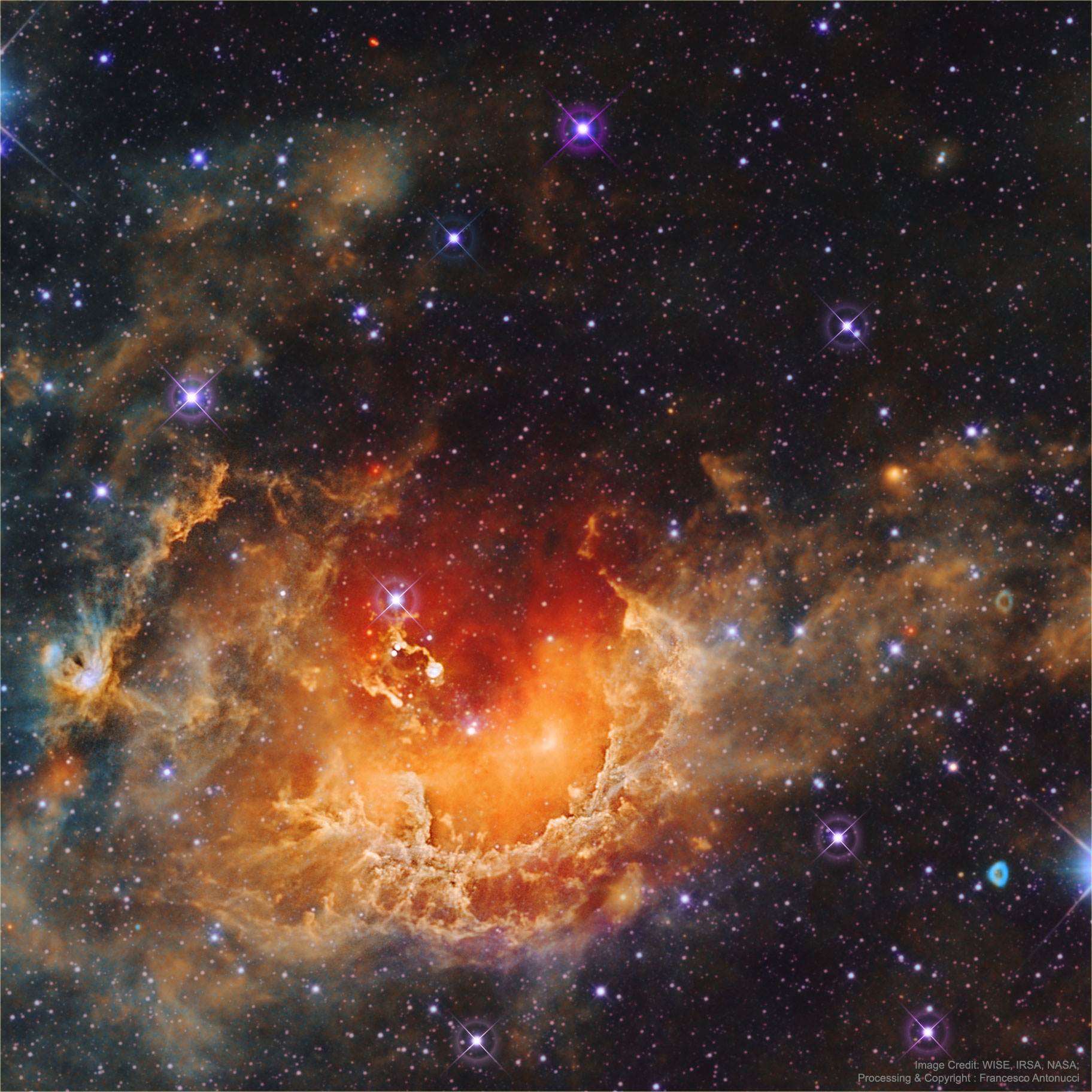
Star Formation in the Tadpole Nebula 
Image Credit: WISEIRSANASAProcessing & CopyrightFrancesco Antonucci
Explanation: What's all of the commotion in the Tadpole nebula? Star formation. Dusty emission in the Tadpole nebula, IC 410, lies about 12,000 light-years away in the northern constellation of the Charioteer (Auriga). The cloud of glowing gas is over 100 light-years across, sculpted by stellar winds and radiation from embedded open star cluster NGC 1893Formed in the interstellar cloud a mere 4 million years ago, bright newly formed cluster stars are seen all around the star-forming nebula. Notable near the image center are two relatively dense streamers of material trailing away from the nebula's central regions. Potentially sites of ongoing star formation in IC 410, these cosmic tadpoleshapes are about 10 light-years long. The featured image was taken in infrared light by NASA's Wide Field Infrared Survey Explorer (WISE) satellite.

2017-05-06

Astronomy picture of the day - 2017 May 6 - Galaxy Cluster Abell 370 and Beyond

See Explanation.  Clicking on the picture will download
 the highest resolution version available.
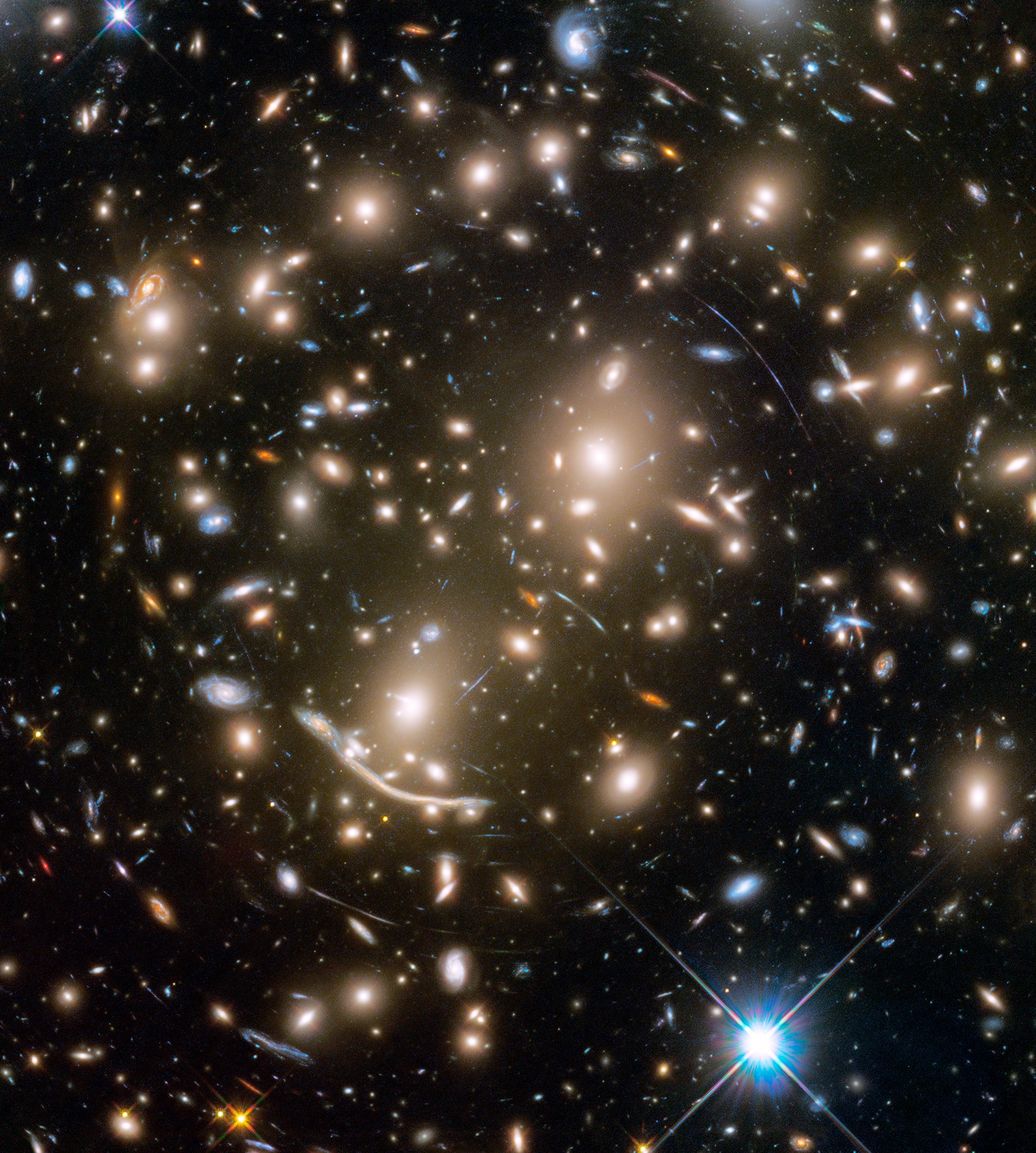
Galaxy Cluster Abell 370 and Beyond 
Image Credit: NASAESA, Jennifer Lotz and the HFF Team (STScI)

Explanation: Some 4 billion light-years away, massive galaxy cluster Abell 370 only appears to be dominated by two giant elliptical galaxies and infested with faint arcs in this sharp Hubble Space Telescope snapshot. The fainter, scattered bluish arcs along with the dramatic dragon arc below and left of center are images of galaxies that lie far beyond Abell 370. About twice as distant, their otherwise undetected light is magnified and distorted by the cluster's enormous gravitational mass, dominated by unseen dark matter. Providing a tantalizing glimpse of galaxies in the early universe, the effect is known as gravitational lensing. A consequence of warped spacetime it was first predicted by Einstein a century ago. Far beyond the spiky foreground Milky Way star at lower right, Abell 370 is seen toward the constellation Cetus, the Sea Monster. It is the last of six galaxy clusters imaged in the recently concluded Frontier Fields project.

2017-05-05

Billy Preston - "You can't beat God giving" - Video - Music - Live

Résultat de recherche d'images pour "imagens de Billy Preston"
"You can't beat God giving"

Astronomy picture of the day - 2017 May 5 - The Bull's Eye and the Young Moon

See Explanation.  Clicking on the picture will download
 the highest resolution version available.
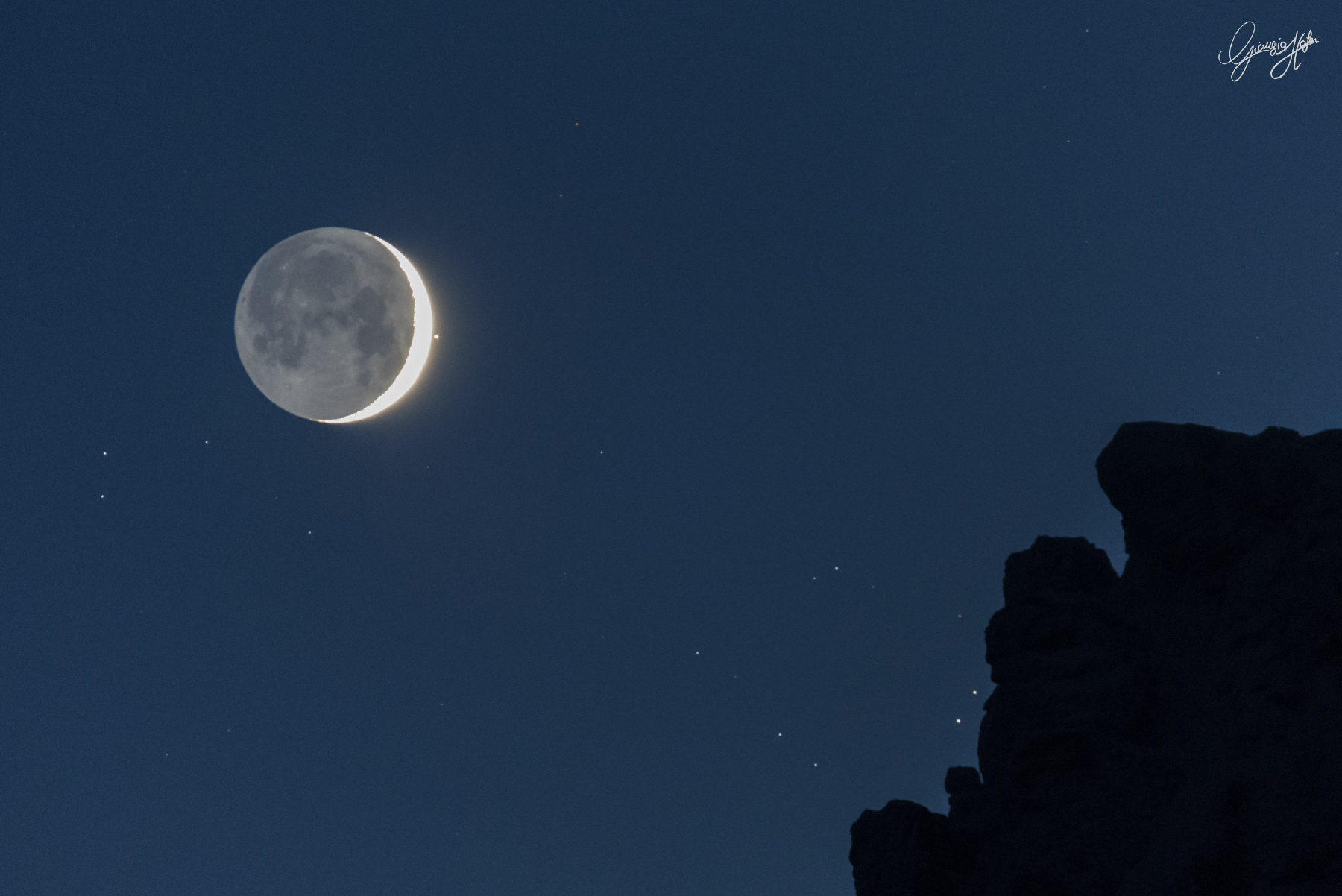
The Bull's Eye and the Young Moon 
Image Credit & CopyrightGiorgia Hofer
Explanation: Aldebaran, eye of Taurus the Bull, and a young crescent Moon shared an early evening sky last Friday. The lovely celestial pairing could be enjoyed around planet Earth, but from some locations the Moon was even seen to pass in front of Aldebaran, a dramatic lunar occultation of the familiar bright star. Taken at nightfall on April 28, this skyscape captures Aldebaran shortly after it emerged from behind the bright lunar limb. In the foreground are craggy peaks of the Dolomite mountains near Laggio di Cadore, Italy. Before reappearing beyond the sunlit crescent, Aldebaran first winked out behind the Moon's ashen glow, the lunar nightside faintly illuminated by earthshine.

2017-05-04

Astronomy picture of the day - 2017 May 4 - 2017 May 4

See Explanation.  Clicking on the picture will download
 the highest resolution version available.
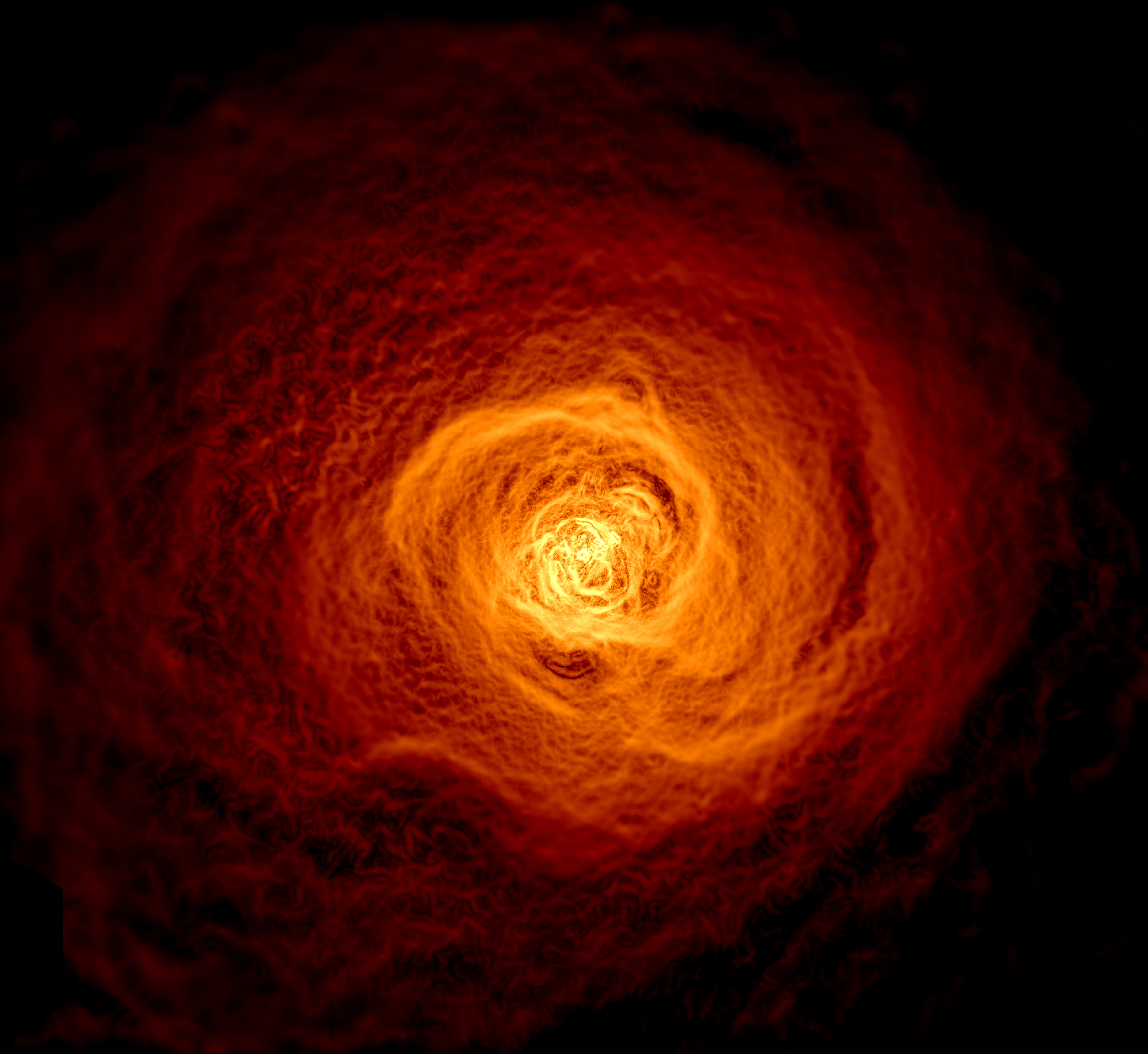
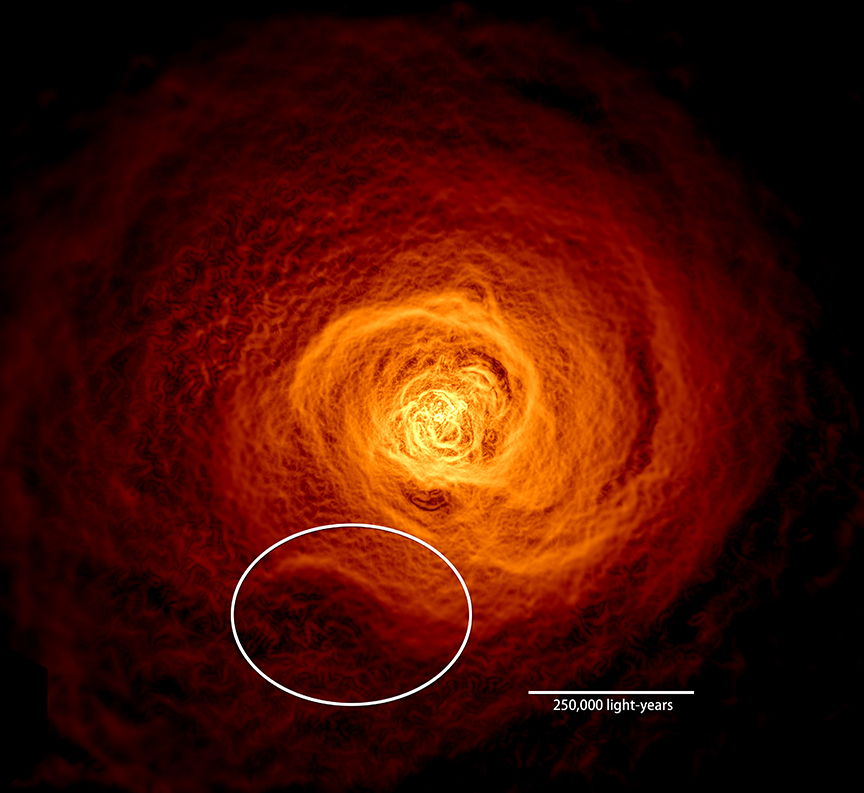
The Perseus Cluster Waves 
Image Credit: NASACXCGSFCStephen Walker, et al.
Explanation: The cosmic swirl and slosh of giant waves in an enormous reservoir of glowing hot gas are traced in this enhanced X-ray image from the Chandra Observatory. The frame spans over 1 million light-years across the center of the nearby Perseus Galaxy Cluster, some 240 million light-years distant. Like other clusters of galaxies, most of the observable mass in the Perseus cluster is in the form of the cluster-filling gas. With temperatures in the tens of millions of degrees, the gas glows brightly in X-rays. Computer simulations can reproduce details of the structures sloshing through the Perseus cluster's X-ray hot gas, including the remarkable concave bay seen below and left of center. About 200,000 light-years across, twice the size of the Milky Way, the bay's formation indicates that Perseus itself was likely grazed by a smaller galaxy cluster billions of years ago.

2017-05-03

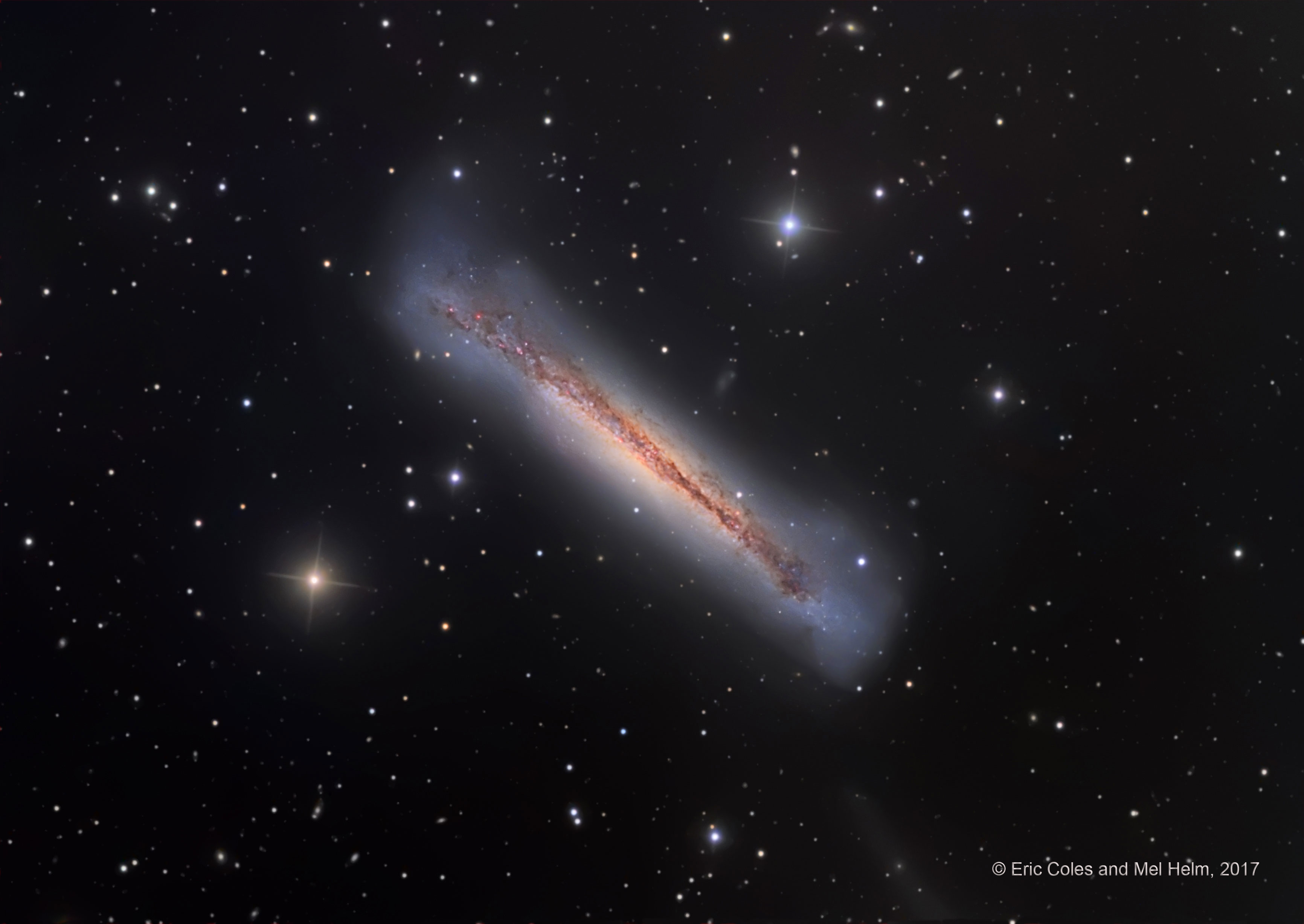
Astronomy picture of the day - 2017 May 3 - NGC 3628: The Hamburger Galaxy

See Explanation.  Clicking on the picture will download
 the highest resolution version available.
NGC 3628: The Hamburger Galaxy 
Image Credit & CopyrightEric Coles and Mel Helm
Explanation: No, hamburgers are not this big. What is pictured is a sharp telescopic views of a magnificent edge-on spiral galaxy NGC 3628 show a puffy galactic disk divided by dark dust lanes. Of course, this deep galactic portraitputs some astronomers in mind of its popular moniker, The Hamburger Galaxy. The tantalizing island universe is about 100,000 light-years across and 35 million light-years away in the northern springtime constellation Leo. NGC 3628shares its neighborhood in the local Universe with two other large spirals M65 and M66 in a grouping otherwise known as the Leo Triplet. Gravitational interactions with its cosmic neighbors are likely responsible for the extended flare and warp of this spiral's disk.

2017-05-02

Sting - "Whenever I say your love" - Video - Music

"Whenever I say your love"

Fotos - "Vista chinesa - Tijuca" (Rio de Janeiro)

"Vista chinesa - Tijuca"

15-03-2012
JoanMira

Astronomy picture of the day - 2017 May 2 - Approach above Sunset

See Explanation. Clicking on the picture will download
 the highest resolution version available.
Approach above Sunset 
Image Credit: ESANASA
Explanation: There it is! The Cygnus supply ship was a welcome sight to the astronauts on the International Space Station just over a week ago. Launched three days before on a United Launch Alliance Atlas V from Cape Canaveral, Florida, the Orbital ATK's Cygnus spacecraft approached the International Space Station above the backdrop of a picturesque planet Earth. The Sun was setting off the image to the upper left, illuminating clouds well below the approaching vehicle. The robotic Cygnus spacecraft was captured first on camera and later with the space station's Canadarm2 by ESA's Flight Engineer Thomas Pesquet and NASA's Expedition-51 Commander Peggy Whitson. Commander Whitson, a biochemist, has now set a new American record for the most total days in space. Besides essentials, the Cygnus carried equipment to bolster over 200 science experiments being conducted on the football-field sized Earth-orbiting outpost.