2017-07-04

Astronomy picture of the day - 2017 July 4 - Celestial Fireworks: Into Star Cluster Westerlund 2

Celestial Fireworks: Into Star Cluster Westerlund 2 
Visualization Credit: NASA, ESA, Hubble, J. Anderson et al. (STScI); Acknowledgment: The Hubble Heritage Team (STScI/AURA), A. Nota (ESA/STScI), the Westerlund 2 Science Team, and the ESO
Explanation: What if you could go right into a cluster where stars are forming? A one-minute, time-lapse, video visualization of just this has been made with 3D computer modeling of the region surrounding the star cluster Westerlund 2, based on images from the Hubble Space Telescope in visible and infrared light. Westerlund 2 spans about 10 light years across and lies about 20,000 light years distant toward the constellation of the Ship's Keel (Carina). As theillustrative animation begins, the greater Gum 29 nebula fills the screen, with the young cluster of bright stars visible in the center. Stars zip past you as you approach the cluster. Soon your imaginary ship pivots and you pass over light-year long pillars of interstellar gas and dust. Strong winds and radiation from massive young stars destroy all but the densest nearby dust clumps, leaving these pillars in their shadows -- many pointing back toward the cluster center. Last, you pass into the top of the star cluster and survey hundreds of the most massive stars known.

2017-07-03

Astronomy picture of the day - 2017 July 3 - Mountains of Dust in the Carina Nebula

See Explanation.  Clicking on the picture will download
 the highest resolution version available.
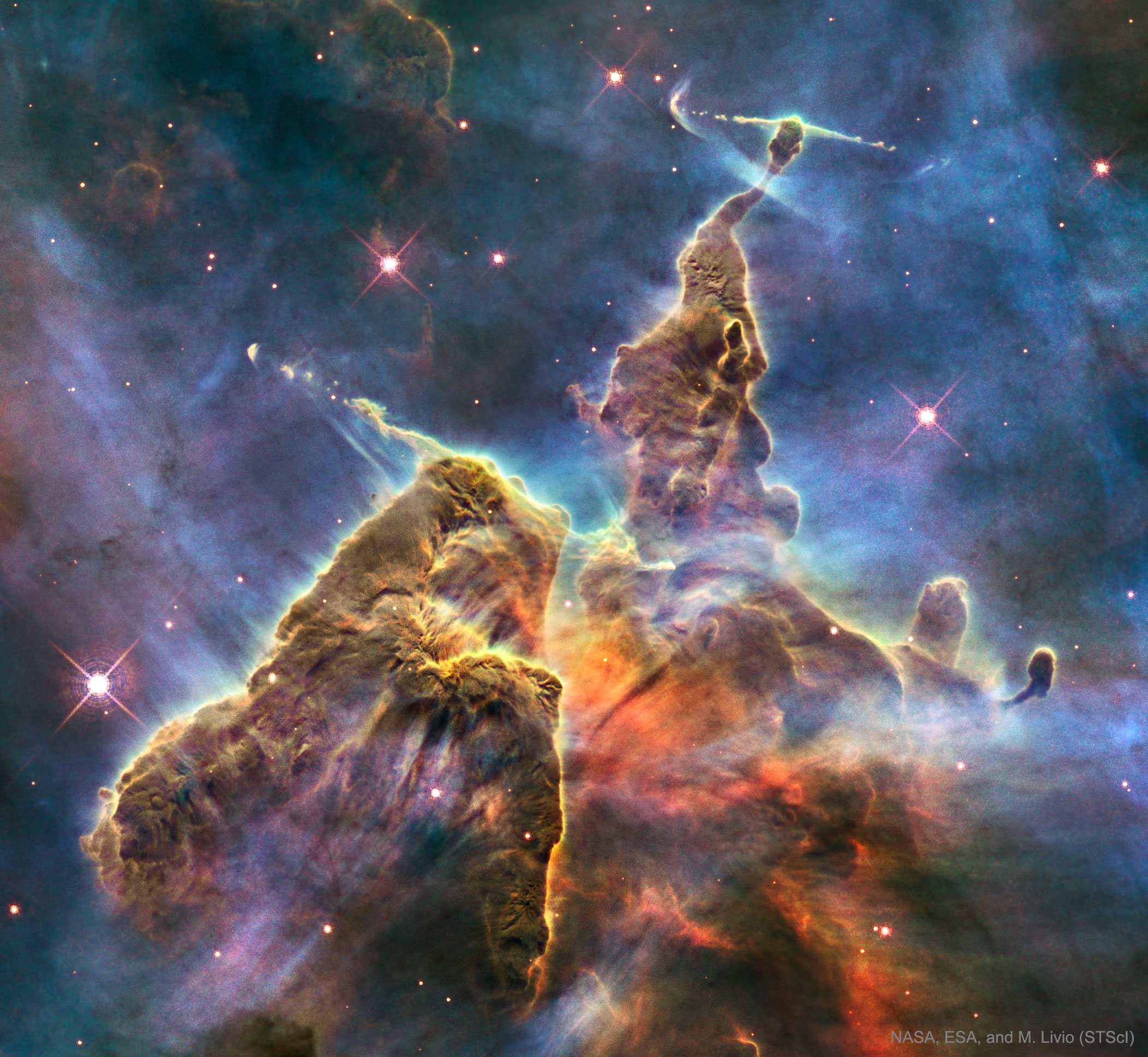
Mountains of Dust in the Carina Nebula 
Image Credit: NASAESA, and M. Livio (STScI)
Explanation: It's stars versus dust in the Carina Nebula and the stars are winning. More precisely, the energetic light and winds from massive newly formed stars are evaporating and dispersing the dusty stellar nurseries in which they formed. Located in the Carina Nebula and known informally as Mystic Mountain, these pillar's appearance is dominated by the dark dust even though it is composed mostly of clear hydrogen gas. Dust pillars such as these are actually much thinner than air and only appear as mountains due to relatively small amounts of opaque interstellar dust. About 7,500 light-years distant, the featured image was taken with the Hubble Space Telescope and highlights an interior region of Carina which spans about three light years. Within a few million years, the stars will likely win out completely and the entire dust mountain will evaporate.

2017-06-30

Imagens - Monumentos de Portugal - Torre dos Clérigos - Porto

Disputa com a ponte D. Luís o estatuto de ex-líbris do Porto. É a torre sineira da Igreja dos Clérigos e foi construída em meados do século XVII, com projeto do arquiteto italiano Nicolau Nasoni, que previa inicialmente uma segunda torre gémea. Tem seis andares e 75 metros de altura, que se sobem por uma escada em espiral com 240 degraus. Na altura da sua construção, era o edifício mais alto de Portugal. Está classificada pelo IPPAR como Monumento Nacional desde 1910.

Astronomy picture of the day - 2017 June 30 - NGC 7814: The Little Sombrero in Pegasus

See Explanation.  Clicking on the picture will download
 the highest resolution version available.
NGC 7814: The Little Sombrero in Pegasus 
Image Credit & CopyrightCHART32 TeamProcessing - Johannes Schedler


Explanation: Point your telescope toward the high flying constellation Pegasus and you can find this expanse of Milky Way stars and distant galaxies. Dominated by NGC 7814, the pretty field of view would almost be covered by a full moon. NGC 7814 is sometimes called the Little Sombrero for its resemblance to the brighter more famous M104, the Sombrero Galaxy. Both Sombrero and Little Sombrero are spiral galaxies seen edge-on, and both have extensive halos and central bulges cut by a thin disk with thinner dust lanes in silhouette. In fact, NGC 7814 is some 40 million light-years away and an estimated 60,000 light-years across. That actually makes the Little Sombrero about the same physical size as its better known namesake, appearing smaller and fainter only because it is farther away. Very faint dwarf galaxies, potentially a satellites of NGC 7814, have been discovered in deep exposures of Little Sombrero.

2017-06-29

Imagenes del Mundo - Agricultor en - Naypyitaw, (Myanmar)

Un agricultor dispersa semillas de arroz en campos de lluvia en Naypyitaw, (Myanmar).

AUNG SHINE OO AP

Imagenes del Mundo - Duerme el bebé - Marawi (Filipinas)

Un bebé duerme dentro de una mosquitera en un centro de evacuación a las afueras de Marawi (Filipinas) mientras las fuerzas gubernamentales continúan su ataque contra los insurgentes.

JORGE SILVA REUTERS

Imagenes del Mundo - El niño y el gato - Manila (Filipinas)

Un niño rescata a una cría de gato que cayó a un río después de una operación de demolición de casas en Las Piñas, al sur de Manila (Filipinas).

FRANCIS R. MALASIG EFE

Imagenes del Mundo - Berna (Suiza)

Un rayo cae durante una tormenta eléctrica en la ciudad de Berna (Suiza).

ANTHONY ANEX EFE

Imagenes del Mundo - Bombay (India)

Un hombre se moja mientras unas palomas vuelan, en la temporada del monzón en la costa del Mar Arábigo, en Bombay (India).

RAJANISH KAKADE AP

Imagens - Monumentos de Portugal - Mosteiro dos Jeronimos

Iniciado em 1501, no reinado de D. Manuel I, viria a ser concluído já no reinado de D. João III. Com a sua fachada de 300 metros, juntamente com a vizinha Torre de Belém, é um dos mais emblemáticos exemplos do chamado estilo manuelino, uma derivação do gótico em que abundam os pormenores decorativos com motivos náuticos, em celebração da epopeia dos descobrimentos. Está classificado como património mundial pela UNESCO.