2017-12-19

Astronomy picture of the day - 2017 December 19 - The Spiral North Pole of Mars

See Explanation.  Clicking on the picture will download
 the highest resolution version available.
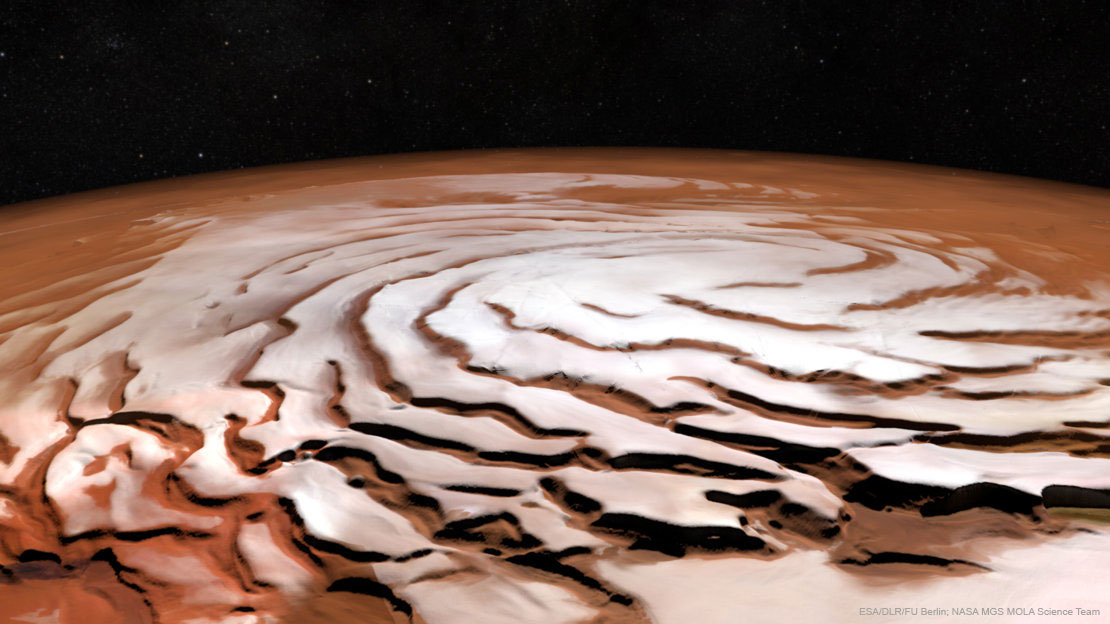
The Spiral North Pole of Mars 
Image Credit: ESA/DLR/FU BerlinNASA MGS MOLA Science Team
Explanation: Why is there a spiral around the North Pole of Mars? Each winter this pole develops a new outer layer about one meter thick composed of carbon dioxide frozen out of the thin Martian atmosphere. This fresh layer is deposited on a water-ice layer that exists year round. Strong winds blow down from above the cap's center and swirl due to the spin of the red planet -- contributing to Planum Boreum's spiral structure. The featured image is a perspective mosaic generated earlier this year from numerous images taken by ESA's Mars Express and elevations extracted from the laser altimeter aboard NASA's Mars Global Surveyor mission. New missions to Mars planned in the next few years include Insight with plans to drill into Mars, and ExoMars and the Mars 2020 Rover with plans to search for signs of microscopic Martian life -- past and present.

2017-12-18

Astronomy picture of the day - 2017 December 18 - The Einstein Cross Gravitational Lens

See Explanation.  Clicking on the picture will download
 the highest resolution version available.
The Einstein Cross Gravitational Lens 
Image Credit & Copyright: J. Rhoads (Arizona State U.) et al., WIYNAURANOAONSF
Explanation: Most galaxies have a single nucleus -- does this galaxy have four? The strange answer leads astronomers to conclude that the nucleus of the surrounding galaxy is not even visible in this image. The central cloverleaf is rather light emitted from a background quasar. The gravitational field of the visible foreground galaxy breaks light from this distant quasar into four distinct images. The quasar must be properly aligned behind the center of a massive galaxy for a mirage like this to be evident. The general effect is known as gravitational lensing, and this specific case is known as the Einstein Cross. Stranger still, the images of the Einstein Cross vary in relative brightness, enhanced occasionally by the additional gravitational microlensing effect of specific stars in the foreground galaxy.

2017-12-17

Astronomy picture of the day - 2017 December 17 - A Wintry Shower

See Explanation.  Clicking on the picture will download
 the highest resolution version available.
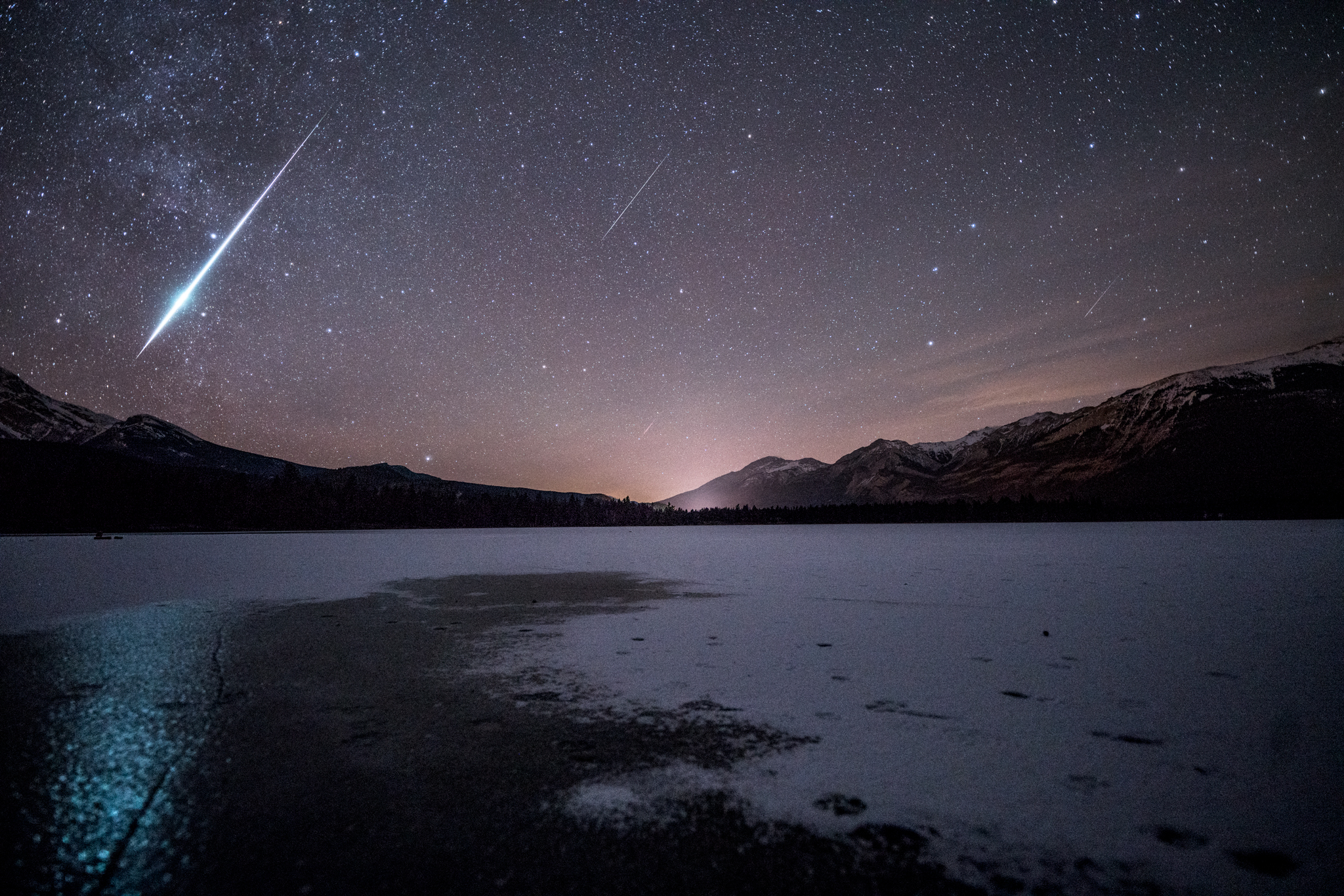
A Wintry Shower 
Image Credit & CopyrightJack Fusco
Explanation: Four Geminids flash through northern skies in this wintry night skyscape. The bright fireball and 3 fainter meteors were captured in a single 10 second exposure, near the peak of December's Geminid meteor shower. Reflecting the fireball's greenish light, a partially frozen Lake Edith in Alberta Canada's Jasper National Park lies in the foreground, with the Canadian Rocky Mountains ranging along the northern horizon. Of course, the glacial lake is cold even in summer. But photographer Jack Fusco reports that he experienced -9 degree C temperatures that night while enjoying one of the most active meteor showers he's ever seen.

2017-12-13

Astronomy picture of the day - 2017 December 13 - Meteors over Inner Mongolia

See Explanation.  Clicking on the picture will download
 the highest resolution version available.
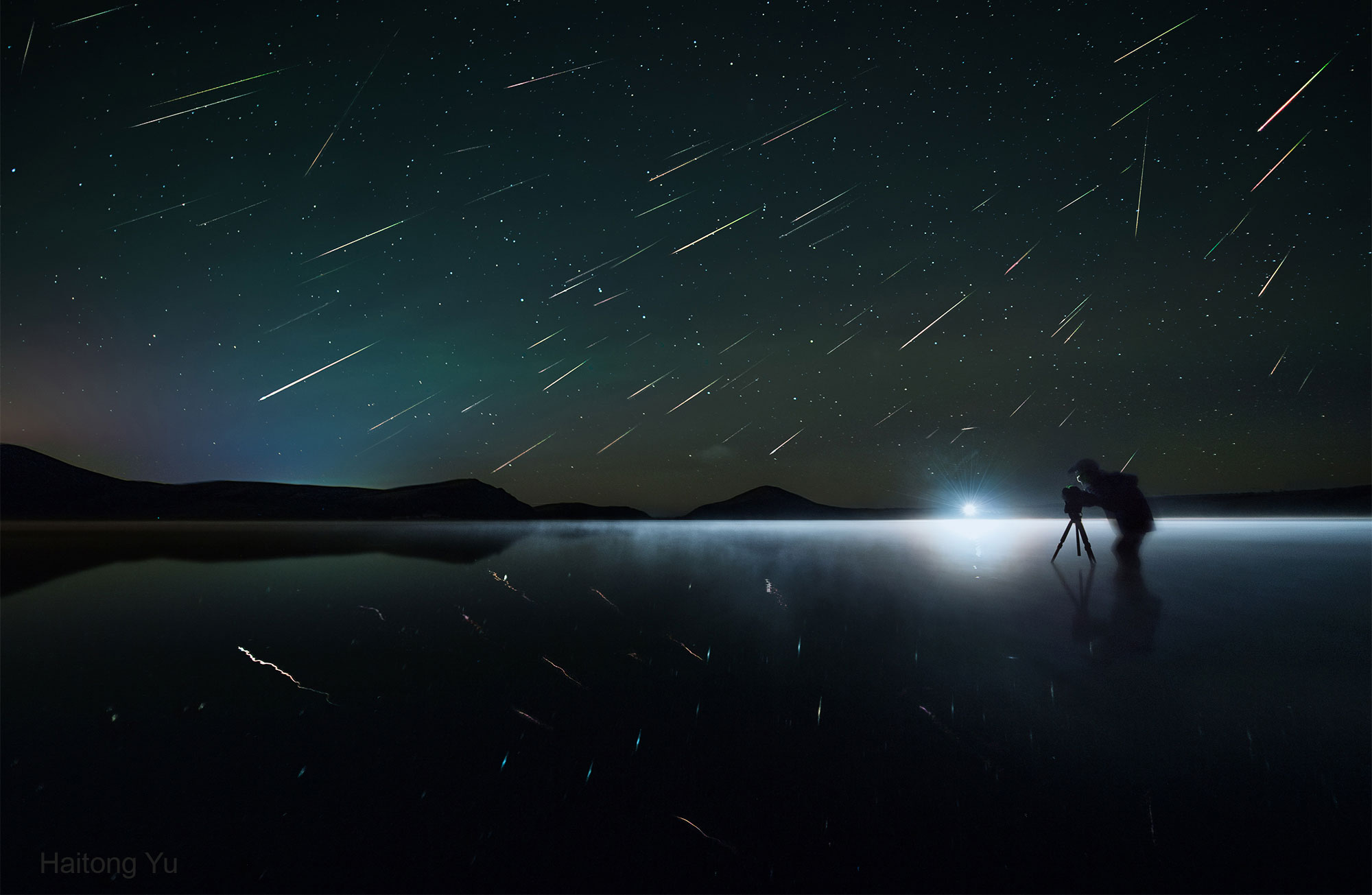
Meteors over Inner Mongolia 
Image Credit & Copyright: Haitong Yu
Explanation: Did you ever get caught in a meteor shower? If yes, then every minute or so the sky sparked with fleeting flashes of light. This was the fate of the pictured astrophotographer during last year's Perseids meteor shower. During the featured three-hour image composite, about 90 Perseids rained down above Lake Duolun of Inner MongoliaChina. If you trace back the meteor streaks, you will find that most of them appear to radiate from a single constellation -- in this case Perseus. In fact, you can even tell which meteors are not Perseids because they track differently. Tonight promises to be another good night to get caught in a meteor shower because it is the peak for the Geminids. Gemini, the shower radiant, should rise shortly after sunset and be visible most of the night.

2017-12-12

Astronomy picture of the day - 2017 December 12 - Highlights of the Winter Sky

See Explanation.  Clicking on the picture will download
 the highest resolution version available.
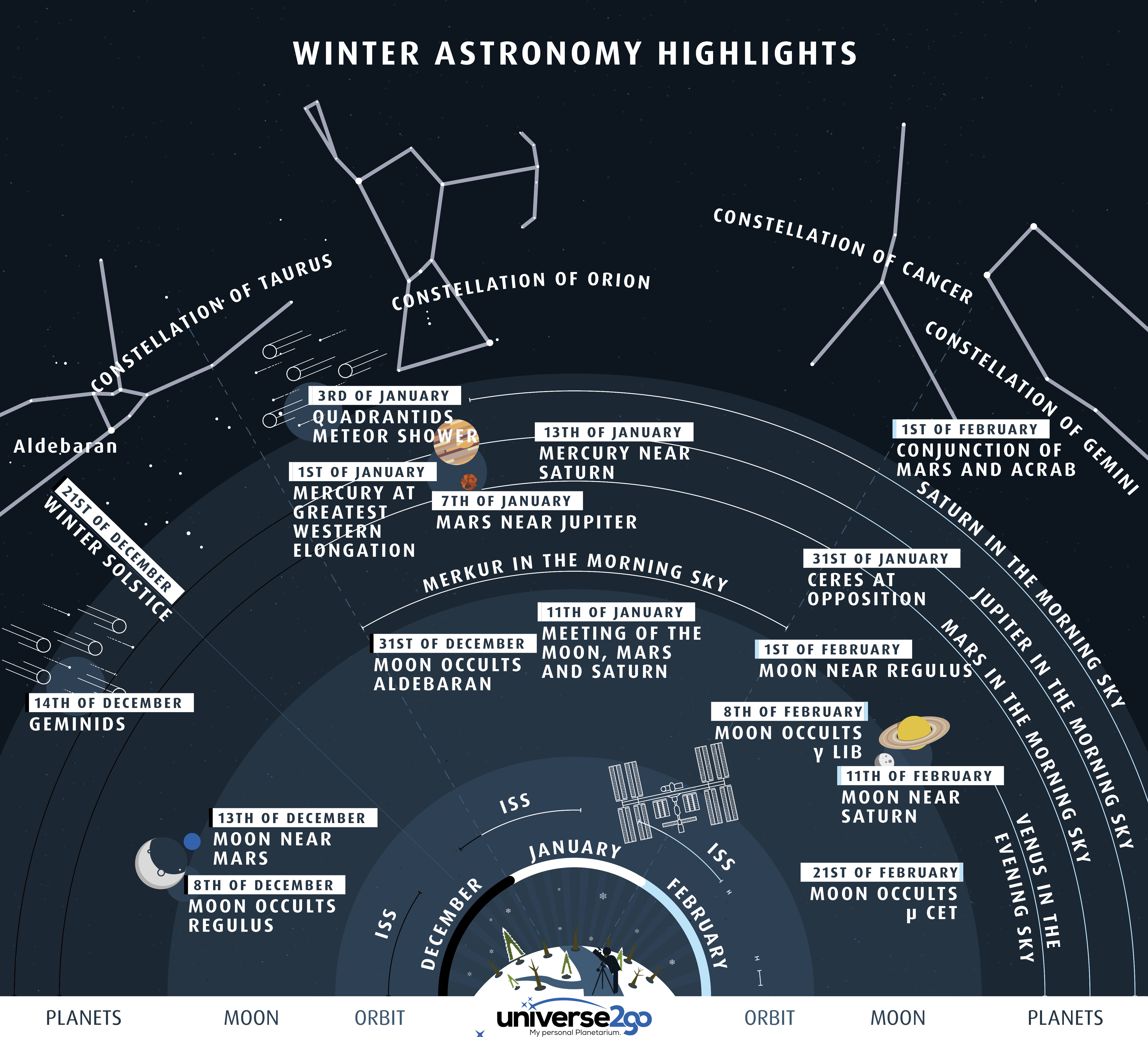
Highlights of the Winter Sky 
Illustration Credit & Copyright: Universe2go.com
Explanation: What's up in the sky this winter? The featured graphic gives a few highlights for Earth's northern hemisphere. Viewed as a clock face centered at the bottom, early winter sky events fan out toward the left, while late winter events are projected toward the right. Objects relatively close to Earth are illustrated, in general, as nearer to the cartoon figure with the telescope at the bottom center -- although almost everything pictured can be seen without a telescope. Highlights of this winter's sky include the Geminids meteor shower peaking this week, the constellation of Orion becoming notable in the evening sky, and many planets being visible before sunrise in February. As true in every season, the International Space Station (ISS) can be sometimes be found drifting across your sky if you know just when and where to look.

2017-12-11

Imagens do mundo - "Derrocada em São Pedro de Moel", Portugal

Derrocada em São Pedro de Moel
"Derrocada em São Pedro de Moel"

Astronomy picture of the day - 11-12-2017 - Mercury Visualized from MESSENGER

2017 December 11
Mercury Visualized from MESSENGER 
Video Credit: NASAJHUAPLCIWProcessing: Roman TkachenkoMusic: Open Sea Morning by Puddle of Infinity
Explanation: What would it be like to fly over the planet Mercury? Images and data taken from NASA's robotic MESSENGER spacecraft that orbited Mercury from 2011 to 2015 have been digitally combined to envision a virtual flight that highlights much of the hot planet's surface. In general, the Solar System's innermost world appears similar to Earth's Moon as it is covered by a heavily cratered gray terrain. MESSENGER discovered much about Mercury including that shadows near its poles likely host water ice. The featured video opens as Mercury is viewed from the Sun-facing side and concludes with the virtual spacecraft retreating into Mercury's night. Mercury actually rotates so slowly that it only completes three rotations for every two trips around the Sun. In 2018, Europe and Japan plan to launch BepiColombo to better map Mercury's surface and probe its magnetic field.

2017-12-10

Drawings from my mind - "A stairway to Hell"

"A stairway to Hell"

10-04-2015
JoanMira

Astronomy picture of the day - 2017 December 10 - In Green Company: Aurora over Norway

See Explanation.  Clicking on the picture will download
 the highest resolution version available.
In Green Company: Aurora over Norway 
Image Credit & Copyright: Max Rive
Explanation: Raise your arms if you see an aurora. With those instructions, two nights went by with, well, clouds -- mostly. On the third night of returning to same peaks, though, the sky not only cleared up but lit up with a spectacular auroral display. Arms went high in the air, patience and experience paid off, and the creative featured image was captured as a composite from three separate exposures. The setting is a summit of the Austnesfjorden fjord close to the town of Svolvear on the Lofoten islands in northern Norway. The time was early 2014. Although our Sun is nearing Solar Minimum and hence showing relatively little surface activity, holes in the upper corona have provided some niceauroral displays over the last few months.

2017-12-09

Images du monde - Un hibou au Canada

En survolant la rivière d'Ottawa, au Canada, ce grand hibou gris plonge sur sa proie à travers la neige.

Par Rick Dobson