
2018-02-05

Astronomy picture of the day - 2018 February 5 - NGC 7635: The Bubble Nebula Expanding
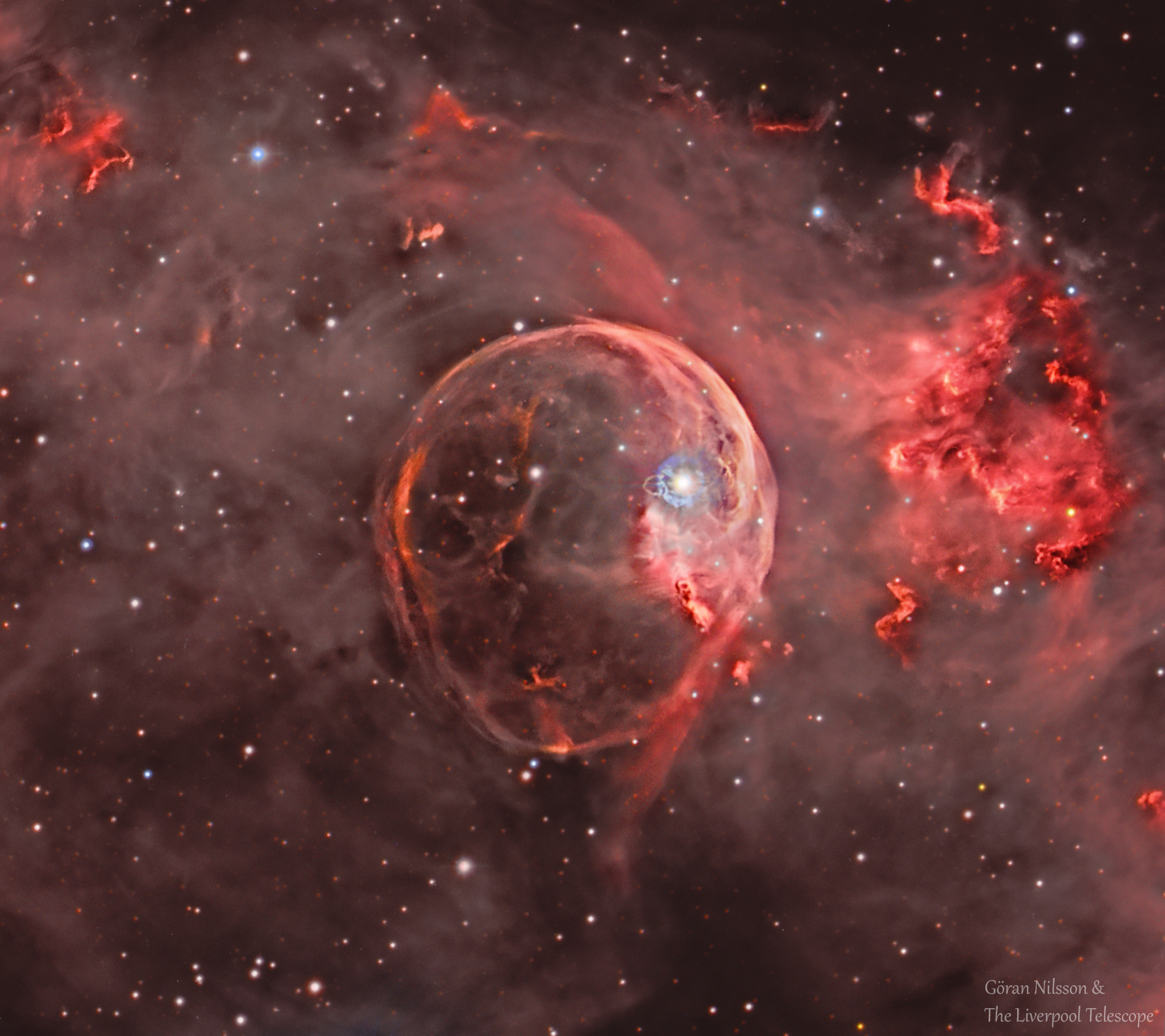
Image Credit: Göran Nilsson & The Liverpool Telescope
Explanation: It's the bubble versus the cloud. NGC 7635, the Bubble Nebula, is being pushed out by the stellar wind of massive star BD+602522, visible in blue toward the right, inside the nebula. Next door, though, lives a giantmolecular cloud, visible to the far right in red. At this place in space, an irresistible force meets an immovable object in an interesting way. The cloud is able to contain the expansion of the bubble gas, but gets blasted by the hot radiation from the bubble's central star. The radiation heats up dense regions of the molecular cloud causing it to glow. The Bubble Nebula, pictured here is about 10 light-years across and part of a much larger complex of stars and shells. TheBubble Nebula can be seen with a small telescope towards the constellation of the Queen of Aethiopia (Cassiopeia).
2018-02-04


Astronomy picture of the day - 2018 February 4 - Venus and the Triply Ultraviolet Sun
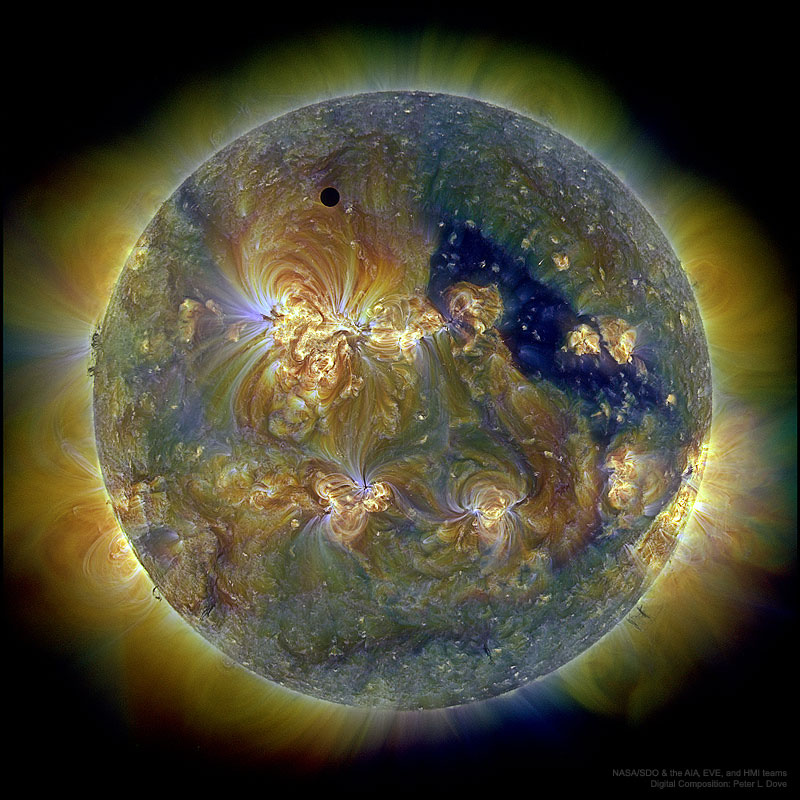
Image Credit: NASA/SDO & the AIA, EVE, and HMI teams; Digital Composition: Peter L. Dove
Explanation: An unusual type of solar eclipse occurred in 2012. Usually it is the Earth's Moon that eclipses the Sun. That year, most unusually, the planet Venus took a turn. Like a solar eclipse by the Moon, the phase of Venusbecame a continually thinner crescent as Venus became increasingly better aligned with the Sun. Eventually the alignment became perfect and the phase of Venus dropped to zero. The dark spot of Venus crossed our parent star. The situation could technically be labeled a Venusian annular eclipse with an extraordinarily large ring of fire. Pictured here during the occultation, the Sun was imaged in three colors of ultraviolet light by the Earth-orbiting Solar Dynamics Observatory, with the dark region toward the right corresponding to a coronal hole. Hours later, as Venus continued in its orbit, a slight crescent phase appeared again. The next Venusian transit across the Sun will occur in 2117.
2018-02-02

Astronomy picture of the day - 2018 February 2 - Moonrise Eclipse
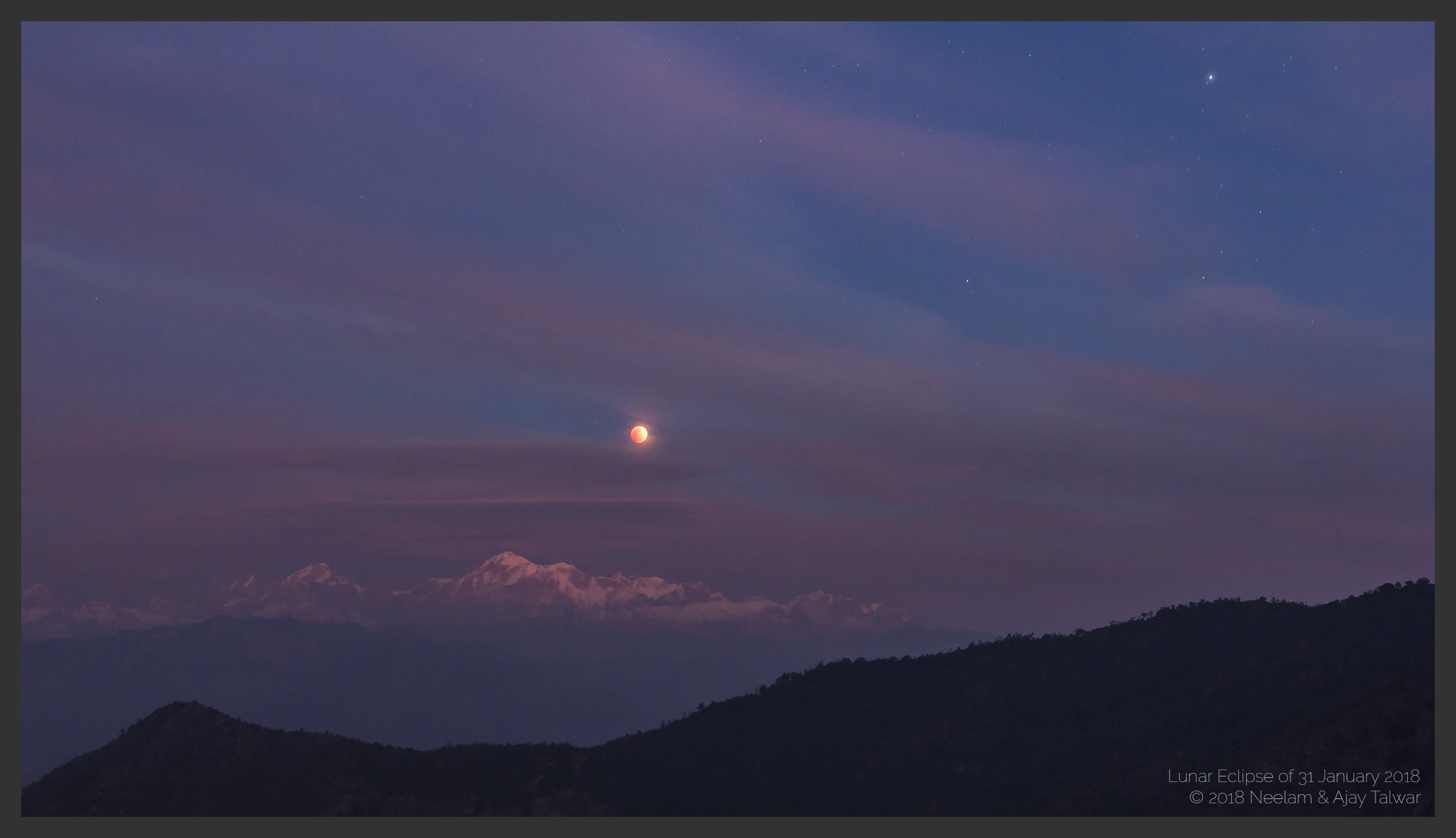
Image Credit & Copyright: Neelam and Ajay Talwar
Explanation: This atmospheric picture of a distant horizon looks toward the tall Trisul peaks of India's snowy Himalayan mountains. Taken from a remote location on January 31, brightest star Sirius shines at the upper right. The red Moon rising is gliding through Earth's shadow during the evening's much anticipated total lunar eclipse. Enjoyed across the planet's night side, the eclipse was the first of two total lunar eclipses in 2018, kicking off a good year for moonwatchers. But this was a rare treat. The eclipsed Moon also loomed large near perigee, the closest point in its orbit, during the second Full Moon of the month, also known as a Blue Moon. For the July 27, 2018 total lunar eclipse, the Full Moon will be very near apogee.
2018-02-01


Inscription à :
Articles (Atom)