2018-02-21

Alita Pinheiro - "Walking in the rain" - Pintura contemporânea

"Walking in the rain"

2017
Alita Pinheiro

Steve Hanks - "Enviando flores" - Aguarela

Steve Hanks, aquarelas
"Enviando flores"

Astronomy picture of the day - 2018 February 21 - Jupiter in Infrared from Hubble

See Explanation.  Clicking on the picture will download
 the highest resolution version available.
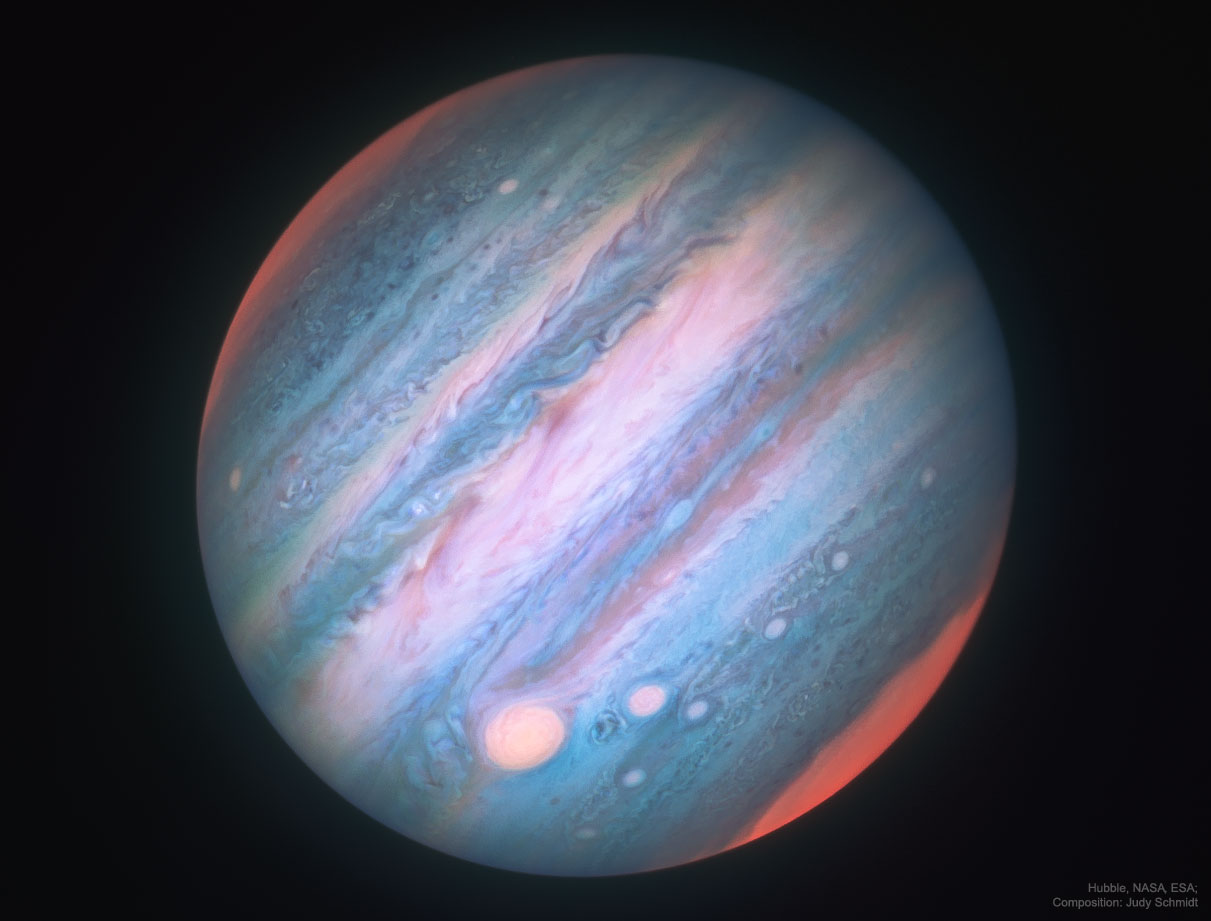
Jupiter in Infrared from Hubble 
Image Credit: NASAESAHubbleData: Michael Wong (UC Berkeleyet al.Processing & LicenseJudy Schmidt
Explanation: Jupiter looks a bit different in infrared light. To better understand Jupiter's cloud motions and to help NASA's robotic Juno spacecraft understand the Hubble Space Telescope is being directed to regularly image the entire Jovian giant. The colors of Jupiter being monitored go beyond the normal human visual range to include both ultraviolet and infrared light. Featured here in 2016, three bands of near-infrared light have been digitally reassigned into a mapped color image. Jupiter appears different in infrared partly because the amount of sunlight reflected back is distinct, giving differing cloud heights and latitudes discrepant brightnesess. Nevertheless, many familiar features on Jupiterremain, including the light zones and dark belts that circle the planet near the equator, the Great Red Spot on the lower left, and the string-of-pearls storm systems south of the Great Red Spot. The poles glow because high altitute haze there is energized by charged particles from Jupiter's magnetosphereJuno has now completed 10 of 12 planned science orbits of Jupiter and continues to record data that are helping humanity to understand not only Jupiter's weather but what lies beneath Jupiter's thick clouds.

2018-02-20

Astronomy picture of the day - 2018 February 20 - A Partial Solar Eclipse over Buenos Aires

See Explanation.  Clicking on the picture will download
 the highest resolution version available.
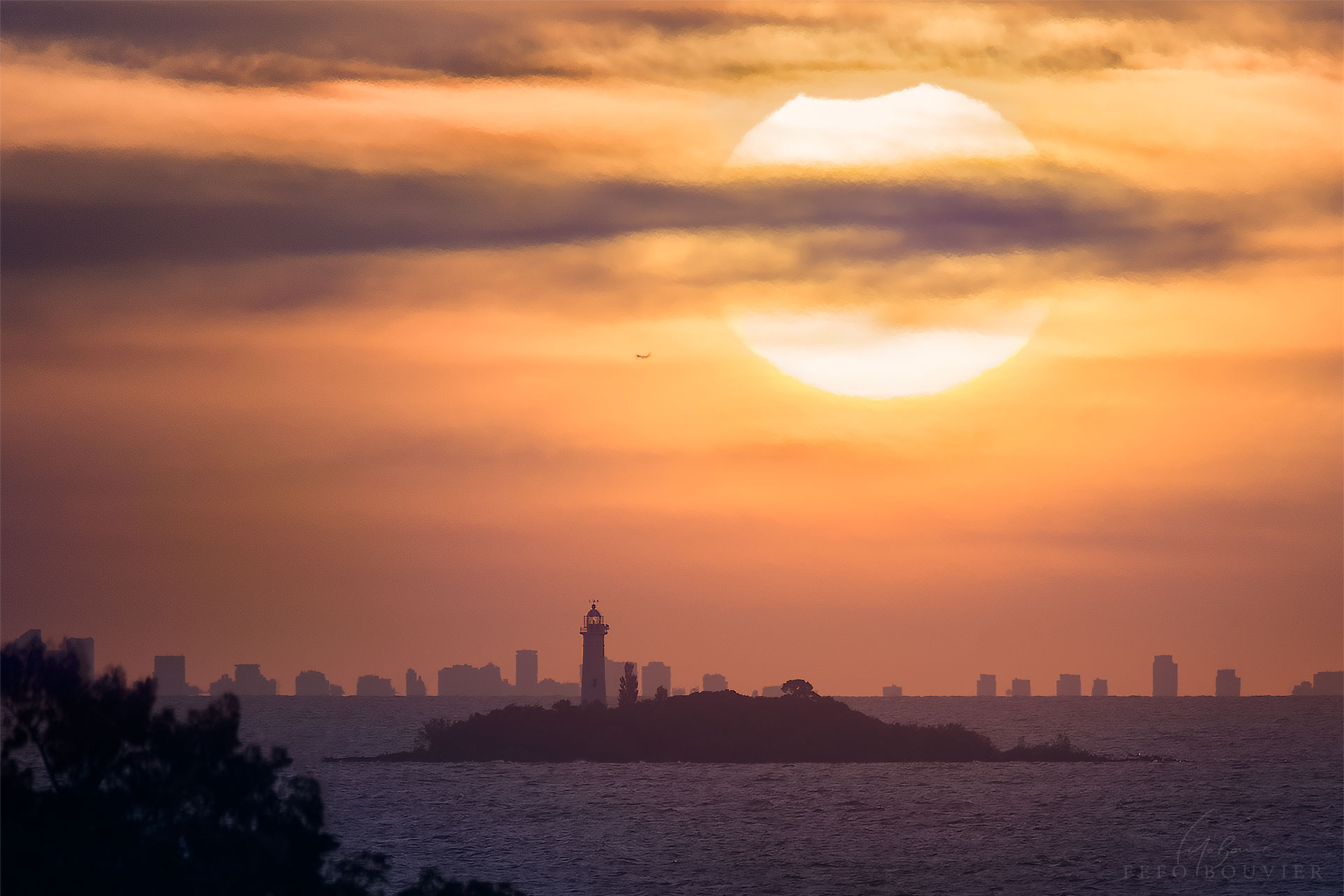
A Partial Solar Eclipse over Buenos Aires 
Image Credit & Copyright: Fefo Bouvier
Explanation: What's happened to top of the Sun? Last week, parts of Earth's southern hemisphere were treated to a partial solar eclipse, where the Moon blocks out part of the Sun. The featured image was taken toward the end of the eclipse from the coast of Uruguay overlooking Argentina's Buenos Aires. Light-house adorned Farallón Island is seen in the foreground, and a plane is visible just to the left of the Sun. The image is actually a digital combination of two consecutive exposures taken with the same camera using the same settings -- one taken of the landscape and another of the background Sun. The next solar eclipse visible on Earth will be another partial eclipse occurring in mid-July and visible from parts of southern Australia including Tasmania.

2018-02-19

Fachadas da Praça do Giraldo - Evora - 1940/1950 - Fotografias do passado

Fachadas da Praça do Giraldo, vendo-se a pastelaria Brasserie e a Wacuum Oil Company.

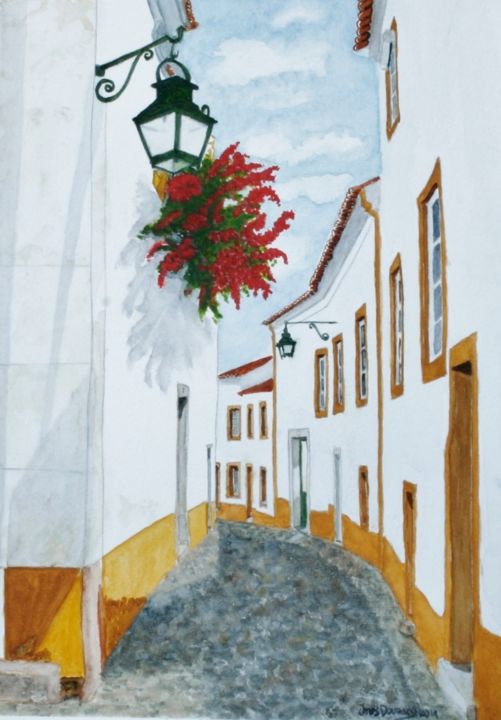
Inês Dourado - "Rua de Evora" - Aguarela

"Uma Rua de Évora"(Évora's Street, Alentejo, South of Portugal) - Peinture,  29x20 cm ©2014 par Inês Dourado -  
                                                                                                                
    Art figuratif, Peinture contemporaine, Réalisme, Papier, Lieux, Architecture, Villes, Paysage urbain, Portugal, Alentejo, South of Portugal, Évora, património, Watercolor paintings, aguarelas, inês dourado, Cityscapes, urban landscapes, paisagens urbanas, história da arte, art history

"Rua de Evora"

Astronomy picture of the day - 2018 February 19 - Galaxy Formation in a Magnetic Universe

Galaxy Formation in a Magnetic Universe 
Video Credit: IllustrisTNG ProjectVisualization: Mark Vogelsberger (MIT) et al.
Music: Gymnopedie 3 (Composer: Erik Satie, Musician: Wahneta Meixsell)
Explanation: How did we get here? We know that we live on a planet orbiting a star orbiting a galaxy, but how did all of this form? To understand details better, astrophysicists upgraded the famous Illustris Simulation into IllustrisTNG-- now the most sophisticated computer model of how galaxies evolved in our universe. Specifically, this featured video tracks magnetic fields from the early universe (redshift 5) until today (redshift 0). Here blue represents relatively weak magnetic fields, while white depicts strong. These B fields are closely matched with galaxies and galaxy clusters. As the simulation begins, a virtual camera circles the virtual IllustrisTNG universe showing a young region -- 30-million light years across -- to be quite filamentary. Gravity causes galaxies to form and merge as the universe expands and evolves. At the end, the simulated IllustrisTNG universe is a good statistical match to our present real universe, although some interesting differences arise -- for example a discrepancy involving the power in radio waves emitted by rapidly moving charged particles.

2018-02-18

Astronomy picture of the day - 2018 February 18 - LL Ori and the Orion Nebula

See Explanation.  Clicking on the picture will download
 the highest resolution version available.
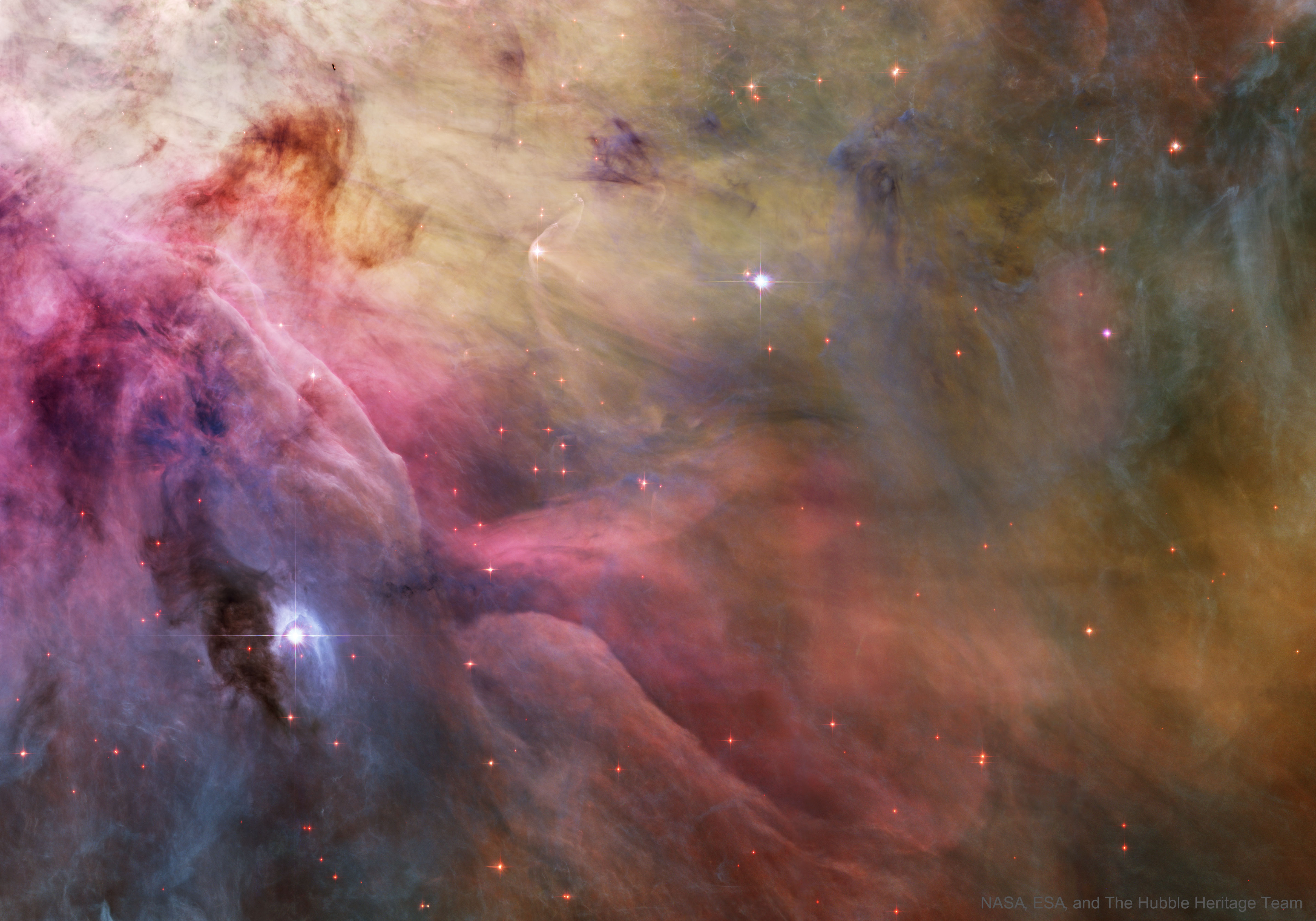
LL Ori and the Orion Nebula 
Image Credit: NASAESA, and The Hubble Heritage Team
Explanation: Stars can make waves in the Orion Nebula's sea of gas and dust. This esthetic close-up of cosmic clouds and stellar winds features LL Orionis, interacting with the Orion Nebula flow. Adrift in Orion's stellar nursery and still in its formative years, variable star LL Orionis produces a wind more energetic than the wind from our own middle-aged Sun. As the fast stellar wind runs into slow moving gas a shock front is formed, analogous to the bow wave of a boat moving through water or a plane traveling at supersonic speed. The small, arcing, graceful structure just above and left of center is LL Ori's cosmic bow shock, measuring about half a light-year across. The slower gas is flowing away from the Orion Nebula's hot central star cluster, the Trapezium, located off the upper left corner of the picture. In three dimensions, LL Ori's wrap-around shock front is shaped like a bowl that appears brightest when viewed along the "bottom" edge. This beautiful painting-like photograph is part of a large mosaic view of the complex stellar nursery in Orion, filled with a myriad of fluid shapes associated with star formation.

Alita Pinheiro - "Valsa" - Pintura contemporânea


Foto de Alita Pinheiro.

"Valsa"

Fevereiro de 2017
Alita Pinheiro

Mery Paulino - "Anjo da guarda" - Arte-bordados


Anjo da guarda para berço de bebé ; renda e fita de cetim ou seda, argola forrada e medalhão de metal prateado representando um anjinho. Diâmetro 17 centímetros.


Mery Paulino é portuguesa originaria da Madeira e vive na Venezuela. Apaixonada de bordado, enviou-nos este seu magnifico trabalho.