Instalación de una pista de patinaje en el hall central del Grand Palais en París (Francia).
2014-12-16
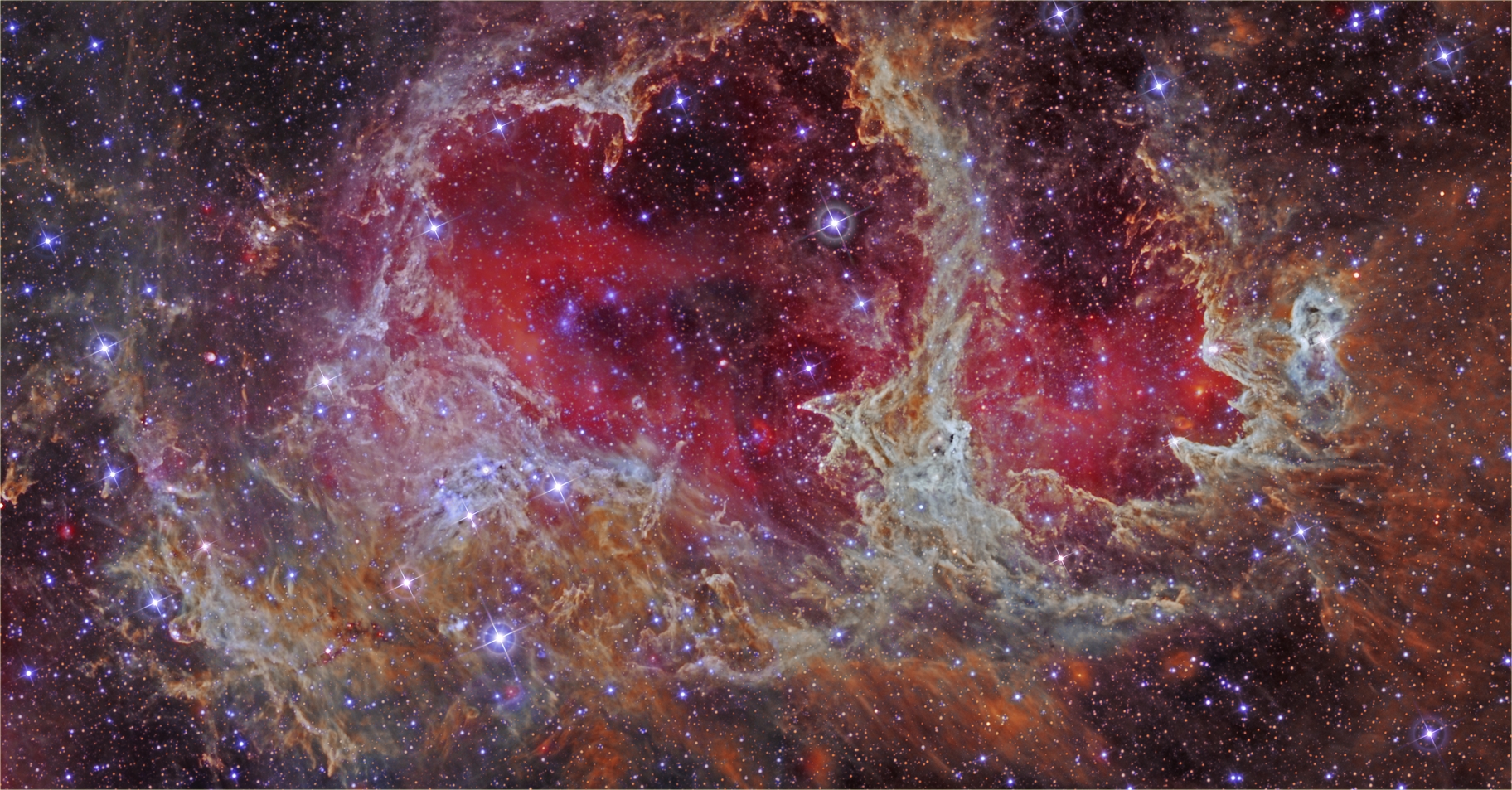
Astronomy picture of the day - 16-12-2014 - W5: Pillars of Star Formation
Image Credit: WISE, IRSA, NASA; Processing & Copyright : Francesco Antonucci
Explanation: How do stars form? Images of the star forming region W5 like those in the infrared by NASA's Wide Field Infrared Survey Explorer (WISE) satellite provide clear clues with indications that massive stars near the center of empty cavities are older than stars near the edges. A likely reason for this is that the older stars in the center are actually triggering the formation of the younger edge stars. The triggered star formation occurs when hot outflowing gas compresses cooler gas into knots dense enough to gravitationally contract into stars. In the featured scientifically-colored infrared image, spectacular pillars, left slowly evaporating from the hot outflowing gas, provide further visual clues.W5 is also known as IC 1848, and together with IC 1805 form a complex region of star formation popularly dubbed the Heart and Soul Nebulas. The above image highlights a part of W5 spanning about 2,000 light years that is rich instar forming pillars. W5 lies about 6,500 light years away toward the constellation of Cassiopeia.
2014-12-15
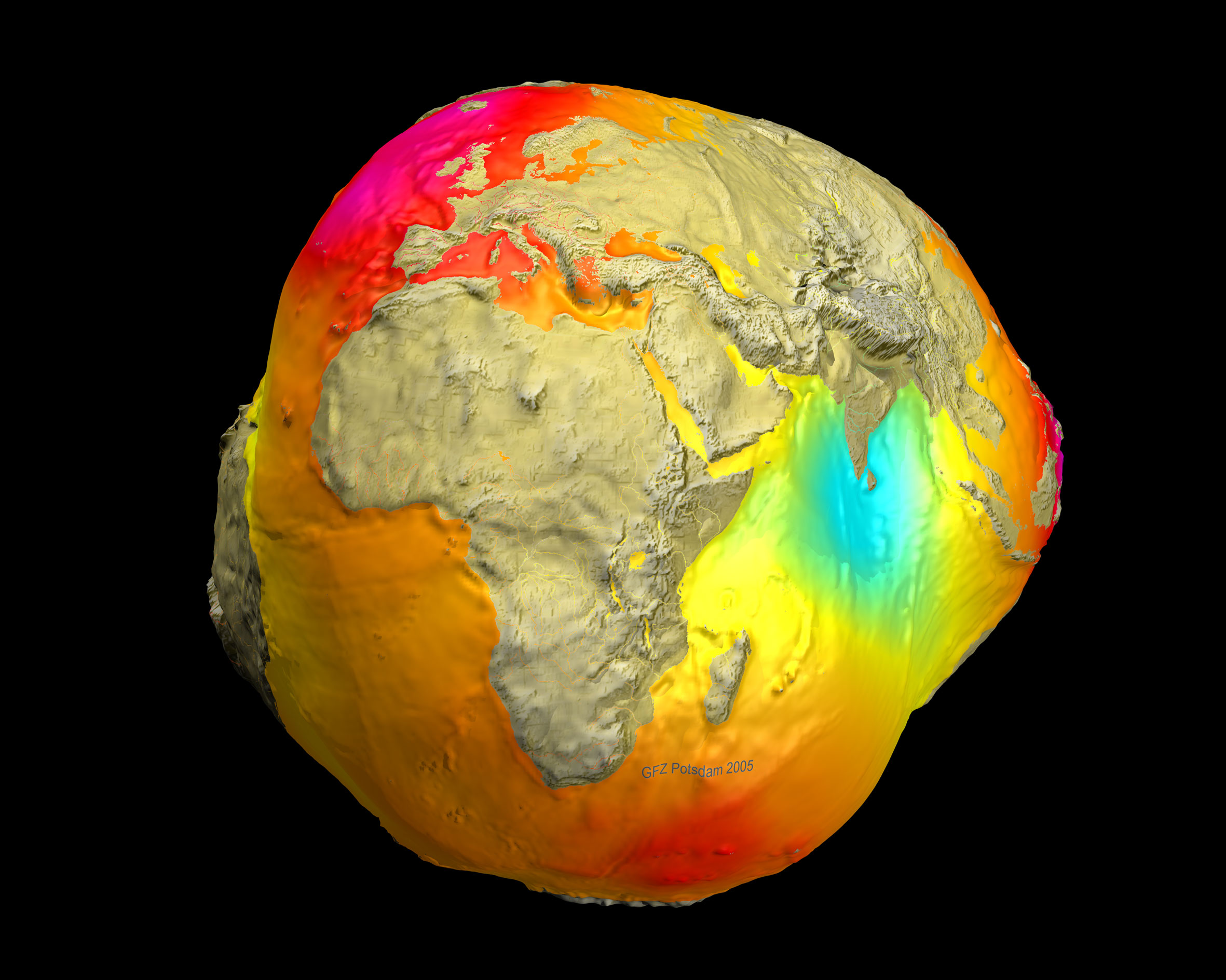
Astronomy picture of the day - 15-12-2014 - The Potsdam Gravity Potato
Image Credit: CHAMP, GRACE, GFZ, NASA, DLR
Explanation: Why do some places on Earth have higher gravity than others? Sometimes the reason is unknown. To help better understand the Earth's surface, sensitive measurments by the orbiting satellites GRACE and CHAMPwere used to create a map of Earth's gravitational field. Since a center for studying this data is in Potsdam, Germany, and since the result makes the Earth look somewhat like a potato, the resulting geoid has been referred to as the Potsdam Gravity Potato. High areas on this map, colored red, indicate areas where gravity is slightly stronger than usual, while in blue areas gravity is slightly weaker. Many bumps and valleys on the Potsdam Gravity Potato can be attributed to surface features, such as the North Mid-Atlantic Ridge and the Himalayan Mountains, but others cannot, and so might relate to unusually high or low sub-surface densities. Maps like this also help calibrate changes in the Earth's surface including variable ocean currents and the melting of glaciers. The above map was made in 2005, but more recent and more sensitive gravity maps of Earth was produced in 2011.
2014-12-14
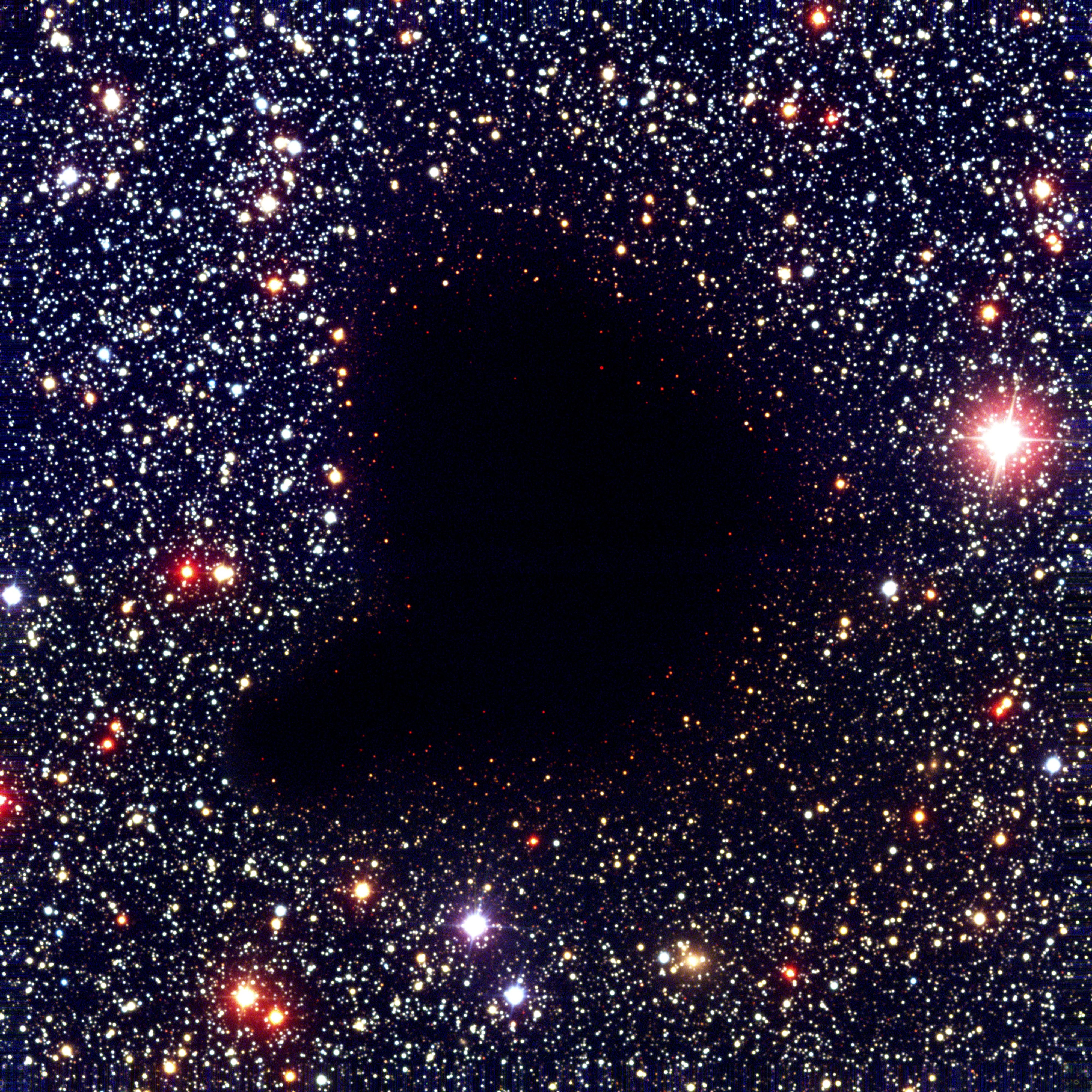
Astronomy picture of the day - 14-12-2014 - Molecular Cloud Barnard 68
Image Credit: FORS Team, 8.2-meter VLT Antu, ESO
Explanation: Where did all the stars go? What used to be considered a hole in the sky is now known to astronomers as a dark molecular cloud. Here, a high concentration of dust and molecular gas absorb practically all the visible light emitted from background stars. The eerily dark surroundings help make the interiors of molecular clouds some of the coldest and most isolated places in the universe. One of the most notable of these dark absorption nebulae is a cloud toward the constellation Ophiuchus known as Barnard 68, pictured above. That no stars are visible in the center indicates that Barnard 68 is relatively nearby, with measurements placing it about 500 light-years away and half a light-year across. It is not known exactly how molecular clouds like Barnard 68 form, but it is known that these clouds are themselves likely places for new stars to form. In fact, Barnard 68 itself has been found likely to collapse and form a new star system. It is possible to look right through the cloud in infrared light.
2014-12-13
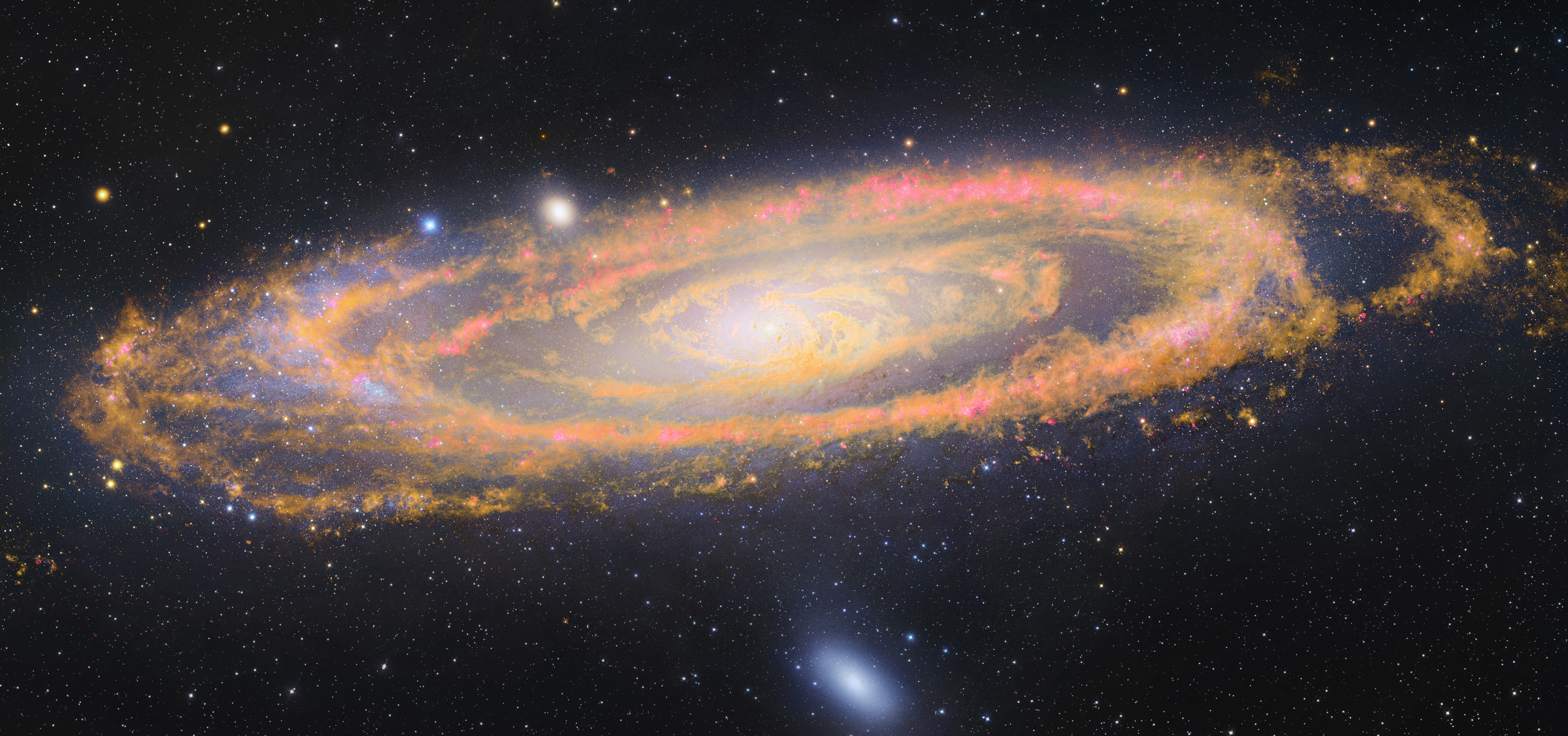
Astronomy picture of the day - 13-12-2014 - The Infrared Visible Andromeda
Image Credit: Subaru Telescope (NAOJ), Hubble Space Telescope
Mayall 4M Telescope (KPNO, NOAO), Digitized Sky Survey, Spitzer Space Telescope
Processing & Copyright: Robert Gendler
Explanation: This remarkable synthetic color composite image was assembled from archives of visible light and infrared astronomy image data. The field of view spans the Andromeda Galaxy (M31), a massive spiral a mere 2.5 million light-years away. In fact, with over twice the diameter of our own Milky Way, Andromeda is the largest nearby galaxy. Andromeda's population of bright young blue stars lie along its sweeping spiral arms, with the telltale reddish glow of star forming regions traced in space- and ground-based visible light data. But infrared data from the Spitzer Space Telescope, also blended directly into the detailed composite's red and green color channels, highlight the the lumpy dust lanes warmed by the young stars as they wind even closer to the galaxy's core. Otherwise invisible at optical wavelengths, the warm dust takes on orange hues. Two smaller companion galaxies, M110 (below) and M32 (above) are also included in the frame.
2014-12-11
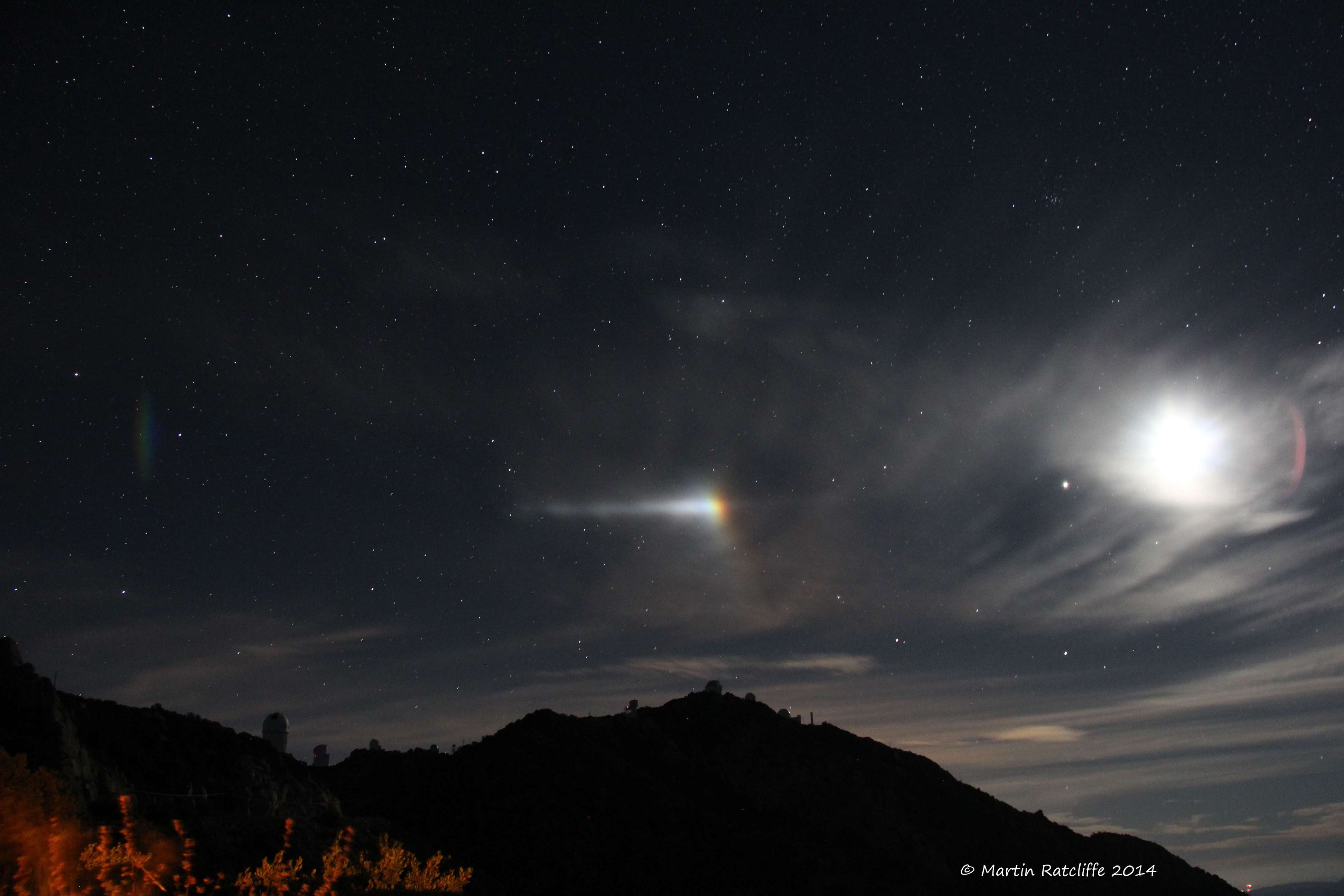
Astronomy picture of the day - 11-12-2014 - Moondog Night
Image Credit & Copyright: Martin Ratcliffe
Explanation: In this night scene from the early hours of November 14, light from a last quarter Moon illuminates clouds above the mountaintop domes of Kitt Peak National Observatory near Tucson, Arizona. Bright Jupiter is just left of the overexposed lunar disk with a streak of camera lens flare immediately to the right, but that's no fireball meteor exploding near the center of the picture. Instead, from the roadside perspective a stunningly bright moondog or paraselene stands directly over Kitt Peaks's WIYN telescope. Analogous to a sundog or parhelion, a paraselene is produced by moonlight refracted through thin, hexagonal, plate-shaped ice crystals in high cirrus clouds. As determined by the crystal geometry, paraselenae (plural) are seen at an angle of 22 degrees or more from the Moon. Compared to the bright lunar disk they are more often faint and easier to spot when the Moon is low. About 10 minutes after the photograph even this bright moondog had faded from the night.
2014-12-10
Imagens do Mundo - Karo - Indonésia
Nueva erupción del Monte Sinabung en Karo (Indonesia).
SUTANTA ADITYA (AFP)
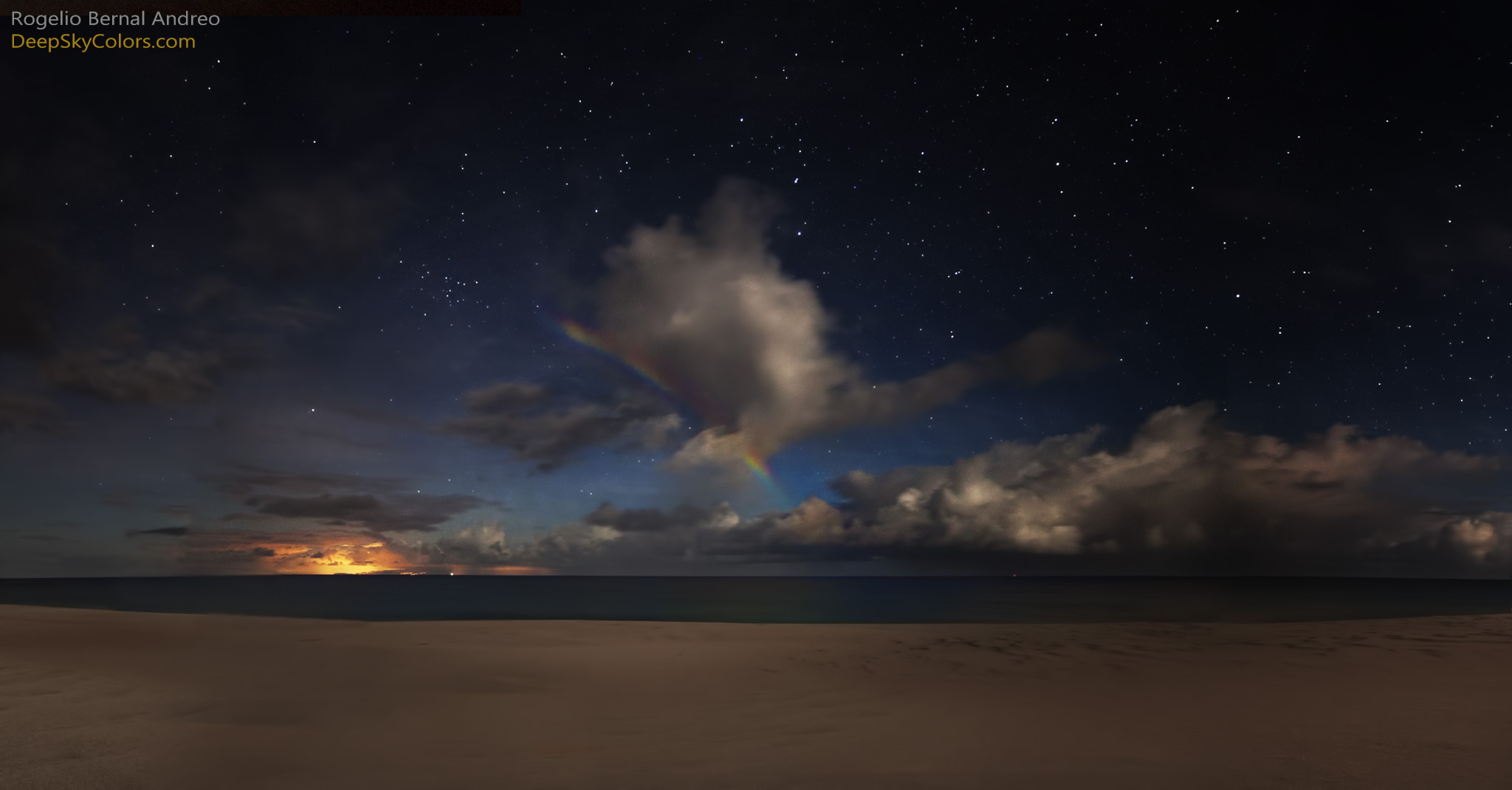
Astronomy picture of the day - 10-12-2014 - Moonbow Beach
Image Credit & Copyright: Rogelio Bernal Andreo (Deep Sky Colors)
Explanation: Like a rainbow at night, a beautiful moonbow shines above the western horizon in this deserted beach scene from Molokai Island, Hawaii, USA, planet Earth. Captured last June 17 in early morning hours, the lights along the horizon are from Honolulu and cities on the island of Oahu some 30 miles away. So where was the Moon? A rainbow is produced by sunlight internally reflected in rain drops from the direction opposite the Sun back toward the observer. As the light passes from air to water and back to air again, longer wavelengths are refracted (bent) less than shorter ones resulting in the separation of colors. And so the moonbow is produced as raindrops reflect moonlight from the direction opposite the Moon. That puts the Moon directly behind the photographer, still low and rising over the eastern horizon, a few days past its full phase.
2014-12-09
Os filhos da mÃe e os filhos da puta
Nós, todos que andam a sofrer cortes salariais, cortes de subsídios, aumentos de impostos que deixam os que pouco têm na penúria, os que recebem uma miséria de reforma, os que foram atirados para o desemprego e recebem um subsídio de miséria ou nem recebem subsídio (a maioria), os que recebem um miséria do denominada Rendimento Social de Inserção ou até nem sequer isso, os que ficaram sem casa, os que passam fome e já andam a mal-alimentar-se em Cantinas Sociais em moldes salazaristas (sopa do Sidónio) que foram implantadas pelo saudosista do "antigamente" e do fascismo, Mota Soares, dito ministro da solidariedade (do raio que o parta). Nós os que perdemos as casas e vimos as nossas famílias desestruturadas. Nós, os que passamos fome, os que não conseguem pagar as contas de eletricidade, da água, do gás, nem comprar comida por nos terem atirado literalmente para a miséria. Nós, esses, os miseráveis, somos os filhos da mãe.
Agora adivinhem quem são os filhos da puta!
Se a miséria em que estão envolvidos ou para ela caminham não vos permite raciocinar, não discernindo, por isso, quem são os filhos da puta, aconselho a que passeiem pelas bandas de Belém, de São Bento, do Terreiro do Paço, das ruas dos bancos e dos banqueiros, porque talvez o olfato vos ajude a apurar o discernimento.
Certo é que nós, os que estamos na miséria ou os que para lá caminham somos os Filhos da Mãe.
Então, já sabem quem são os Filhos da Puta?
Apesar de haver putas que declaram publicamente que os políticos não são filhos delas, como a da fotografia, acreditemos que nem todas são frontais e sinceras. Haverá as que até têm vergonha dos filhos que têm e que então, por isso, estão muito caladinhas.
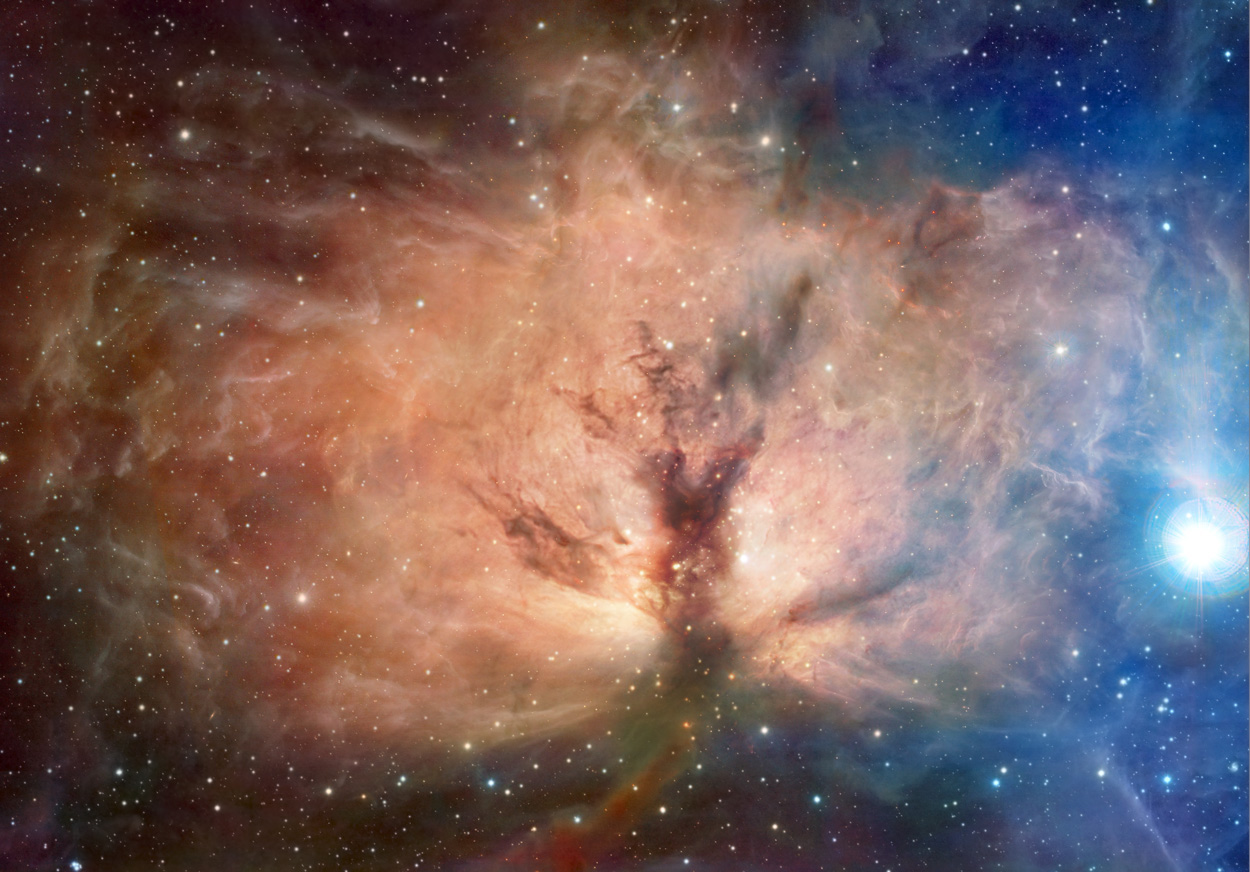
Astronomy picture of the day - 09-12-2014 - The Flame Nebula in Visible and Infrared
Image Credit & Copyright: Optical (RGB+Ha): Aldo Mottino & Ezequiel Bellocchio (Argentina); Infrared: ESO/J. Emerson/VISTA.
Explanation: What lights up the Flame Nebula? Fifteen hundred light years away towards the constellation of Orion lies a nebula which, from its glow and dark dust lanes, appears, on the left, like a billowing fire. But fire, the rapid acquisition of oxygen, is not what makes this Flame glow. Rather the bright star Alnitak, the easternmost star in the Belt of Orion visible just to the right of the nebula, shines energetic light into the Flame that knocks electrons away from the great clouds of hydrogen gas that reside there. Much of the glow results when the electrons and ionized hydrogen recombine. The above false-color picture of the Flame Nebula (NGC 2024) was taken is a composite of both visible and infrared light, the later energy band being where a young star cluster becomes visible. The Flame Nebula is part of the Orion Molecular Cloud Complex, a star-forming region that includes the famous Horsehead Nebula.
Inscription à :
Commentaires (Atom)