2015-03-17
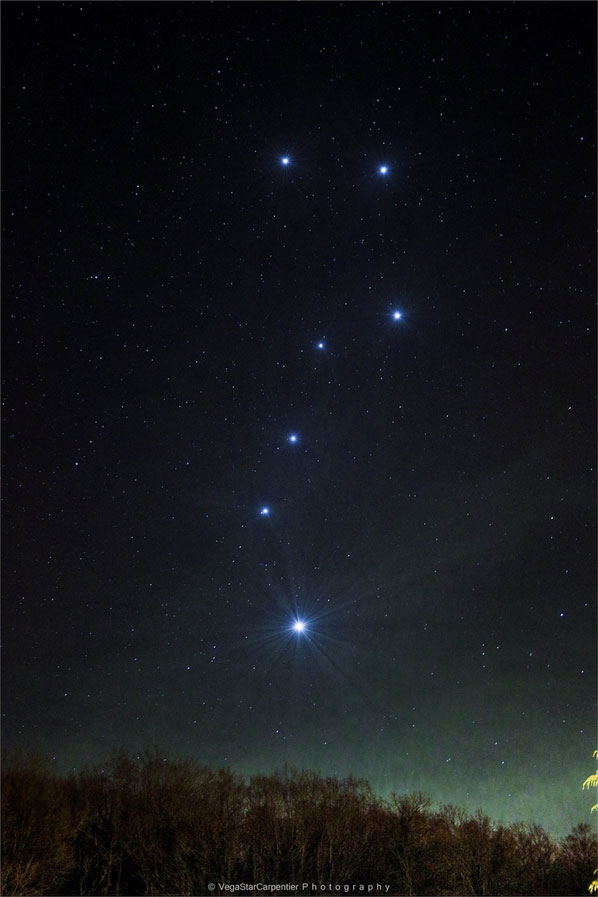
Astronomy picture of the day - 17-03-2015 - The Big Dipper Enhanced
Image Credit & Copyright: VegaStar Carpentier
Explanation: Do you see it? This common question frequently precedes the rediscovery of one of the most commonly recognized configurations of stars on the northern sky: the Big Dipper. This grouping of stars is one of the few things that has likely been seen, and will be seen, by every human generation. In this featured image, however, the stars of the Big Dipper have been digitally enhanced -- they do not really appear this much brighter than nearby stars. The image was taken earlier this month from France. The Big Dipper is not by itself a constellation. Although part of the constellation of the Great Bear (Ursa Major), the Big Dipper is an asterism that has been known by different names to different societies. Five of the Big Dipper stars are actually near each other in space and were likely formed at nearly the same time. Relative stellar motions will cause the Big Dipper to slowly change its apparent configurationover the next 100,000 years.
2015-03-16
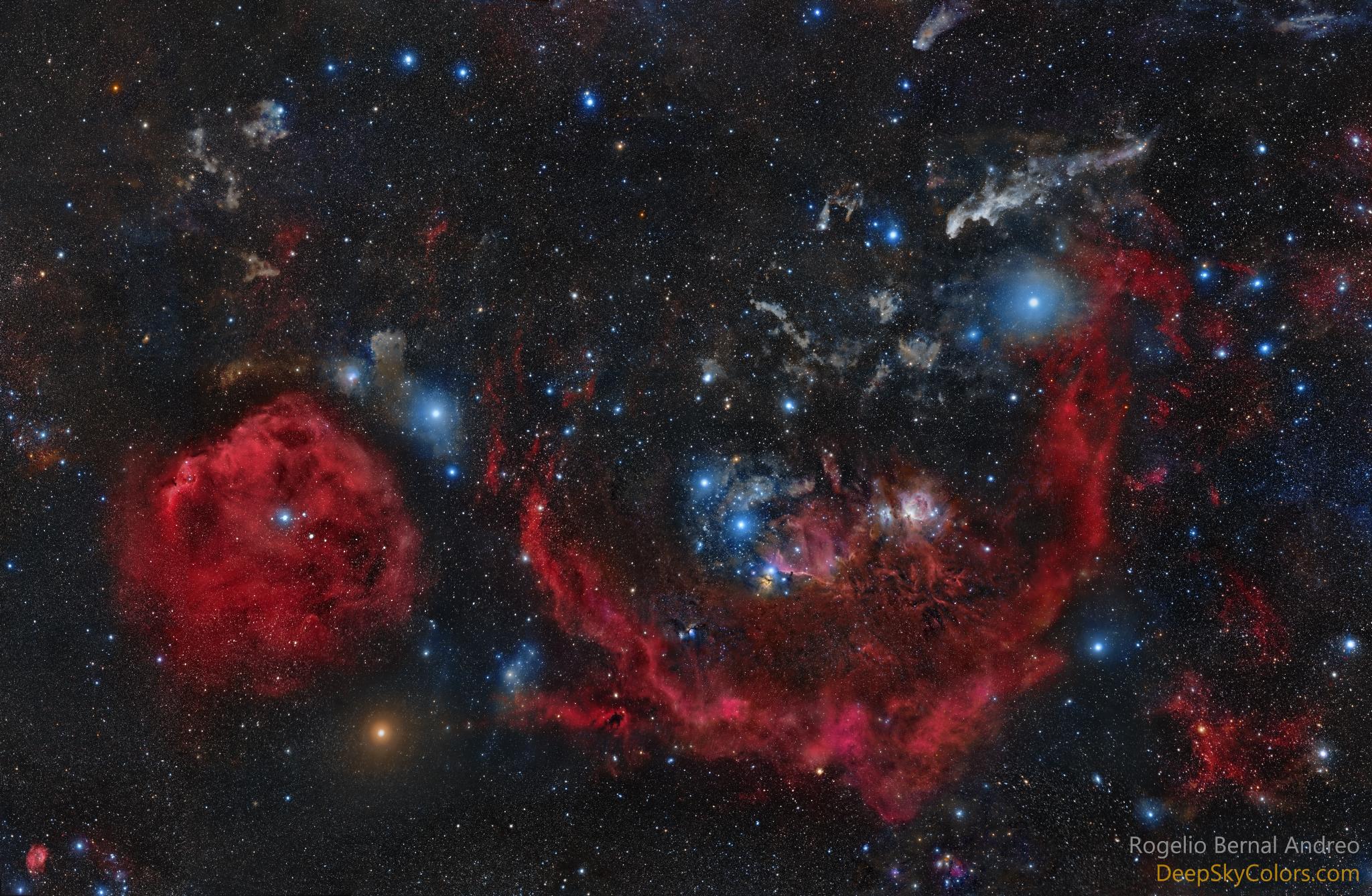
Astronomy picture of the day - 16-03-2015 - The Clouds of Orion the Hunter
Image Credit & Copyright: Rogelio Bernal Andreo
Explanation: Cradled in cosmic dust and glowing hydrogen, stellar nurseries in Orion the Hunter lie at the edge of giant molecular clouds some 1,500 light-years away. Spanning about 30 degrees, this breath-taking vista stretches across the well-known constellation from head to toe (left to right) and beyond. At 1,500 light years away, the Great Orion Nebula is the closest large star forming region, here visible just right and below center. To its left are theHorsehead Nebula, M78, and Orion's belt stars. Sliding your cursor over the picture will also find red giant Betelgeuse at the hunter's shoulder, bright blue Rigel at his foot, the Witch Head Nebula above -- and illuminated by -- Rigel, and the glowing Lambda Orionis (Meissa) nebula on the left, near Orion's head. Of course, the Orion Nebula and bright stars are easy to see with the unaided eye, but dust clouds and emission from the extensive interstellar gas in thisnebula-rich complex, are too faint and much harder to record. In this mosaic of broadband telescopic images, additional image data acquired with a narrow hydrogen alpha filter was used to bring out the pervasive tendrils of energized atomic hydrogen gas like in the arc of the giant Barnard's Loop.
2015-03-15
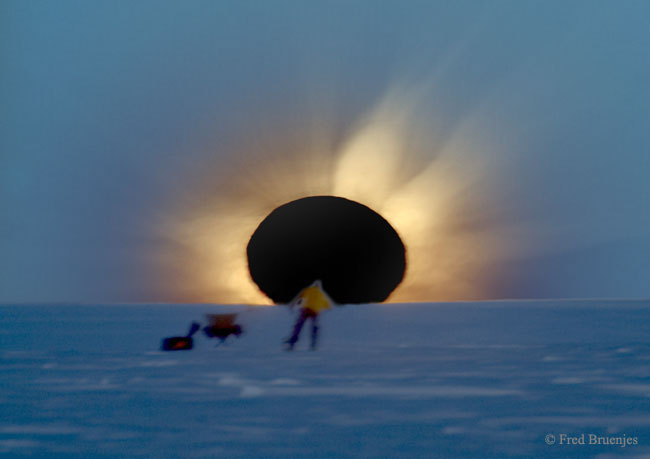
Astronomy picture of the day - 15-03-2015 - A Total Eclipse at the End of the World
Image Credit & Copyright: Fred Bruenjes (moonglow.net)
Explanation: Would you go to the end of the world to see a total eclipse of the Sun? If you did, would you be surprised to find someone else there already? In 2003, the Sun, the Moon, Antarctica, and two photographers all lined up in Antarctica during an unusual total solar eclipse. Even given the extreme location, a group of enthusiastic eclipse chasers ventured near the bottom of the world to experience the surreal momentary disappearance of the Sun behind the Moon. One of the treasures collected was the above picture -- a composite of four separate images digitally combined to realistically simulate how the adaptive human eye saw the eclipse. As the image was taken, both the Moon and the Sun peaked together over an Antarctic ridge. In the sudden darkness, the magnificent corona of the Sun became visible around the Moon. Quite by accident, another photographer was caught in one of the images checking his video camera. Visible to his left are an equipment bag and a collapsible chair. A total solar eclipse will occur on Friday and be visible from the north Atlantic Ocean.
2015-03-14
Aconteceu a 14 de março de...1879 - Nascimento do físico alemão Albert Einstein
A 14 de Março de 1879, nasce, em Ulm, (Alemanha) Albert Einstein, físico alemão que propôs a teoria da relatividade.
Entre Athènes et Berlin, l’escalade des vexations
Jusqu’à présent, Berlin avait réussi à garder son sang-froid. Habitués aux caricatures nazies, les responsables politiques sont restés insensibles aux provocations venant de Grèce.Angela Merkel en uniforme SS, Wolfgang Schäuble, ministre des Finances et chantre de la rigueur en Europe, caricaturé en soldat du IIIe Reich… Les Allemands ont l’habitude. Mais le ton s’est durci cette semaine. Les relations entre Berlin et Athènes se dégradent, alors même que le président de la Commission européenne, Jean-Claude Juncker, ne cachait pas son pessimisme hier après avoir rencontré à Bruxelles le premier ministre grec, Alexis Tsipras.
L’ambassadeur grec a protesté officiellement contre le ministre allemand des Finances, Wolfgang Schäuble, qui aurait «insulté» son homologue grec, Yanis Varoufakis, en le traitant de «bêtement naïf». Berlin a démenti. Mais cette plainte dénote l’atmosphère tendue entre les deux capitales. De son côté, le ministre allemand de l’Intérieur a dû réagir à des menaces venant d’Athènes. Thomas de Maizière a été obligé de réclamer des «explications» sur les menaces de «détourner vers l’Allemagne le flot de réfugiés et de demandeurs d’asile».
La dette de guerre nazie
... (voir la suite sur)...
La Tribune de Genève - Suisse
Le Vanuatu balayé par le violent cyclone PAM
L’archipel du Vanuatu, situé dans l’océan Pacifique, a subi, vendredi 13 mars, les assauts du cyclone Pam, de catégorie 5, le niveau maximal. Aucun bilan officiel n’était établi samedi dans la matinée, mais les Nations unies craignent un nombre important de victimes.
« Quinze ou trente minutes de terreur absolue. » C'est ainsi qu'Alice Clements, porte-parole de l'Unicef, a décrit le passage de Pam sur l'archipel du Vanuatu, vendredi 13 mars. Crédits : AP
En savoir plus sur
Le Monde - France
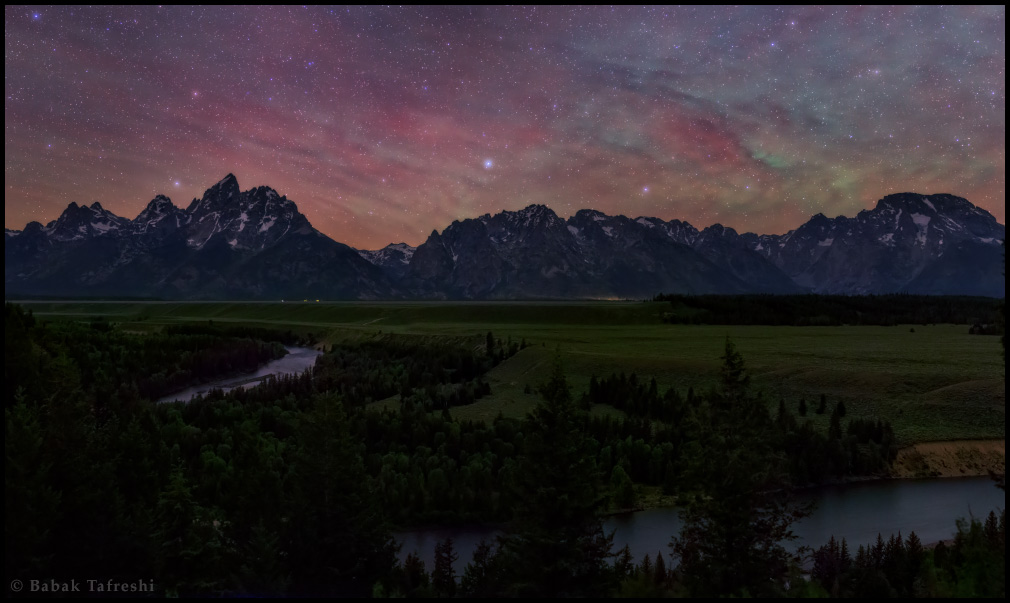
Astronomy picture of the day - 14-03-2015 - Tetons and Snake River, Planet Earth
Image Credit & Copyright: Babak Tafreshi (TWAN)
Explanation: An alluring night skyscape, this scene looks west across the Grand Teton National Park, Wyoming, USA, Planet Earth. The Snake River glides through the foreground, while above the Tetons' rugged mountain peaks the starry sky is laced with exceptionally strong red and green airglow. That night, the luminous atmospheric glow was just faintly visible to the eye, its color and wavey structure captured only by a sensitive digital camera. In fact, this contemporary digital photograph matches the location and perspective of a well-known photograph from 1942 - The Tetons and The Snake River , by Ansel Adams, renowned photographer of the American West. Adams' image is one of 115 images stored on the Voyager Golden Record. Humanity's message in a bottle, golden records were onboard both Voyager 1 and Voyager 2 spacecraft, launched in 1977 and now headed toward interstellar space.
Inscription à :
Commentaires (Atom)
.jpg)