2015-07-25

Las 10 razas de perros más raras del mundo - Lundehund noruego

Es físicamente diferente a cualquier otro: ¡tiene seis dedos en cada pata! La raza fue creada alrededor del siglo XV para la caza del frailecillo, un pájaro típico de Noruega. El sexto dedo fue añadido para aumentar su agarre a las rocas y evitar que se cayera. Otra particularidad está en la unión de sus huesos. Son capaces de girar la cabeza hacia atrás sobre la columna vertebral y de estirar las patas hasta quedar en 90 grados, como los brazos de los humanos.

Astronomy picture of the day - 2015 July 25 - Infrared Trifid

See Explanation.  Clicking on the picture will download
 the highest resolution version available.
Infrared Trifid 
Image Credit: J. Rho (SSC/Caltech), JPL-CaltechNASA
Explanation: The Trifid Nebula, also known as Messier 20, is easy to find with a small telescope, a well known stop in the nebula rich constellation Sagittarius. But where visible light pictures show the nebula divided into three parts by dark, obscuring dust lanes, this penetrating infrared image reveals filaments of glowing dust clouds and newborn stars. The spectacular false-color view is courtesy of the Spitzer Space Telescope. Astronomers have used the Spitzerinfrared image data to count newborn and embryonic stars which otherwise can lie hidden in the natal dust and gas clouds of this intriguing stellar nursery. As seen here, the Trifid is about 30 light-years across and lies only 5,500 light-years away.

2015-07-24

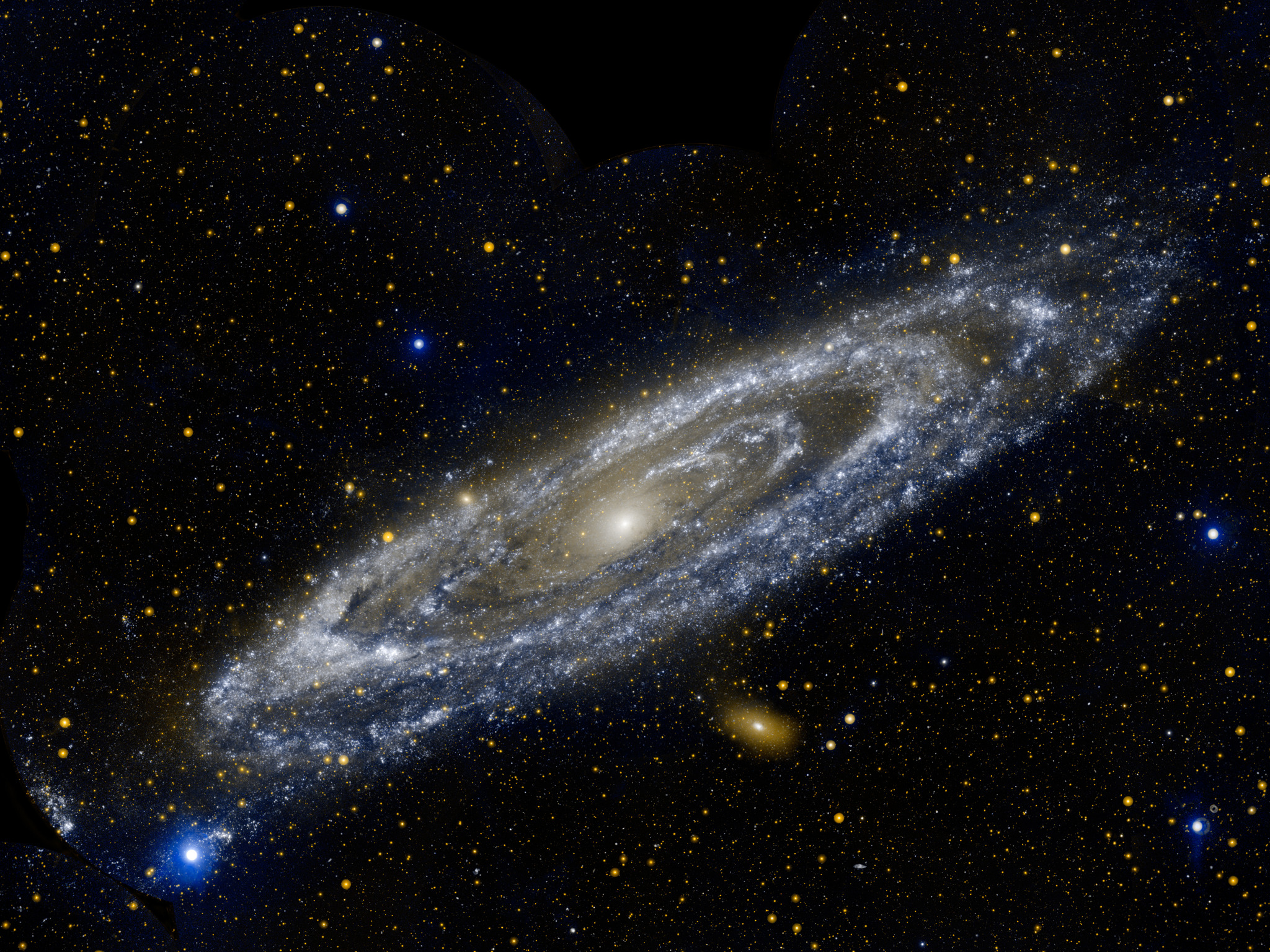
Astronomy picture of the day - 2015 July 24 - Ultraviolet Rings of M31

See Explanation.  Clicking on the picture will download
 the highest resolution version available.
Ultraviolet Rings of M31 
Image Credit: GALEX, JPL-CaltechNASA


Explanation: A mere 2.5 million light-years away the Andromeda Galaxy, also known as M31, really is just next door as large galaxies go. So close and spanning some 260,000 light-years, it took 11 different image fields from theGalaxy Evolution Explorer (GALEX) satellite's telescope to produce this gorgeous portrait of the spiral galaxy in ultraviolet light. While its spiral arms stand out in visible light images of Andromeda, the arms look more like rings in the GALEX ultraviolet view, a view dominated by the energetic light from hot, young, massive stars. As sites of intense star formation, the rings have been interpreted as evidence Andromeda collided with its smaller neighboring elliptical galaxy M32 more than 200 million years ago. The large Andromeda galaxy and our own Milky Way are the most massive members of the local galaxy group.

2015-07-23

Portugal: Terapia contra cancro a revelar-se eficaz


Uma molécula para terapia inovadora no tratamento de vários tipos de cancro, patenteada pela Universidade de Coimbra (UC), está a revelar, de acordo com os estudos efetuados, a "eficácia desejada", anunciou esta quinta-feira esta instituição. "Vários estudos e experiências realizadas em ratinhos, entre 2011 e 2014, provaram a eficácia da molécula Redaporfin", descoberta na UC, para o tratamento de diversos tipos de cancro, "através de terapia fotodinâmica" (tratamento inovador que "permite eliminar células cancerígenas de forma precisa"), afirma a UC numa nota hoje divulgada. De acordo com os ensaios realizados, "86% dos ratinhos com tumores diversos que foram tratados com esta tecnologia, seguindo exigentes protocolos de segurança, ficaram curados", salienta a mesma nota, adiantando que "não se observaram efeitos secundários, como acontece com os tratamentos convencionais", como a quimioterapia. O estudo, que acaba de ser publicado no European Journal of Cancer, demonstrou igualmente uma "taxa de reincidência da doença muitíssimo baixa", revelando a eficácia do fármaco. Os testes efetuados "previram com rigor quando é que a resposta ao tratamento iria surgir, com que doses e em que circunstâncias seriam obtidos os efeitos terapêuticos no doente", salienta o diretor da química medicinal deste projeto, Luís Arnaut. As previsões estão a ser "confirmadas nos ensaios clínicos em curso", acrescenta o investigador da UC. Esta confirmação é "excecional" porque, "na grande maioria dos estudos, muito do conhecimento adquirido nos testes em animais não é confirmado nos humanos", mas "neste caso foi possível chegar à dose adequada para obter resultado terapêutico nos doentes sem efeitos adversos, como previsto", explica Luís Arnaut. 

Ler mais em: http://www.cmjornal.xl.pt/nacional/sociedade/detalhe/terapia_contra_cancro_esta_a_revelar_se_eficaz.html

Origem de expressões populares: "Gatos-pingados"


Significado: Tem sentido depreciativo usando-se para referir uma suposta inferioridade (numérica ou institucional), insignificância ou irrelevância. Origem: Esta expressão remonta a uma tortura procedente do Japão que consistia em pingar óleo a ferver em cima de pessoas ou animais, especialmente gatos. Existem várias narrativas ambientais na Ásia que mostram pessoas com os pés mergulhados num caldeirão de óleo quente. Como o suplício tinha uma assistência reduzida, tal era a crueldade, a expressão "gatos pingados" passou a denominar pequena assistência sem entusiasmos ou curiosidade para qualquer evento.

Prof. Paulo 

Foto - "Barquinhos" - 22-07-2015

"Barquinhos"

Cap Ferret
22-07-2015
JoanMira

Astronomy picture of the day - 22-07-2015 - Comet Tails and Star Trails

See Explanation.  Clicking on the picture will download
 the highest resolution version available.
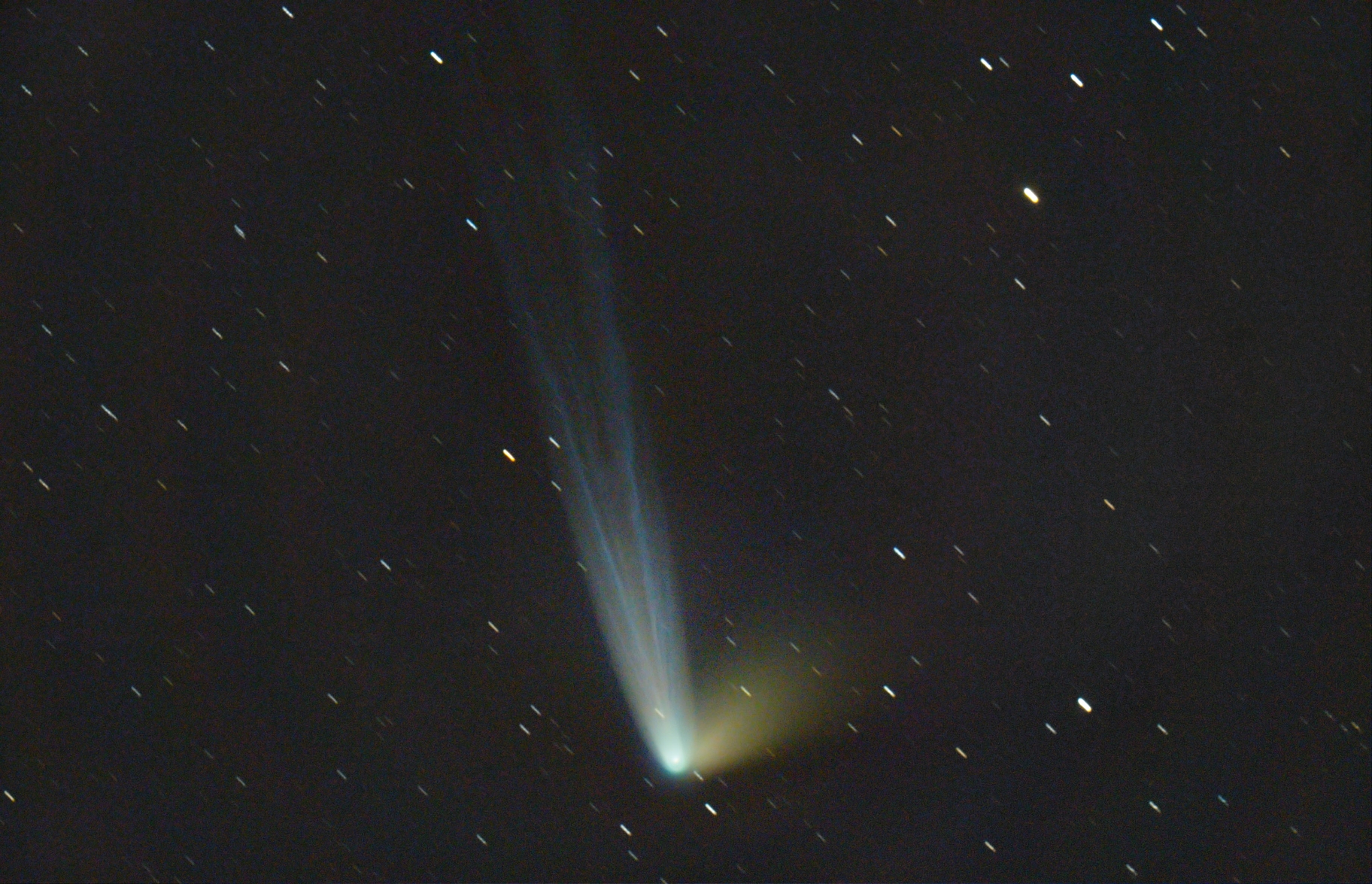
Comet Tails and Star Trails 
Image Credit & Copyright: Kevin Parker
Explanation: After grazing the western horizon on northern summer evenings Comet PanSTARRS (also known as C/2014 Q1) climbed higher in southern winter skies. A visitor to the inner Solar System discovered in August 2014 by the prolific panSTARRS survey, the comet was captured here on July 17. Comet and colorful tails were imaged from Home Observatory in Mackay, Queensland, Australia. The field of view spans just over 1 degree. Sweeping quickly across a the sky this comet PanSTARRS was closest to planet Earth about 2 days later. Still, the faint stars of the constellation Cancer left short trails in the telescopic image aligned to track the comet's rapid motion. PanSTARRS' bluish ion tails stream away from the Sun, buffetted by the solar wind. Driven by the pressure of sunlight, its more diffuse yellowish dust tail is pushed outward and lags behind the comet's orbit. A good target for binoculars from southern latitudes, in the next few days the comet will sweep through skies near Venus, Jupiter, and bright star Regulus.

2015-07-20

Origem de expressões populares: Verdade de La Pallisse


Significado: Uma verdade de La Palice (ou lapalissada / lapaliçada) é evidência tão grande, que se torna ridícula. Origem: O guerreiro francês Jacques de Chabannes, senhor de La Palice (1470-1525), nada fez para denominar hoje um truísmo. Fama tão negativa e multissecular deve-se a um erro de interpretação. Na sua época, este chefe militar celebrizou-se pela vitória em várias campanhas. Até que, na batalha de Pavia, foi morto em pleno combate. E os soldados que ele comandava, impressionados pela sua valentia, compuseram em sua honra uma canção com versos ingénuos: "O Senhor de La Palice / Morreu em frente a Pavia; / Momentos antes da sua morte, / Podem crer, inda vivia." O autor queria dizer que Jacques de Chabannes pelejara até ao fim, isto é, "momentos antes da sua morte", ainda lutava. Mas saiu-lhe um truísmo, uma evidência. Segundo a enciclopédia Lello, alguns historiadores consideram esta versão apócrifa. Só no século XVIII se atribuiu a La Palice um estribilho que lhe não dizia respeito. Portanto, fosse qual fosse o intuito dos versos, Jacques de Chabannes não teve culpa.

Prof. Paulo

Astronomy picture of the day - 2015 July 20 - Comet PanSTARRS and a Crescent Moon

See Explanation.  Clicking on the picture will download
 the highest resolution version available.
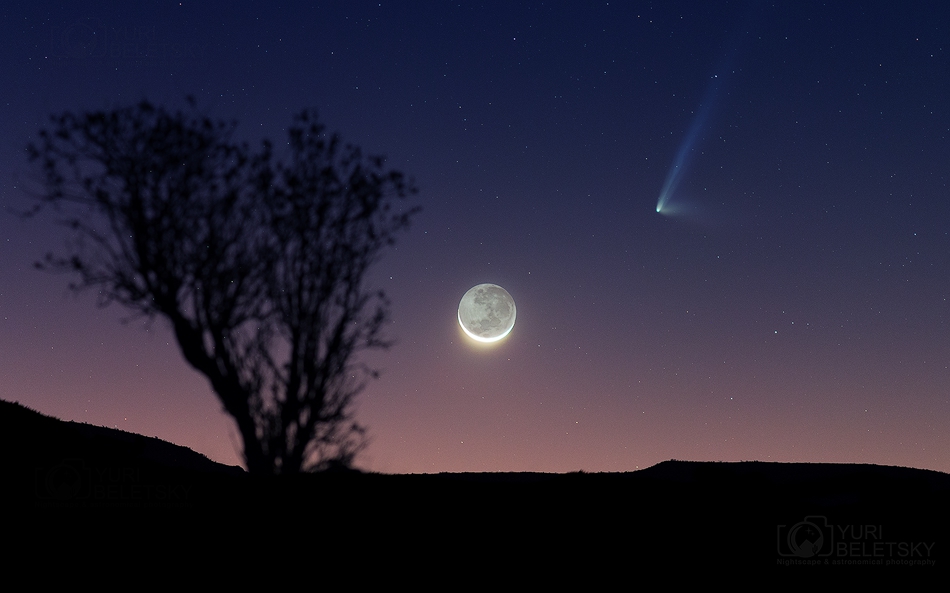
Comet PanSTARRS and a Crescent Moon 
Image Credit & Copyright: Yuri Beletsky (Las Campanas ObservatoryCarnegie Institution)


Explanation: A comet has brightened quickly and unexpectedly. Discovered last year, Comet C/2014 Q1 (PanSTARRS) is expected to be visible now for a few days to the unaided eye, just after sunset, from some locations. The comet rounded the Sun on July 6 and apparently has shed quite a bit of gas and dust. Today it is now as close as it will ever get to the Earth, which is another factor in its recent great apparent brightness and the large angular extent of its tails. In the featured image taken two days ago, Comet PanSTARRS is seen sporting a short white dust tail fading to the right, and a long blue ion tail pointing away from the recently set Sun. A crescent moon dominates the image center. Tomorrow, Comet PannSTARRS will pass only 7 degrees away from a bright Jupiter, with even brighter Venus nearby. Due to its proximity to the Sun, the comet and its tails may best be seen in the sunset din with binoculars or cameras using long-duration exposures.