2017-10-14

Astronomy picture of the day - 2017 October 14 - All-Sky Steve

See Explanation.  Clicking on the picture will download
 the highest resolution version available.
All-Sky Steve 
Image Credit & CopyrightAlan Dyer, Amazingsky.com, TWAN
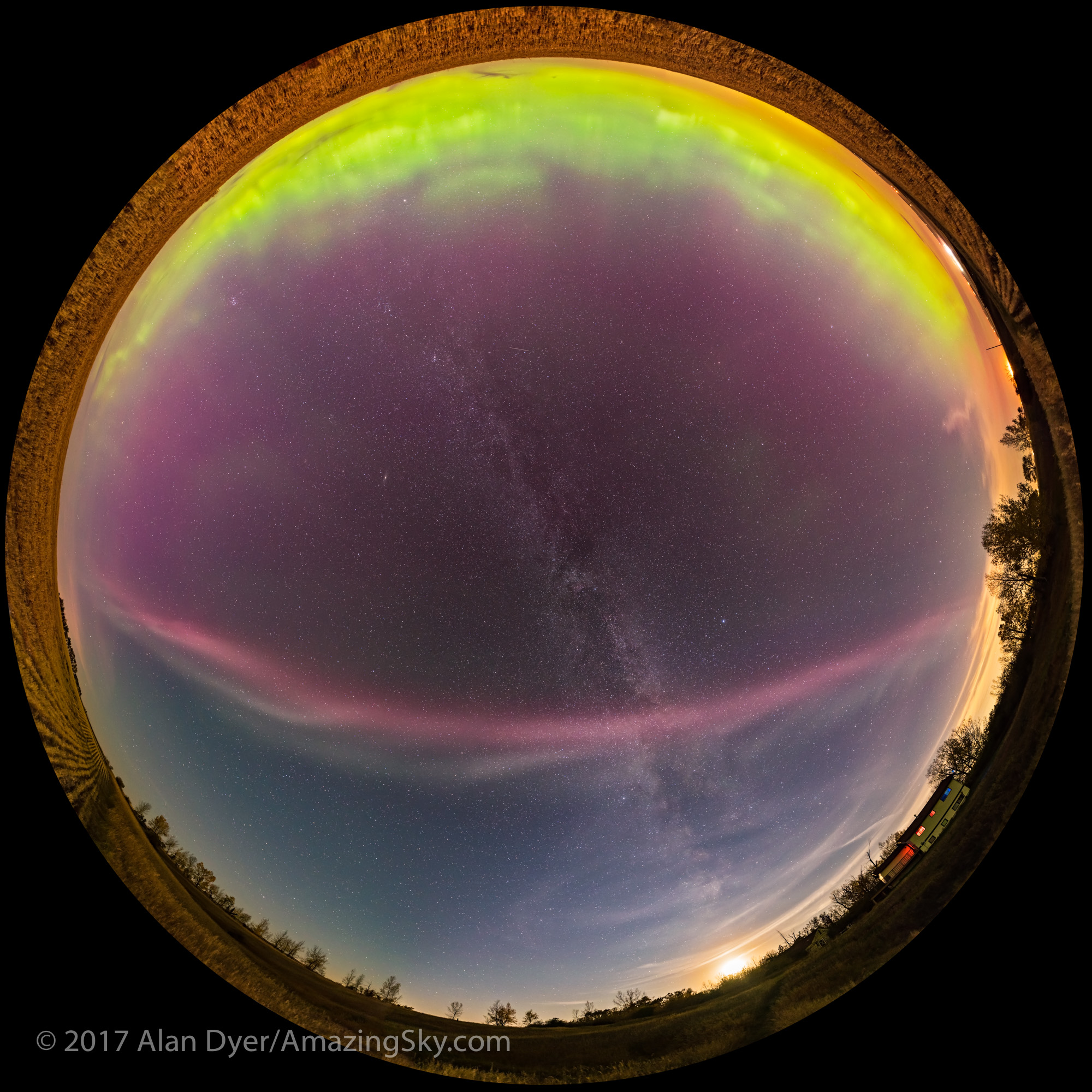
Explanation: Familiar green and red tinted auroral emission floods the sky along the northern (top) horizon in this fish-eye panorama projection from September 27. On the mild, clear evening the Milky Way tracks through the zenith of a southern Alberta sky and ends where the six-day-old Moon sets in the southwest. The odd, isolated, pink and whitish arc across the south has come to be known as Steve. The name was given to the phenomenon by the Alberta Aurora Chasers Facebook group who had recorded appearances of the aurora-like feature. Sometimes mistakenly identified as a proton aurora or proton arc, the mysterious Steve arcs seem associated with aurorae but appear closer to the equator than the auroral curtains. Widely documented by citizen scientists and recently directly explored by a Swarm mission satellite, Steve arcs have been measured as thermal emission from flowing gas rather than emission excited by energetic electrons. Even though a reverse-engineered acronym that fits the originally friendly name is Sudden Thermal Emission from Velocity Enhancement, his origin is still mysterious.

2017-10-13

Astronomy picture of the day - 2017 October 13 - Under the Galaxy

See Explanation.  Clicking on the picture will download
 the highest resolution version available.
Under the Galaxy 
Image Credit & CopyrightYuri Beletsky (Carnegie Las Campanas ObservatoryTWAN)
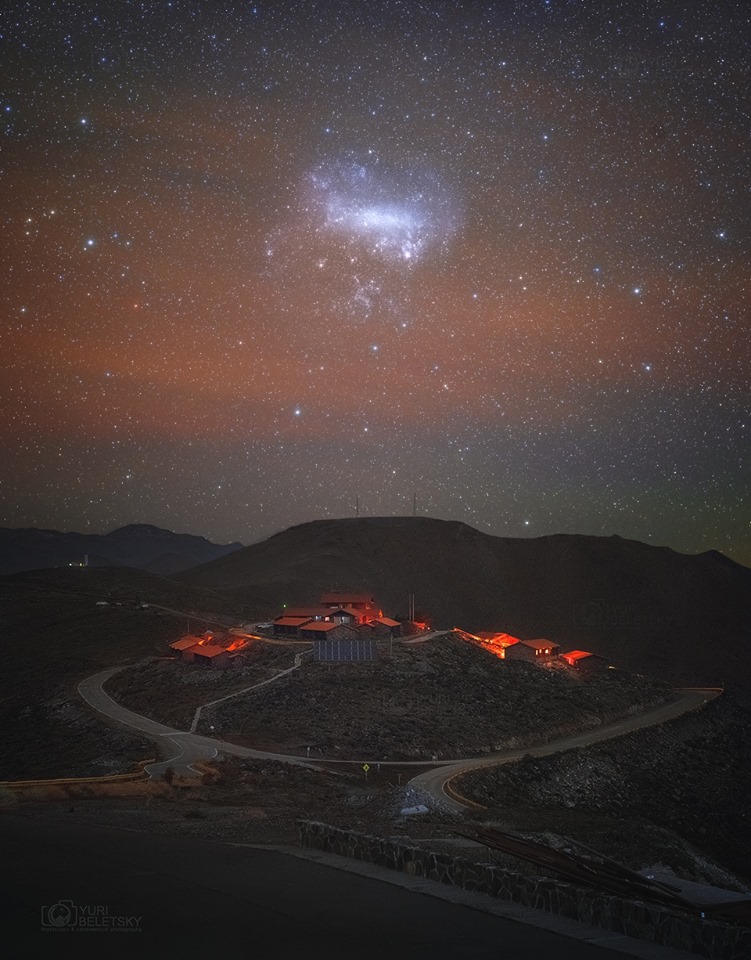
Explanation: The Large Magellanic Cloud, a satellite galaxy of the Milky Way, stands above the southern horizon in this telephoto view from Las Campanas Observatory, planet Earth. In the dark September skies of the Chilean Atacama desert, the small galaxy has an impressive span of about 10 degrees or 20 Full Moons. The sensitive digital camera's panorama has also recorded a faint, pervasive airglow, otherwise invisible to the eye. Apparently bright terrestrial lights in the foreground are actually very dim illumination from the cluster of housing for the observatory astronomers and engineers. But the flattened mountain top along the horizon just under the galaxy is Las Campanas peak, home to the future Giant Magellan Telescope.

2017-10-12

Astronomy picture of the day - 2017 October 12 - NGC 1365: Majestic Island Universe

See Explanation.  Clicking on the picture will download
 the highest resolution version available.
NGC 1365: Majestic Island Universe 
Image Credit & CopyrightDietmar HagerEric BensonTorsten Grossmann
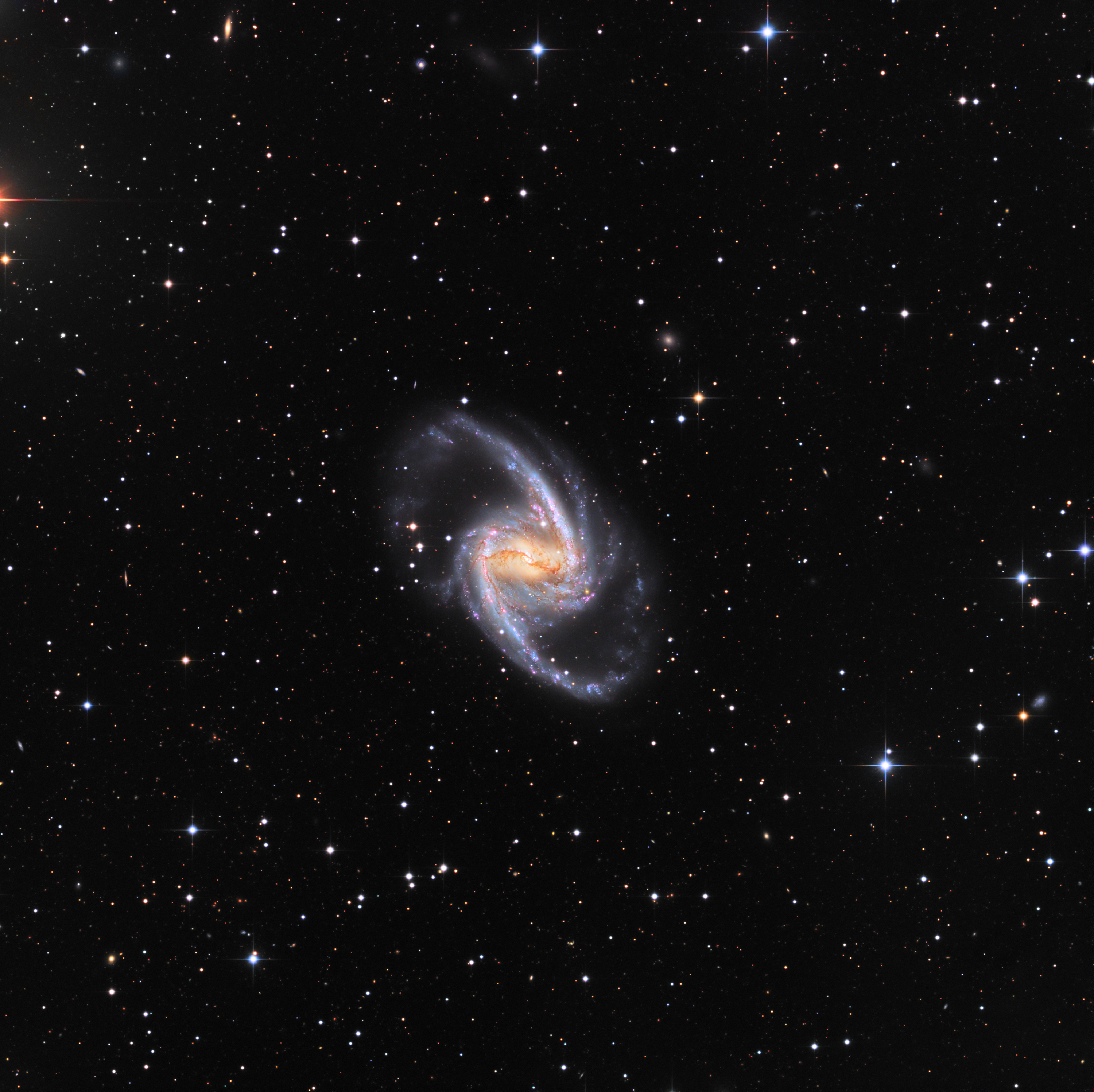
Explanation: Barred spiral galaxy NGC 1365 is truly a majestic island universe some 200,000 light-years across. Located a mere 60 million light-years away toward the chemical constellation Fornax, NGC 1365 is a dominant member of the well-studied Fornax galaxy cluster. This impressively sharp color image shows intense star forming regions at the ends of the bar and along the spiral arms, and details of dust lanes cutting across the galaxy's bright core. At the core lies a supermassive black hole. Astronomers think NGC 1365's prominent bar plays a crucial role in the galaxy's evolution, drawing gas and dust into a star-forming maelstrom and ultimately feeding material into the central black hole.

2017-10-11

Expressões populares portuguesas - "Deixámos isso em banho-maria"


Résultat de recherche d'images pour "imagem de banho maria"

A expressão que usamos quando deixamos em suspenso ou adiamos um determinado assunto, cuja resolução ainda pode demorar a concretizar-se ; mas a verdade é que “deixar algo em banho-maria” remonta ao tempo da panelas de cobre e das velhas colheres de pau.


Durante o banho-maria, cozinham-se os alimentos dentro de um recipiente colocado num outro cheio de água quente. O método saiu dos laboratórios químicos que produziam produtos para as farmacêuticas ou criavam cosméticos, processos extremamente lentos.

Mas quem era Maria? Diz-se que era uma judia alquimista de Alexandria. Viveu trezentos anos antes do nascimento de Jesus de Nazaré e é a ela que se atribui a descoberta do “aquecimento lento e gradual através da água como alternativa à manipulação das substâncias diretamente no fogo”, escreve Andreia Vale no livro sobre expressões do dia-a-dia.

Mas Marias há muitas que utilizaram – e utilizam ainda hoje – esta técnica.

Astronomy picture of the day - 2017 October 11 - Star Cluster NGC 362 from Hubble

See Explanation.  Clicking on the picture will download
 the highest resolution version available.
Star Cluster NGC 362 from Hubble 
Image Credit: Hubble WFC3NASAESAJ. HeylI. Caiazzo, & Javiera Parada (UBC)
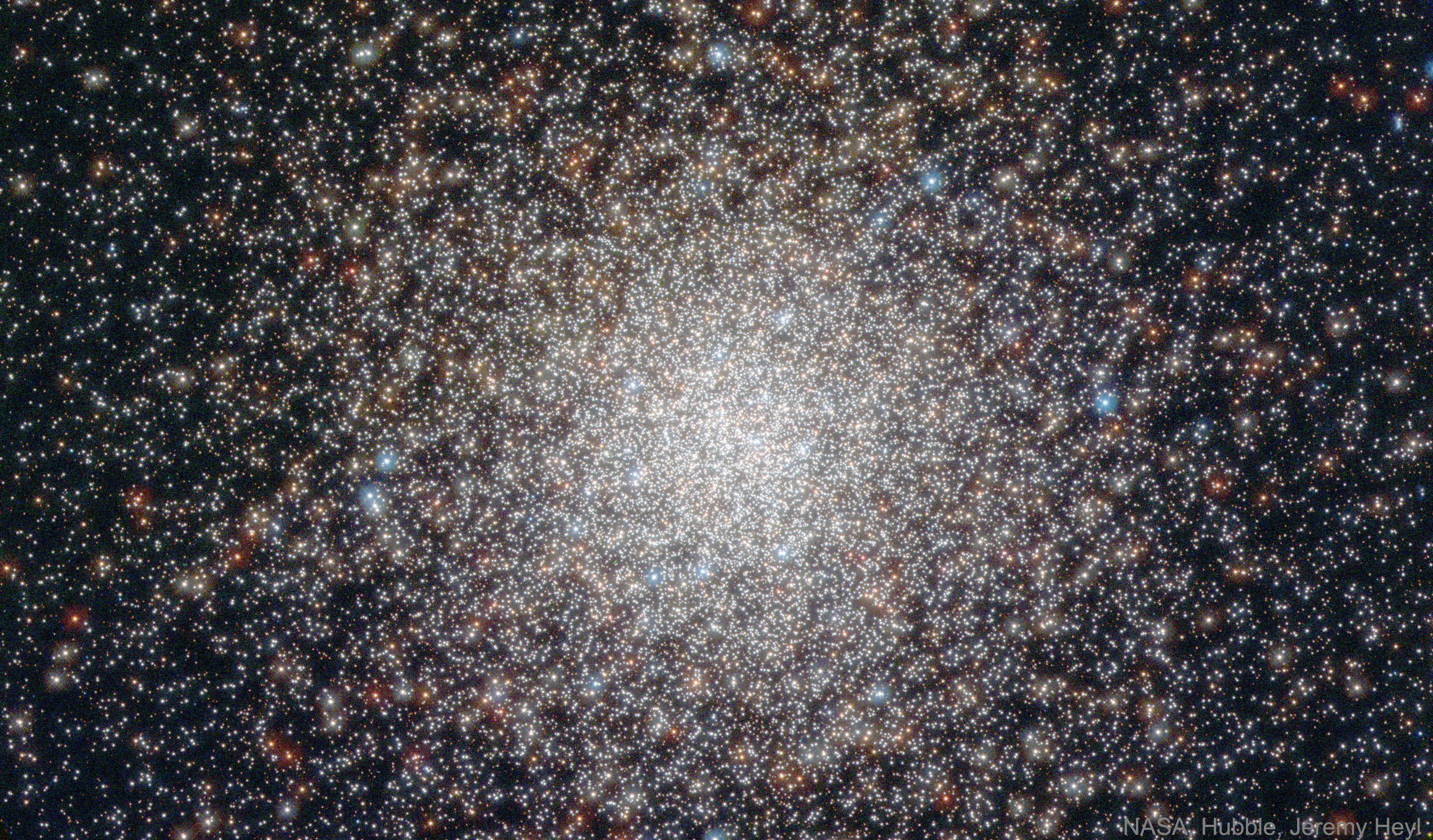
Explanation: If our Sun were near the center of NGC 362, the night sky would glow like a jewel box of bright stars. Hundreds of stars would glow brighter than Sirius, and in many different colors. Although these stars could become part of breathtaking constellations and intricate folklore, it would be difficult for planetary inhabitants there to see -- and hence understand -- the greater universe beyond. NGC 362 is one of only about 170 globular clusters of stars that exist in our Milky Way Galaxy. This star cluster is one of the younger globulars, forming likely well after our Galaxy. NGC 362 can be found with the unaided eye nearly in front of the Small Magellanic Cloud, and angularly close to the second brightest globular cluster known, 47 Tucanae. The featured image was taken with the Hubble Space Telescope to help better understand how massive stars end up near the center of some globular clusters.

Futebol - Portugal 2, Suiça, 0


Apesar de nunca por lá ter passado durante a fase de apuramento, Portugal terminou no primeiro lugar do Grupo B e garantiu a qualificação directa para o Mundial 2018. Um triunfo por 2-0 sobre a Suíça permitiu à selecção portuguesa corrigir o passo em falso dado na jornada inicial, em Basileia. As duas equipas terminam empatadas com 27 pontos, mas a vantagem é portuguesa graças à superior diferença entre golos marcados e sofridos. Um autogolo de Djourou deu início às celebrações no Estádio da Luz, que subiram de tom quando André Silva ampliou o marcador. A noite acabou com jogadores e equipa técnica abraçados no relvado, unidos por uma bandeira nacional gigante, e o hino cantado “a cappella” pelas bancadas.

A missão estava cumprida com sucesso e a viagem marcada para a Rússia, anfitriã do Campeonato do Mundo. Será a décima fase final consecutiva para a selecção portuguesa, numa série que começou com o Euro 2000. Mas a caminhada para o Mundial 2018 começou com um tropeção, três meses depois de a equipa nacional ter-se sagrado campeã da Europa. A derrota na Suíça prometeu complicar a tarefa neste apuramento, até porque seria o início de uma série de nove triunfos consecutivos para os suíços, e a selecção foi obrigada a descer à terra. Portugal manteve a perseguição e na última jornada pulou para o primeiro lugar.

Publico - Portugal

2017-10-10

Playing For Change - "With my own two hands" - Video - Music

"With my own two hands"


Fotos - "Jovem Oliveira"

"Jovem Oliveira"

09-10-2017
JoanMira

Astronomy picture of the day - 2017 October 10 - Milky Way and Zodiacal Light over Australian Pinnacles

See Explanation.
Moving the cursor over the image will bring up an annotated version.
Clicking on the image will bring up the highest resolution version
available.
Milky Way and Zodiacal Light over Australian Pinnacles 
Image Credit & Copyright: Jingyi Zhang
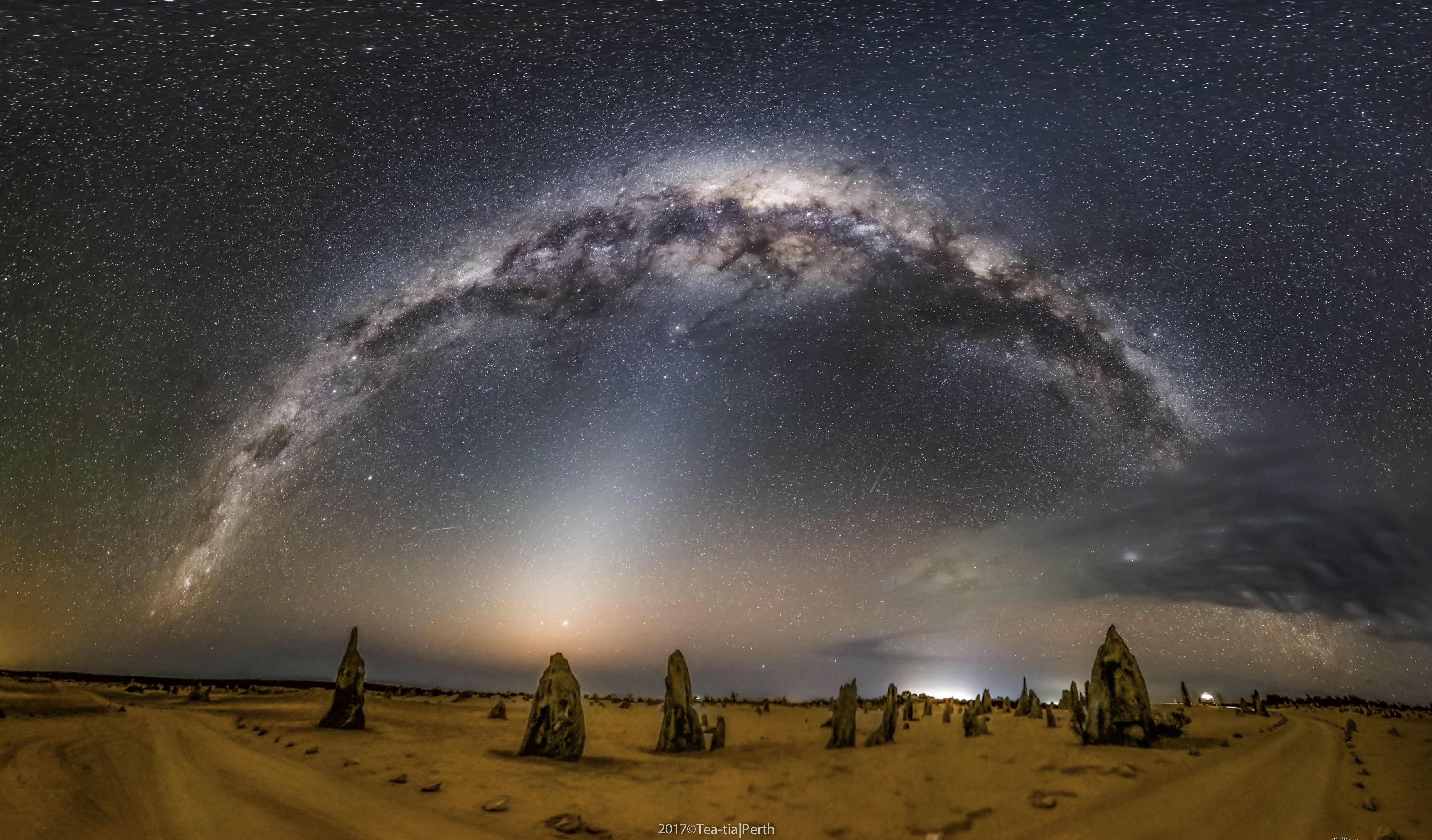
Explanation: What strange world is this? Earth. In the foreground of the featured image are the Pinnacles, unusual rock spires in Nambung National Park in Western Australia. Made of ancient sea shells (limestone), how these human-sized picturesque spires formed remains a topic of research. The panorama was taken last month. A ray of zodiacal light, sunlight reflected by dust grains orbiting between the planets in the Solar System, rises from the horizon near the image center. Arching across the top is the central band of our Milky Way Galaxy. The planets Jupiter and Saturn, as well as several famous stars are also visible in the background night sky.

2017-10-09

Astronomy picture of the day - 2017 October 9 - Unusual Mountain Ahuna Mons on Asteroid Ceres

See Explanation.  Clicking on the picture will download
 the highest resolution version available.
Unusual Mountain Ahuna Mons on Asteroid Ceres 
Image Credit: Dawn MissionNASAJPL-CaltechUCLA, MPS/DLR/IDA
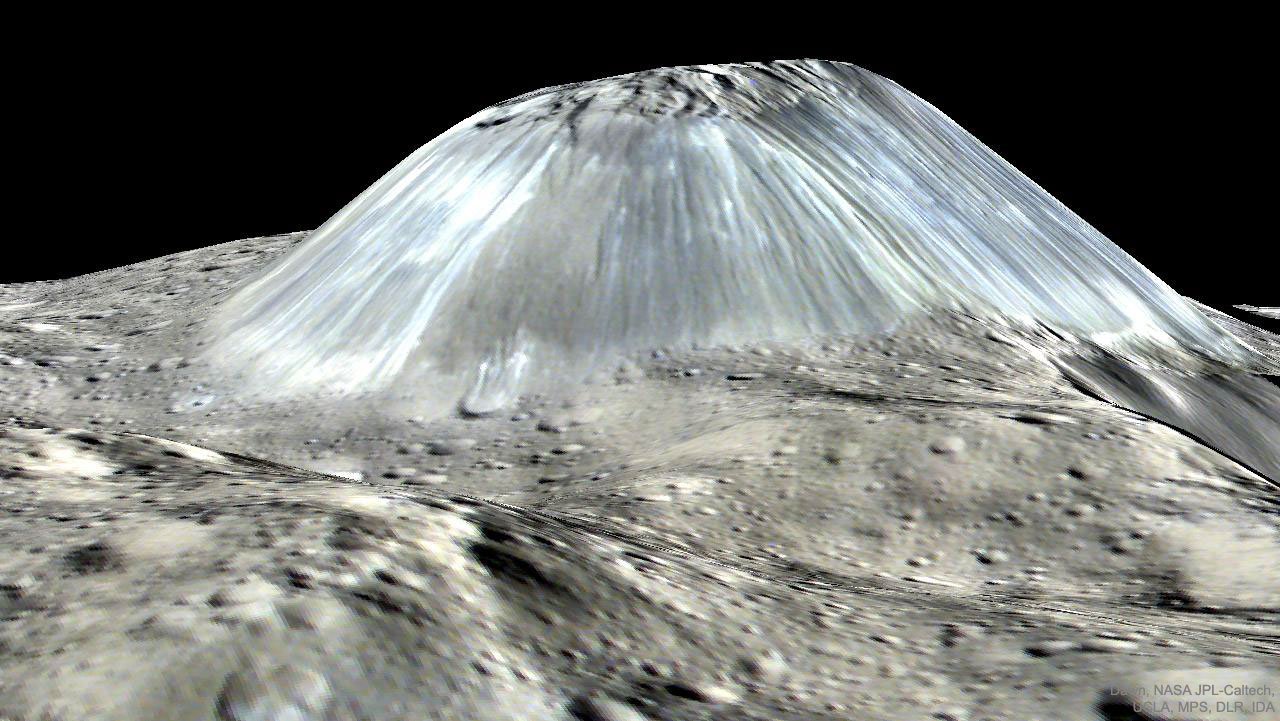
Explanation: What created this unusual mountain? Ahuna Mons is the largest mountain on the largest known asteroid in our Solar SystemCeres, which orbits our Sun in the main asteroid belt between Mars and JupiterAhuna Mons, though, is like nothing that humanity has ever seen before. For one thing, its slopes are garnished not with old craters but young vertical streaks. One hypothesis holds that Ahuna Mons is an ice volcano that formed shortly after a large impact on the opposite side of the dwarf planet loosened up the terrain through focused seismic waves. The bright steaks may be high in reflective salt, and therefore similar to other recently surfaced material such as visible in Ceres' famous bright spots. The featured double-height digital image was constructed from surface maps taken of Ceres last year by the robotic Dawn mission.