2018-04-09
2018-04-08
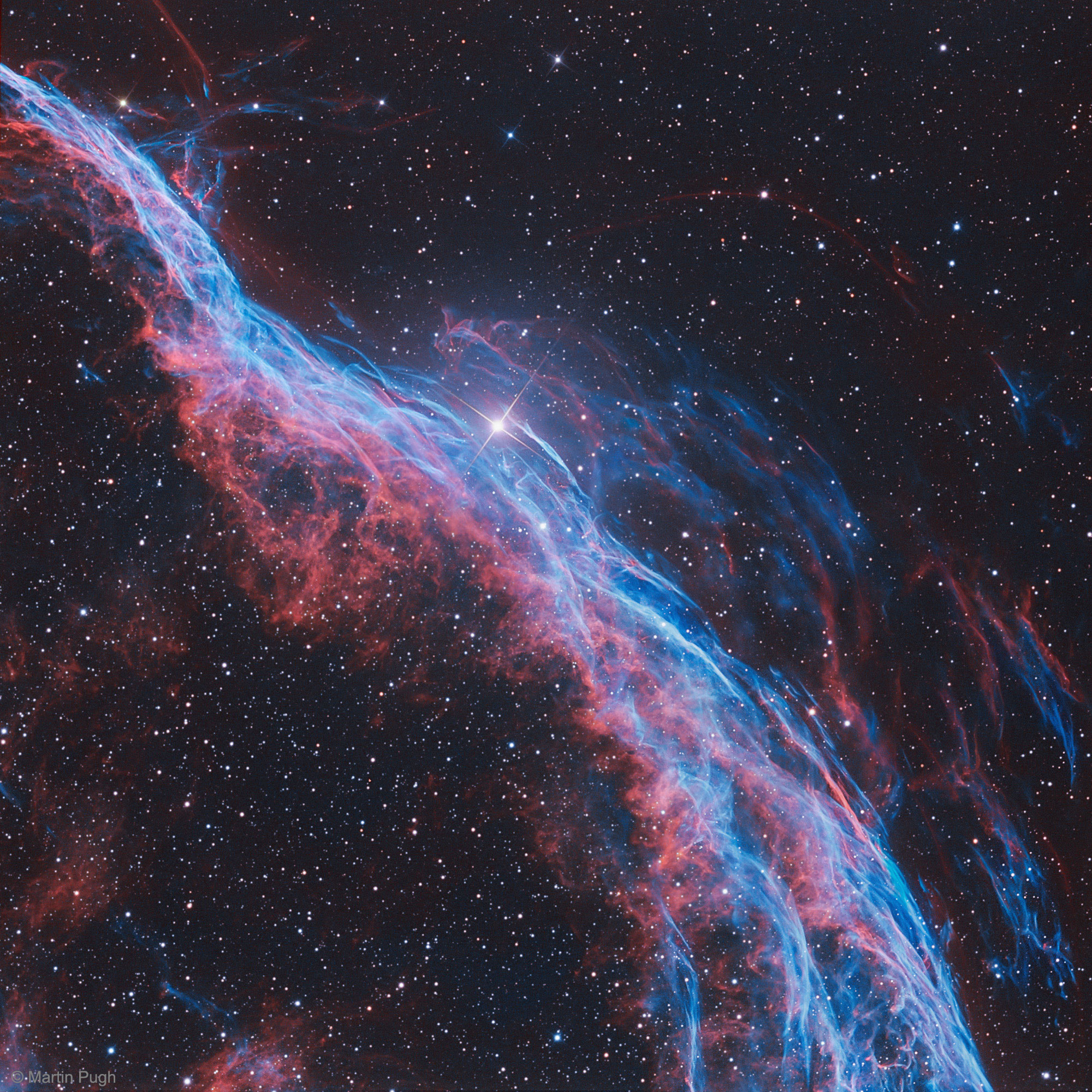
The Witch's Broom Nebula - Astronomy picture of the day - 2018 April 8

Image Credit & Copyright: Martin Pugh (Heaven's Mirror Observatory)
Explanation: Ten thousand years ago, before the dawn of recorded human history, a new light would have suddenly have appeared in the night sky and faded after a few weeks. Today we know this light was from a supernova, or exploding star, and record the expanding debris cloud as the Veil Nebula, a supernova remnant. This sharp telescopic view is centered on a western segment of the Veil Nebula cataloged as NGC 6960 but less formally known as the Witch's Broom Nebula. Blasted out in the cataclysmic explosion, the interstellar shock wave plows through space sweeping up and exciting interstellar material. Imaged with narrow band filters, the glowing filaments are like long ripples in a sheet seen almost edge on, remarkably well separated into atomic hydrogen (red) and oxygen (blue-green) gas. The complete supernova remnant lies about 1400 light-years away towards the constellation Cygnus. This Witch'sBroom actually spans about 35 light-years. The bright star in the frame is 52 Cygni, visible with the unaided eye from a dark location but unrelated to the ancient supernova remnant.
Panorama sur la plaine de Thrace (Bulgarie) - L'image du jour - 08-04-2018
Panorama sur la plaine de Thrace et la ville de Sliven (Bulgarie) d’un promontoire du Grand Balkan.
2018-04-07
Sebastião Ribeiro Salgado Júnior - "Etiópia, 1984" - Fotografia
"Etiópia, 1984"
Sebastião Ribeiro Salgado Júnior (Aimorés, 8 de fevereiro de 1944) é um fotógrafo brasileiro reconhecido mundialmente por seu estilo único de fotografar. Nascido em Minas Gerais, é um dos mais respeitados fotojornalistas da atualidade.
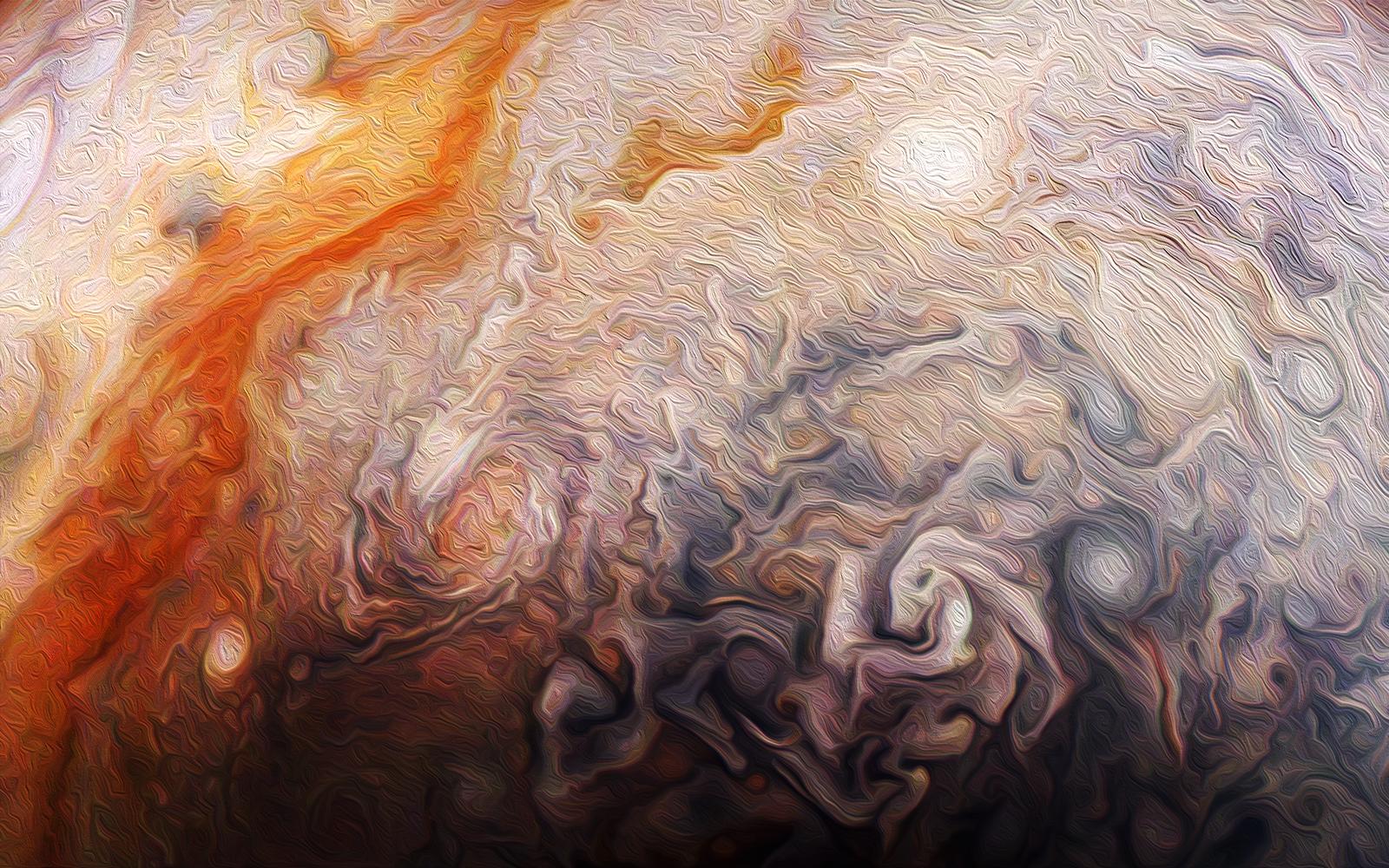
Astronomy picture of the day - 2018 April 7 - Painting with Jupiter

Image Credit: NASA, JPL-Caltech, SwRI, MSSS; Processing: Rick Lundh
Explanation: Brush strokes of Jupiter's signature atmospheric bands and vortices form this planetary post-impressionist work of art. The creative image uses actual data from the Juno spacecraft's JunoCam. To paint on the digital canvas, a image with light and dark tones was chosen for processing and an oil-painting software filter applied. The image data was captured during perijove 10, Juno's December 16, 2017 close encounter with the solar system's ruling gas giant. At the time the spacecraft was cruising about 13,000 kilometers above northern Jovian cloud tops.
2018-04-06
2018-04-05
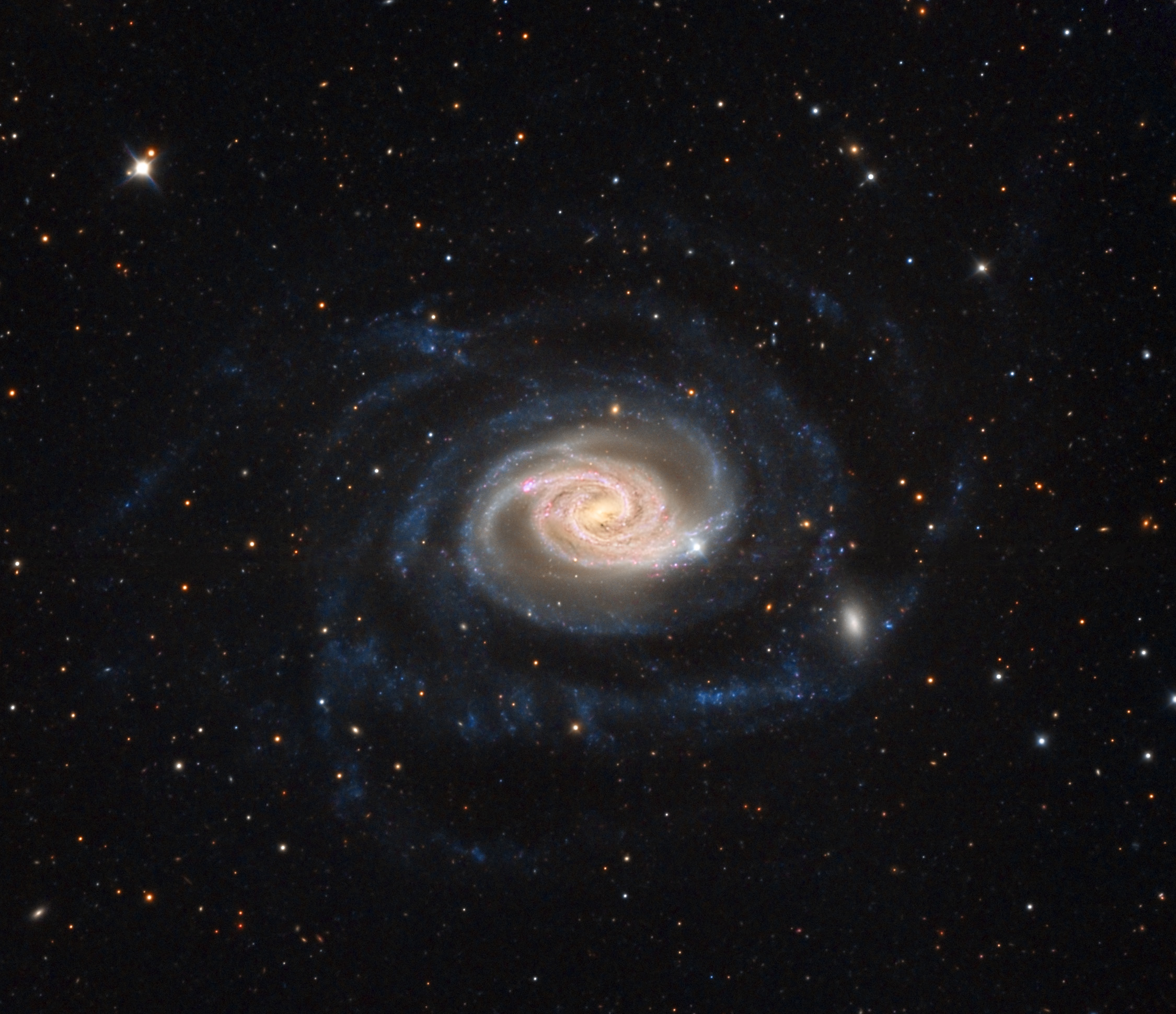
NGC 289: Swirl in the Southern Sky - Astronomy picture of the day - 2018 April 5

Image Credit & Copyright: Adam Block, ChileScope
Explanation: About 70 million light-years distant, gorgeous spiral galaxy NGC 289 is larger than our own Milky Way. Seen nearly face-on, its bright core and colorful central disk give way to remarkably faint, bluish spiral arms. Theextensive arms sweep well over 100 thousand light-years from the galaxy's center. At the lower right in this sharp, telescopic galaxy portrait the main spiral arm seems to encounter a small, fuzzy elliptical companion galaxy interacting with enormous NGC 289. Of course the spiky stars are in the foreground of the scene. They lie within the Milky Way toward the southern constellation Sculptor.
2018-04-04
Le Figaro - Il y a 50 ans, Martin Luther King était assassiné - Articles
"I have a dream": un rêve pour son peuple.
La voix de la non-violence rendue silencieuse. Ce jeudi 4 avril 1968 une terrible nouvelle est relayée par les agences de presse Reuter, A.F.P et A.P: l'assassinat du révérend baptiste Martin Luther King. Passé le choc de cette tragédie, on redoute que ce meurtre n'entraîne des troubles graves. Il est en effet considéré comme «le seul homme capable de freiner la violence» dans un contexte de lutte contre la ségrégation raciale, de propagande raciste, et d'extrémisme de la part de Blancs comme de Noirs.
Le Figaro - France
Astronomy picture of the day - 2018 April 4 - Intrepid Crater on Mars from Opportunity

Image Credit: NASA, JPL, Cornell, Opportunity Rover Team,
Explanation: The robotic rover Opportunity sometimes passes small craters on Mars. Pictured here in 2010 is Intrepid Crater, a 20-meter across impact basin slightly larger than Nereus Crater that Opportunity had chanced across previously. The featured image is in approximately true color but horizontally compressed to accommodate a wide angle panorama. Intrepid Crater was named after the lunar module Intrepid that carried Apollo 12 astronauts to Earth's Moon 49 years ago. Beyond Intrepid Crater and past long patches of rusty Martian desert lie peaks from the rim of large Endeavour Crater, visible on the horizon. The Opportunity rover continues to explore Mars, recently surpassing5,000 Martian days on the red planet.
Inscription à :
Commentaires (Atom)