Nombre total de pages vues

2017-05-21

Article - Corruption sur la vente de sous-marins au Brésil


La DCNS assure au JDD avoir "respecté les règles de droit"

La DCNS, groupe industriel français spécialisé dans le naval militaire, assure au JDDavoir "respecté les règles de droit". Pourtant, la justice a lancé une enquête. Le Parquet national financier cherche en effet à savoir si la vente de cinq sous-marins par la France au Brésil en 2008 a donné lieu au versement de pots-de-vin. Quatre magistrats, dont la chef du PNF, Eliane Houlete, se sont rendus la semaine dernière au Brésil officiellement pour "renforcer la coopération judiciaire" entre les deux pays. Mais selon nos informations, ils ont aussi tenu de discrètes réunions de travail avec des enquêteurs brésiliens sur un grand dossier de corruption qui ébranle le pays, issu du tentaculaire scandale Petrobras.

En 2008, la France, via la DCNS, vend cinq sous-marins, dont un à propulsion nucléaire, au Brésil. Le tout pour un montant de 6,7 milliards d'euros. L'entreprise française DCNS a-t-elle ou non été liée à de quelconques surfacturations ou à des versements de fonds? A-t-elle pu ignorer les pratiques de son partenaire local, Odebrecht, dont plus de 70 cadres sont impliqués dans des affaires de dessous-de-table? Les vérifications lancées par le PNF vont tenter d'y voir clair.

JDD - France

Turismo - "Beautiful music" - Ireland

Résultat de recherche d'images pour "images de Ireland"
"Ireland"

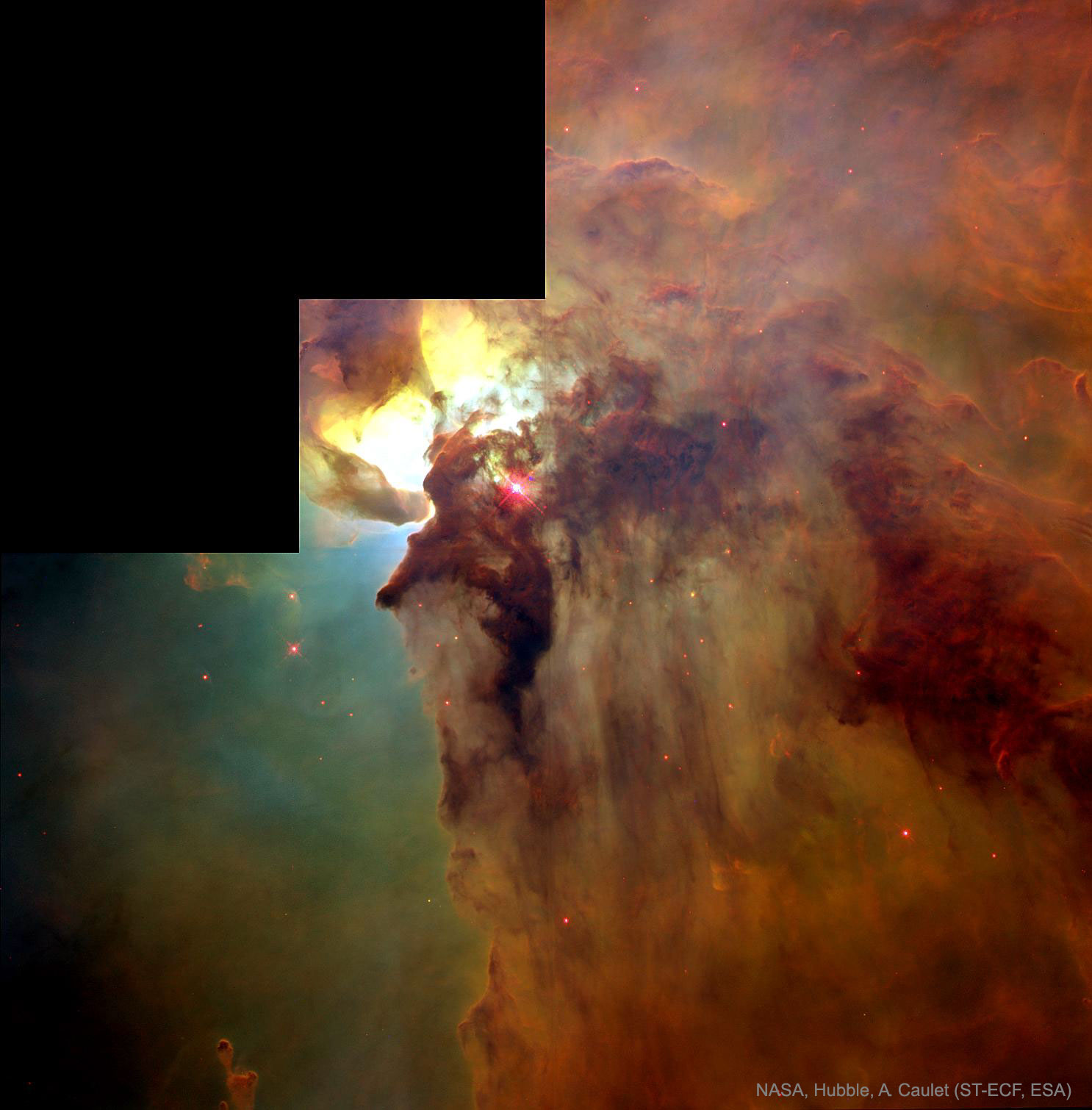
Astronomy picture of the day - 2017 May 21 - In the Center of the Lagoon Nebula

See Explanation.  Clicking on the picture will download
 the highest resolution version available.
In the Center of the Lagoon Nebula 
Image Credit: Hubble, A. Caulet (ST-ECF, ESA), NASA
Explanation: The center of the Lagoon Nebula is a whirlwind of spectacular star formation. Visible on the lower left, at least two long funnel-shaped clouds, each roughly half a light-year long, have been formed by extreme stellar winds and intense energetic starlight. The tremendously bright nearby star, Hershel 36, lights the area. Vast walls of dust hide and redden other hot young stars. As energy from these stars pours into the cool dust and gas, large temperature differences in adjoining regions can be created generating shearing winds which may cause the funnels. This picture, spanning about 5 light years, was taken in 1995 by the orbiting Hubble Space Telescope. The Lagoon Nebula, also known as M8, lies about 5000 light years distant toward the constellation of Sagittarius.

2017-05-20

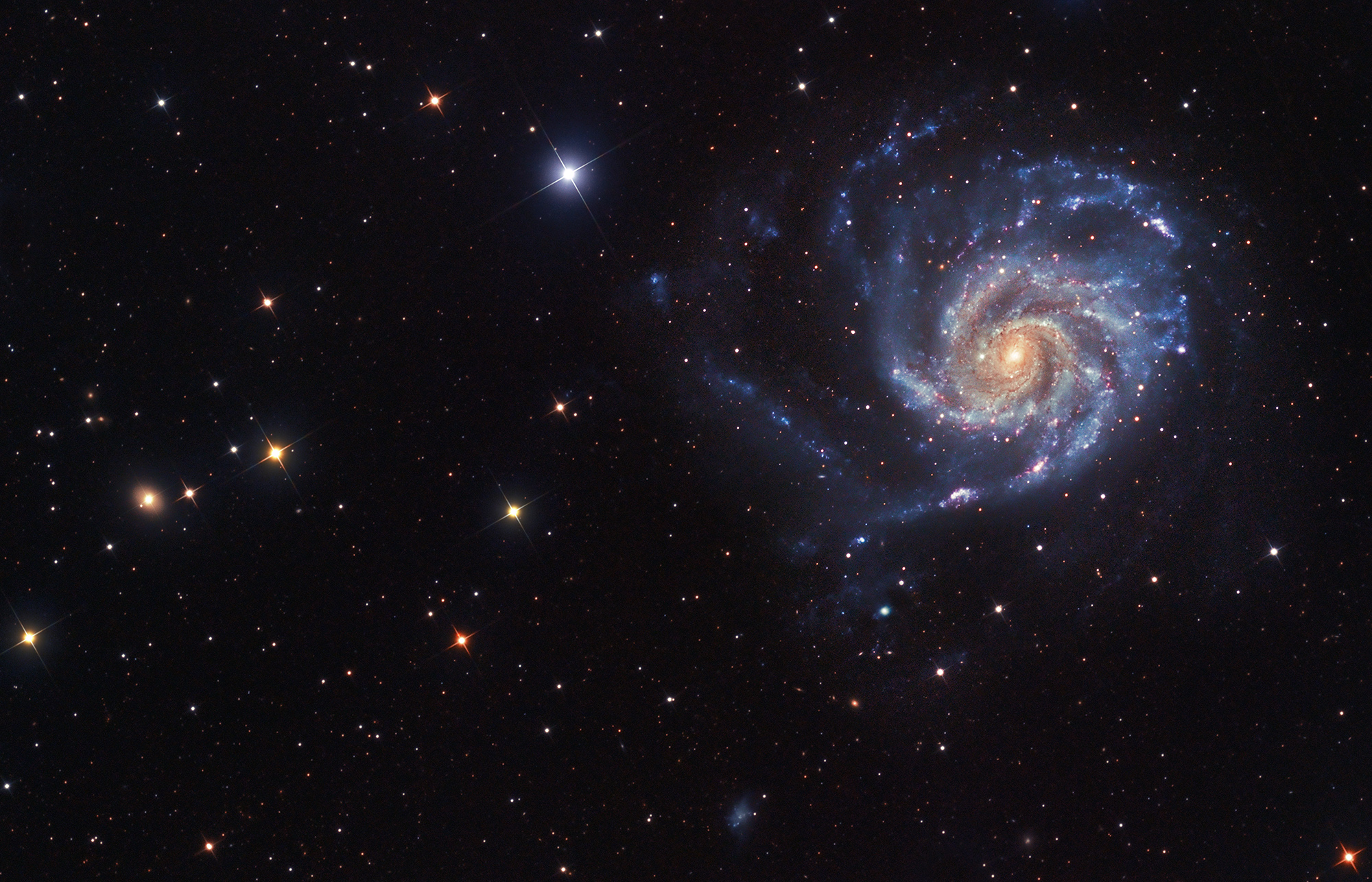
Astronomy picture of the day - 2017 May 20 - A View Toward M101

See Explanation.  Clicking on the picture will download
 the highest resolution version available.
A View Toward M101 
Image Credit & CopyrightLaszlo Bagi
Explanation: Big, beautiful spiral galaxy M101 is one of the last entries in Charles Messier's famous catalog, but definitely not one of the least. About 170,000 light-years across, this galaxy is enormous, almost twice the size of our own Milky Way galaxy. M101 was also one of the original spiral nebulae observed by Lord Rosse's large 19th century telescope, the Leviathan of Parsontown. M101 shares this modern telescopic field of view with spiky foreground stars within the Milky Way, and more distant background galaxies. The colors of the Milky Way stars can also be found in the starlight from the large island universe. Its core is dominated by light from cool yellowish stars. Along its grand spiral arms are the blue colors of hotter, young stars mixed with obscuring dust lanes and pinkish star forming regions. Also known as the Pinwheel Galaxy, M101 lies within the boundaries of the northern constellation Ursa Major, about 25 million light-years away.

2017-05-19

Irish Rovers - "Drunken sailor" - Video - Music

Résultat de recherche d'images pour "images d'irlande"
"Drunken sailor"

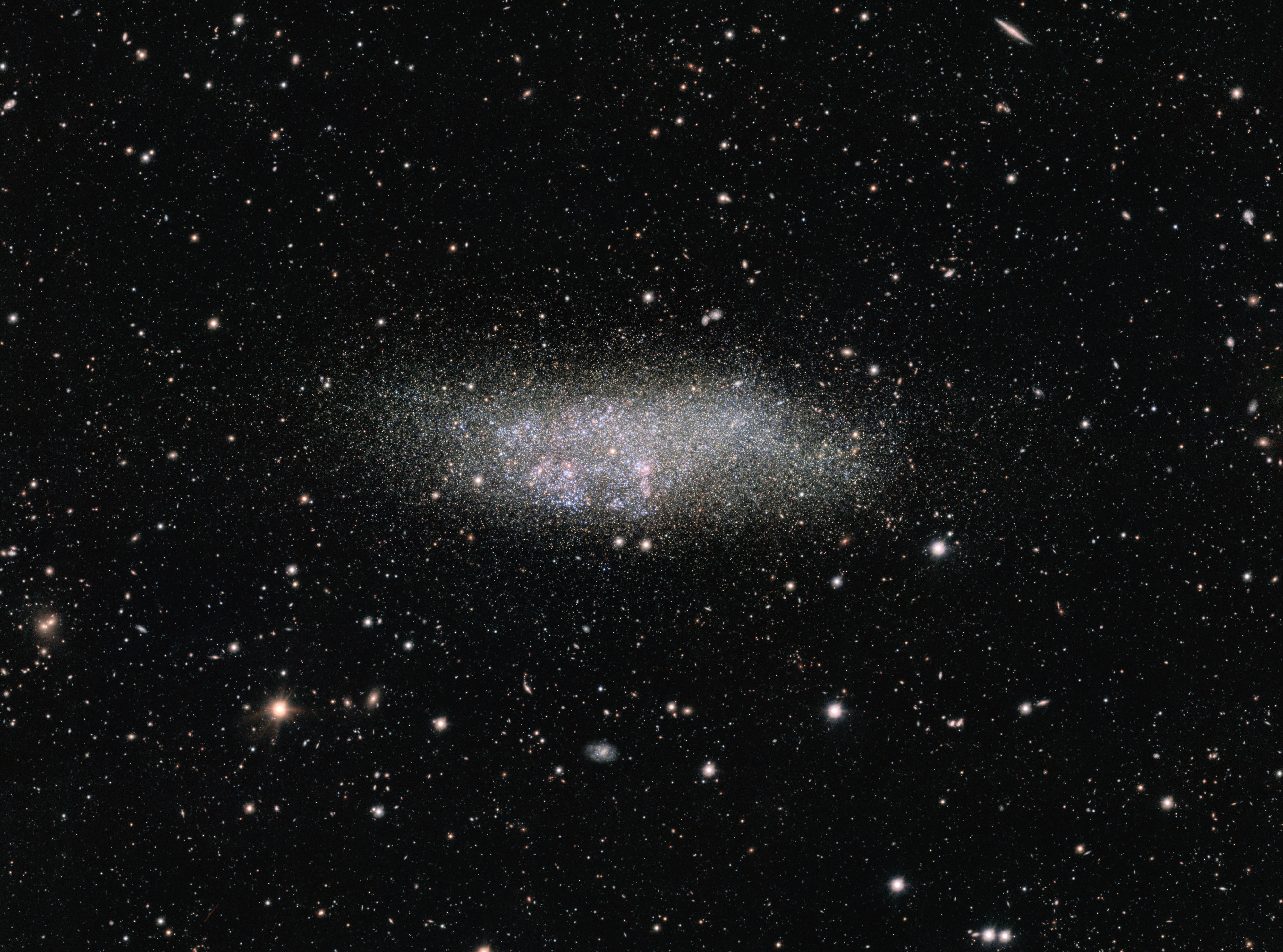
Astronomy picture of the day - 2017 May 19 - Wolf-Lundmark-Melotte

See Explanation.  Clicking on the picture will download
 the highest resolution version available.
Wolf-Lundmark-Melotte 
Image Credit: ESOVST/Omegacam Local Group Survey


Explanation: Named for the three astronomers instrumental in its discovery and identification, Wolf - Lundmark - Melotte (WLM) is a lonely dwarf galaxy. Seen toward the mostly southern constellation Cetus, about 3 million light-years from the Milky Way, it is one of the most remote members of our local galaxy group. In fact, it may never have interacted with any other local group galaxy. Still, telltale pinkish star forming regions and hot, young, bluish stars speckle the isolated island universe. Older, cool yellowish stars fade into the small galaxy's halo, extending about 8,000 light-years across. This sharp portrait of WLM was captured by the 268-megapixel OmegaCAM widefield imager and survey telescope at ESO's Paranal Observatory.

2017-05-18

English Version - (Salvador Sobral - Amar pelos dois) - Video - Music - Live

Résultat de recherche d'images pour "Image de Salvador Sobral"
"Both of us"

Grupo Musical Raizes do Alentejo - "Como é lindo o Pomarão" - Slides - Musica

Résultat de recherche d'images pour "imagens do Alentejo"
"Como é lindo o Pomarão"

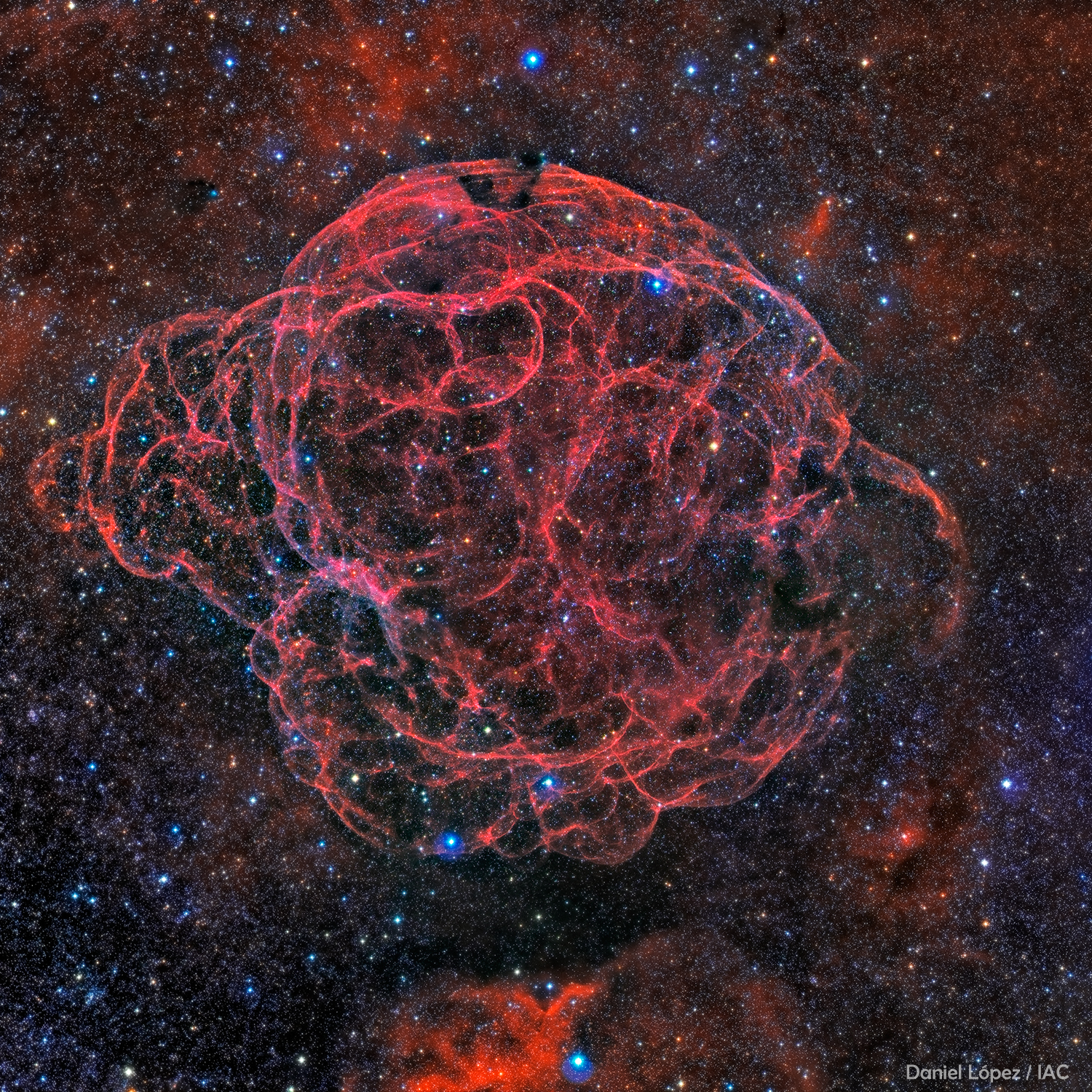
Astronomy picture of the day - 2017 May 18 - Simeis 147: Supernova Remnant

See Explanation.  Clicking on the picture will download
 the highest resolution version available.
Simeis 147: Supernova Remnant 
Image Credit & CopyrightDaniel López (El Cielo de Canarias) / IAC


Explanation: It's easy to get lost following intricate filaments in this detailed image of faint supernova remnant Simeis 147. Also cataloged as Sharpless 2-240 it goes by the popular nickname, the Spaghetti Nebula. Seen toward the boundary of the constellations Taurus and Auriga, it covers nearly 3 degrees or 6 full moons on the sky. That's about 150 light-years at the stellar debris cloud's estimated distance of 3,000 light-years. This composite includes image data taken through narrow-band filters, enhancing the reddish emission from ionized hydrogen atoms to trace the shocked, glowing gas. The supernova remnant has an estimated age of about 40,000 years, meaning light from the massive stellar explosion first reached Earth 40,000 years ago. But the expanding remnant is not the only aftermath. The cosmic catastrophe also left behind a spinning neutron star or pulsar, all that remains of the original star's core.